
Javed Iqbal “The Serial Killer”
Inside the Mind of Pakistan’s Most Notorious Child Killer
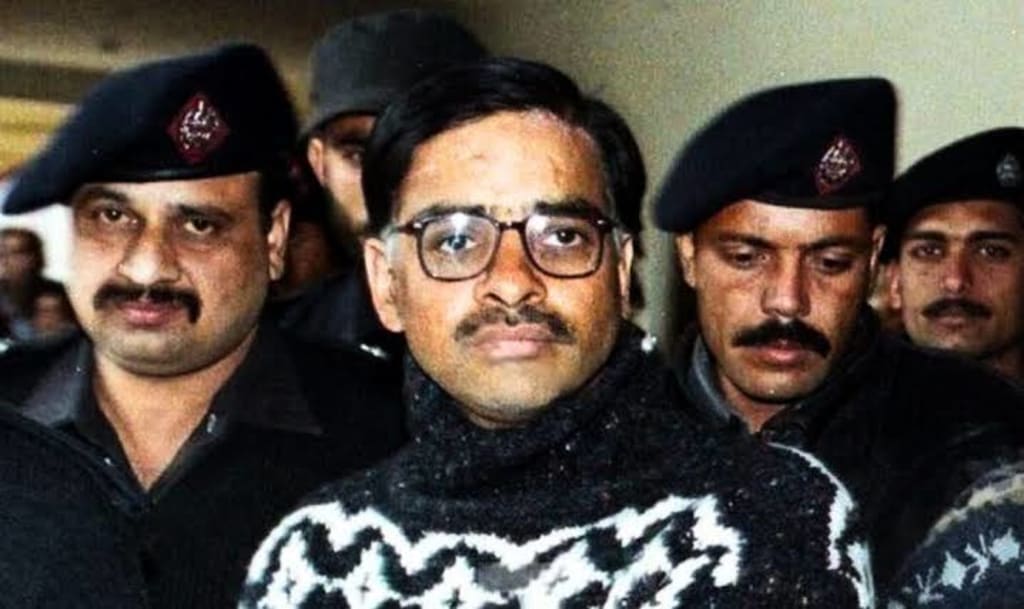
In the smog-choked streets of 1990s Lahore, life pulsed with chaotic energy. Rickshaws honked relentlessly, street vendors called out their wares, and children wove through crowds with playful laughter. But beneath the surface of this lively city, a shadow loomed—a shadow that would stain the pages of Pakistan’s history with horror and disbelief.
His name was Javed Iqbal, a man who, by appearance alone, could blend seamlessly into the fabric of everyday life. To some, he was a well-to-do businessman, running a modest steel-recycling plant. To others, he was simply another face in the crowded lanes of the city. But behind the facade, Javed Iqbal carried secrets so dark they would one day freeze the nation in collective terror.
Born in 1956 to a wealthy family in Lahore, Iqbal’s early life seemed to offer every privilege. He was sent to good schools, and as he grew, he inherited his father’s factory, gaining financial independence. Yet, beneath the privileges of his upbringing, something sinister had begun to ferment. Accounts suggest a deeply troubled individual, someone who harbored resentment and a burning desire for power and control.
His descent into monstrosity did not happen overnight. It crept in slowly, meticulously, like the predator he would become. Javed developed an obsession: young boys from the streets, homeless, forgotten, or simply out of sight of protective eyes. These children, abandoned by society, became his chosen victims.
From 1998 to 1999, Javed Iqbal orchestrated one of the most horrifying killing sprees in Pakistan’s history. He lured runaway boys with promises of shelter, food, or work—anything to momentarily ease their daily struggles. Once inside the walls of his home, however, there was no escape. He drugged, strangled, and dismembered his victims with chilling precision. Later, he dissolved their remains in vats of acid to erase any trace of his crimes, disposing of the sludge in nearby drains.
What shocked the nation even more than the brutality of his acts was the sheer scale: Javed Iqbal confessed to the murder of 100 boys, aged mostly between 6 and 16. He meticulously documented each killing in a diary, noting names, ages, and the methods of disposal. He even sent taunting letters to the police and media, claiming his actions were a form of revenge against law enforcement. According to him, a personal vendetta with the police, who he claimed had wrongfully targeted and humiliated him earlier, fueled his rampage.
But despite the audacity of his confessions, it wasn’t the authorities who first discovered his crimes—it was Iqbal himself who brought them to light. In a grotesque twist, he wrote letters to the police chief and local newspapers, detailing his actions and providing directions to the evidence left behind in his home. When authorities arrived, they were met with a scene straight from a nightmare: vats filled with acid, boys' clothing, photographs of his victims, and the chilling diaries.
The hunt for Javed Iqbal sparked nationwide panic. He had vanished before the police could apprehend him, slipping through their fingers with alarming ease. For weeks, fear gripped Lahore. Parents kept their children indoors, and rumors spread like wildfire. When he was finally captured, it wasn’t in a dramatic standoff but in quiet surrender. Iqbal walked into the office of a leading newspaper and turned himself in, claiming he had intended to die by suicide but changed his mind.
His trial was swift and sensational. The judge, in an unprecedented sentence, decreed that Iqbal should be strangled to death in front of the parents of his victims, his body then cut into pieces and dissolved in acid—the very method he had inflicted on the innocent. It was a sentence aimed not just at justice but at retribution, a reflection of the outrage felt across the country.
However, fate would intervene before the punishment could be carried out. On October 8, 2001, Javed Iqbal was found dead in his prison cell, an apparent suicide by hanging. Many speculated whether it was truly self-inflicted or if vigilante justice had reached him even within the supposedly secure walls of the jail. His death denied the families of his victims the closure they so desperately sought.
Javed Iqbal’s reign of terror left an indelible scar on Pakistan’s collective memory. He became the embodiment of evil, a grim reminder of how easily society’s most vulnerable can fall prey to monstrous cruelty when they are unseen and unheard. In the years since, his story has fueled debates about child protection, the failures of law enforcement, and the cracks in a system that allowed such horrors to unfold unchecked.
But perhaps the most haunting aspect of Javed Iqbal’s story is not merely the scale of his crimes, but the realization that monsters do not always lurk in the shadows. Sometimes, they walk among us, unnoticed, until it is far too late.
About the Creator
Gul Aslam Khan
My name is Gul Aslam Khan and I am a story Writer and publisher on Vocal.
Keep reading
More stories from Gul Aslam Khan and writers in Criminal and other communities.
The Stars Forgot Her Name
She appeared one dawn, standing at the edge of the forest, wrapped in mist and silence. No one saw her arrive. There were no footprints behind her in the dew-covered grass, no traveler’s bag at her feet. Just a girl, barefoot, her hair tangled with frost and starlight, and eyes that held the ache of galaxies.
By Gul Aslam Khan10 months ago in Humans
Ivan Raiklin and Michael Fanone Clash at Jack Smith Hearing: What Happened and Why It Matters
A heated confrontation between political activist Ivan Raiklin and former US Capitol Police officer Michael Fanone during a high-profile House Judiciary Committee hearing has drawn widespread attention in the United States. The incident occurred while former Special Counsel Jack Smith was appearing before lawmakers, turning what was already a politically charged proceeding into a moment of intense personal conflict.
By HIMANSHU GULATI2 days ago in Criminal
Trump’s Latest Statements Stir Global Debate With the UK NATO and Greenland
Trump’s Latest Statements Stir Global Debate With the UK NATO and Greenland In recent weeks, renewed attention has focused on former U.S. President Donald Trump following a series of statements and political positions that have reignited international controversy. Americans searching for the latest political news have shown strong interest in Trump’s comments involving the British royal sphere, his long running dispute connected to Greenland, and his continued criticism of NATO allies. Together, these issues reflect a broader pattern in Trump’s approach to foreign policy, one that emphasizes national interest, sharp rhetoric, and public pressure on allies.
By America today about 16 hours ago in Criminal



Comments
There are no comments for this story
Be the first to respond and start the conversation.