
Jack the Ripper: Exploring the American Suspect Theory
3 American Suspects Are in The Frame

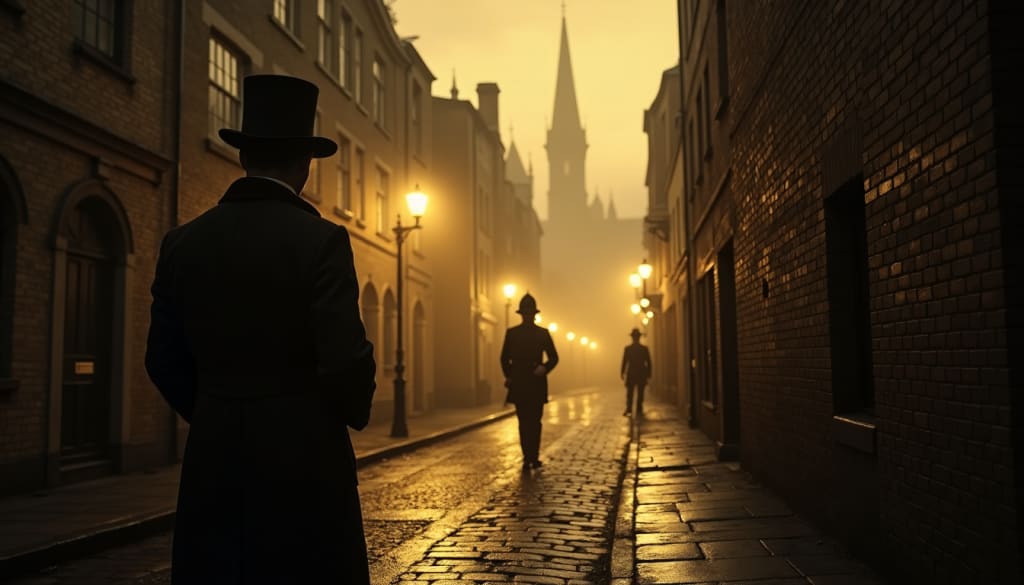
Jack the Ripper’s true identity remains one of history’s most intriguing unsolved mysteries. Over two centuries, investigators have named more than 100 possible suspects.
Investigators mostly looked at local London suspects, but new evidence indicates an unexpected possibility — Jack the Ripper could have been American. Several suspects across the Atlantic have emerged as potential candidates, including a flashy doctor and a theater performer.
Scotland Yard’s investigation stretched across the ocean to America. The American suspects’ mysterious links to London’s Whitechapel district could help us learn more about this enduring mystery.
The Rise of American Suspect Theories
The East End of London underwent dramatic changes in the late 1880s. Foreign influences drew intense scrutiny, especially after waves of immigration revolutionized the area’s social fabric. About 90% of London’s 60–70,000 Jewish population lived in the East End, creating a tight-knit community that attracted interest and mistrust of outsiders.
Historical context of US-UK relations in 1888
Life in the East End of 1888 painted a grim picture of Victorian-era hardships. Single rooms housed up to 8 people, pushing overcrowding to dangerous levels. Dark streets with minimal police presence became perfect spots for criminals. The atmosphere reeked of disease, hopelessness, and alcoholism. These conditions later became vital elements in investigating American suspects.
Early American suspect investigations
American suspects emerged as strong candidates right from the start. Scotland Yard’s discovery of suspicious patterns that connected transatlantic travelers to the murder timeline gave weight to the theory of an American killer.
Dr. Francis Tumblety’s case stands out as particularly compelling. His arrest in London happened right when Mary Kelly was murdered in November 1888. Chief Inspector John Littlechild, who led the Metropolitan Police’s Secret Department, called Tumblety “a very likely” suspect. Tumblety posted bail and fled first to Boulogne, near Paris, and then to New York, where Chief Inspector Byrnes kept him under watch.
Role of transatlantic travel in theories
Transatlantic travel proved vital to these theories. Only three groups could make such journeys: the wealthy, immigrants, and sailors. This limited mobility helped detectives narrow their suspect list, though it made catching fleeing suspects harder.
The American angle gained strength after investigators found several suspects had strong ties on both sides of the Atlantic. Yet most of these “American suspects” aren’t taken seriously today. Their known methods of killing differed too much from the Ripper’s distinctive style.
Profile of Key American Suspects
Three compelling American suspects deserve closer examination for their activities during the time of the Whitechapel murders.
Richard Mansfield: The theatrical connection
Richard Mansfield’s case stands out as particularly intriguing. This American actor’s performance as Dr. Jekyll and Mr. Hyde at London’s Lyceum Theater happened right when the Ripper murders occurred. His stage transformation proved so convincing that women fainted, and theatergoers were scared to walk home alone after his performance. A concerned citizen wrote to the City police on October 5, 1888. The letter suggested that Mansfield’s convincing portrayal of a killer might reveal actual murderous tendencies.
Dr. Francis Tumblety: Suspicious behavior
Dr. Francis Tumblety has already emerged as one of the most solid American candidates. His notable red flags include:
- A documented deep hatred of women, mainly prostitutes
- A disturbing collection of preserved uteri he claimed came from “every class of woman.”
- His arrest in London on November 7, 1888, followed by his immediate flight to France and then America
Chief Inspector John Littlechild of the Metropolitan Police Service called Tumblety “a very likely” suspect because of his extreme hatred of prostitutes and criminal record.
H.H. Holmes and the Murder Castle parallel
The evidence linking H.H. Holmes to the Ripper case appears compelling. Holmes admitted to killing over 27 people, substantially more than the five canonical Ripper victims. Jeff Mudgett, The great-great-grandson of Holmes, explained that in studying Holmes’s diaries, he stayed in London during the peak time frame of the Whitechapel murders.
A six-month gap between the last Ripper killing and Holmes’ first documented murder in America raises eyebrows. Transatlantic travel took between 8 and 15 days back then, which made it possible for one person to commit both sets of murders. Holmes’ medical training also lines up with the surgical precision noted in the Ripper killings.
Scotland Yard’s American Investigation
Scotland Yard’s investigation records show remarkable international teamwork for that period in chasing the Ripper case across the Atlantic. The case grew into one of the most extensive investigations of its time. Investigators questioned more than 2,000 people and looked deeply into over 300 suspects.
Cross-Atlantic police cooperation
Scotland Yard boldly sent an inspector to New York to explore American leads. This pioneering effort marked one of the earliest examples of police forces working together across the Atlantic. Poor communication tools of the era often slowed their progress, hence the need for in-person cooperation.
Evidence gathering methods
The investigation methods revealed several core approaches:
- Door-to-door questioning throughout Whitechapel
- Analysis of forensic material (limited by available technology)
- Questioning of over 76 butchers and slaughterers
- Distribution of roughly 80,000 handbills asking for public help
Investigation challenges and limitations
The investigation faced significant hurdles that held back progress. The biggest challenge came from the basic forensic science capabilities of the day.
Forensic Limitations Effect on Investigation
- No fingerprinting capability. The technique was not used until 1901
- Blood analysis restrictions. Unable to distinguish human from animal blood
- Limited crime scene preservation. Bodies were removed quickly, crime scenes were not documented, and sites were cleaned immediately.
The FBI created its first-ever profile of Jack the Ripper in 1988, which listed 11 key character traits. Their analysis suggested a white male between 25 and 36 living near Whitechapel.
Victim selection patterns
The killer left a unique signature across six murders. The key elements:
- Picquerism interest and overkill
- Domination and control
- Sexual degradation and mutilation
- Organ harvesting
- Specific areas of attack
The killer’s strategy proved calculated rather than frenzied. He attacked from behind and cut the victim’s throat quickly. This method left minimal blood evidence on his clothes.
Geographic profiling across continents
The killer’s zone of operation stayed remarkably focused. All murders happened within a mile of each other. The total hunting area barely covered half a square mile. Social reformers of the day dubbed this area the “wicked quarter-mile.”
Location Significance:
- Flower and Dean’s Street primary hunting ground
- Thrawl Street Victim Residence cluster
- Dorset Street Multiple victim connections
As the FBI profilers determined, the perpetrator was likely a white male between 28 and 36. He blended into Whitechapel and likely lived or worked there. The timing tells us something interesting. All crimes happened between Friday and Sunday in the early morning hours. This schedule matches the movements of potential suspects who held regular jobs.
Conclusion
Evidence from a review of American suspect theories challenges what we know about Jack the Ripper’s identity—analyzing transatlantic links, suspect backgrounds, and killing patterns points to the real possibility of an American killer.
Three suspects stand out from our investigation. Richard Mansfield, Dr. Francis Tumblety, and H.H. Holmes show fascinating links to the Whitechapel murders. Scotland Yard showed remarkable insight when it launched its groundbreaking investigation across the Atlantic.
The killer’s methods and movements suggest someone who mixed careful planning with random violence. This pattern differs from the surgical precision many people attribute to the Ripper. Several American suspects’ known actions and skills match this profile perfectly.
We still can’t prove it. Yet our findings make a strong case that American suspect theories need serious attention in Ripper investigations. This evidence adds fresh angles to the mystery and reminds us that answers often hide beyond what we usually think probable.
About the Creator
MJonCrime
My 30-year law enforcement career fuels my interest in true crime writing. My writing extends my investigative mindset, offers comprehensive case overviews, and invites you, my readers, to engage in pursuing truth and resolution.
The Man Who Stole Silence
M Mehran The city of Karachi never truly sleeps. Even at 3 a.m., when the street vendors have packed their carts and the traffic thins into an occasional growl, there is a pulse beneath the silence. It’s the hum of secrets. And in that hum lived a criminal no one could catch. His name was Farhan Qureshi, though the newspapers would later call him The Whisper Thief. Farhan didn’t carry a gun. He didn’t break locks. He didn’t leave fingerprints. What he stole was far more valuable than gold—he stole silence. For two years, the wealthiest neighborhoods of Karachi reported strange incidents. No jewelry missing. No cash gone. Yet every victim insisted something had been taken. A private conversation. A hidden confession. A secret buried in the dark. The police were baffled. Inspector Danish Malik, a decorated officer known for dismantling organized crime rings, was assigned the case. At first, he dismissed it as paranoia. “People lose money and invent drama,” he told his team. But then he listened to the recordings. Each victim had received a single audio file. In it, their most private moment—an argument with a spouse, a confession of bribery, a hidden affair—played back in chilling clarity. Attached was a simple message: “Pay for your silence.” This wasn’t theft. It was psychological warfare. It was criminal extortion crafted with surgical precision. And Farhan was brilliant. A Criminal Mind Built on Observation Farhan had once studied sound engineering at a local university. He was gifted—top of his class. Professors predicted he would work in film or music production. But talent doesn’t always walk the straight path. After his father’s sudden death, debts swallowed his family. Scholarships vanished. Dreams collapsed. Bitterness replaced ambition. Farhan discovered something during his final semester: people reveal everything when they believe no one is listening. From rooftops, parked cars, and disguised maintenance visits, he planted tiny listening devices in homes of influential businessmen, politicians, and social elites. He never targeted the poor. He chose people with reputations to protect. He didn’t rush. He collected months of conversations before making a move. He built profiles. Studied behavior patterns. Understood their fears. Unlike typical criminals driven by impulse or greed, Farhan thrived on control. And control is addictive. The First Crack in the Perfect Crime Inspector Danish noticed something others ignored. None of the devices were ever found. “Not one?” he asked his forensic team. “Not one,” they confirmed. That meant the criminal wasn’t breaking in repeatedly. He was installing something permanent—or something invisible. Danish reviewed architectural plans of the targeted houses. He discovered a pattern: all the homes had recently installed high-end smart sound systems from the same supplier. The company? EchoWave Solutions. Danish paid them a visit. The office was small, modern, and surprisingly minimal. Only three employees were listed. One of them—Farhan Qureshi. Clean record. No prior arrests. Soft-spoken. Intelligent eyes. When Danish shook his hand, he felt it—the calm confidence of a man who believed he was untouchable. Psychological Cat and Mouse Danish didn’t arrest him immediately. There was no direct evidence. Instead, he started surveillance. Farhan, however, sensed it. Criminal psychology often reveals a dangerous truth: the smartest criminals are hyper-aware. Farhan noticed the unmarked car parked across his apartment. He noticed the unfamiliar number calling and hanging up. So he escalated. Instead of extorting quietly, he released a politician’s secret recording publicly. It exploded across social media. News channels debated ethics, privacy, and corruption. The city panicked. Was he a villain—or a vigilante exposing hypocrisy? That moral confusion protected him. Some citizens secretly admired him. “He only targets the corrupt,” online forums argued. But Danish knew better. A criminal who justifies his actions is still a criminal. The Mistake Every Criminal Makes Arrogance. Farhan believed he understood fear better than anyone. But he underestimated something—human unpredictability. One of his victims refused to pay. Instead, she invited him to release everything. Her name was Samina Rahman, a school principal with nothing to hide. Farhan sent the audio. It was harmless—her crying over financial struggles, her doubts about leadership. Instead of shame, she received sympathy. The public response shifted. If he could invade her privacy, he could invade anyone’s. Now fear replaced fascination. Danish used that moment. He publicly announced a digital trace had been found—bluffing. He described a fictional encryption flaw in the criminal’s system. Farhan panicked. Not outwardly—but digitally. He logged into his secure server from a backup connection he believed was untraceable. It wasn’t. Cybercrime units tracked the IP to a warehouse near the port. Inside, they found walls lined with monitors. Audio feeds labeled with names. Dates. Addresses. And Farhan. He didn’t run. He simply removed his headphones and said, “You’re late.” Inside the Criminal’s Mind During interrogation, Farhan remained composed. “Why?” Danish asked. Farhan’s answer was chilling. “Because silence is power. The wealthy use it to hide corruption. I just borrowed it.” “But you sold it,” Danish replied. Farhan smiled faintly. “Everyone sells something.” Psychologists later analyzed him as highly intelligent, emotionally detached, and morally rationalizing—traits common in non-violent white-collar criminals. Yet what made him truly dangerous wasn’t cruelty. It was patience. The Aftermath The case became one of Karachi’s most discussed criminal investigations. It reshaped conversations about digital privacy, surveillance, and smart home vulnerabilities. EchoWave Solutions shut down. New cybersecurity laws were proposed. And Farhan Qureshi was sentenced to twelve years in prison for extortion, illegal surveillance, and cybercrime. But even behind bars, rumors circulate. Some say he’s writing a book. Some say he’s helping authorities understand criminal behavior. Others whisper that he left hidden recordings no one has found. Because the scariest criminals don’t always steal money. They steal peace of mind.
By Muhammad Mehran8 days ago in Criminal
The Piggy Project
I’ve had so many names in this life I lose track of which ones were ever really mine and which ones I wore because someone needed me to. Some were handed to me before I had words to refuse them, before I knew what they meant, before I knew I could say no. Most weren’t meant to hurt. That doesn’t mean they didn’t leave marks. Marks that told me who I belong to, who I am by way of who claims me, recognizes me in the good and bad, who walks beside me.
By Fatal Serendipity3 days ago in Confessions



Comments
There are no comments for this story
Be the first to respond and start the conversation.