
Is America a Terrorist State? And Why Trump's Policies Alarm the World
final verdict: power without accountability

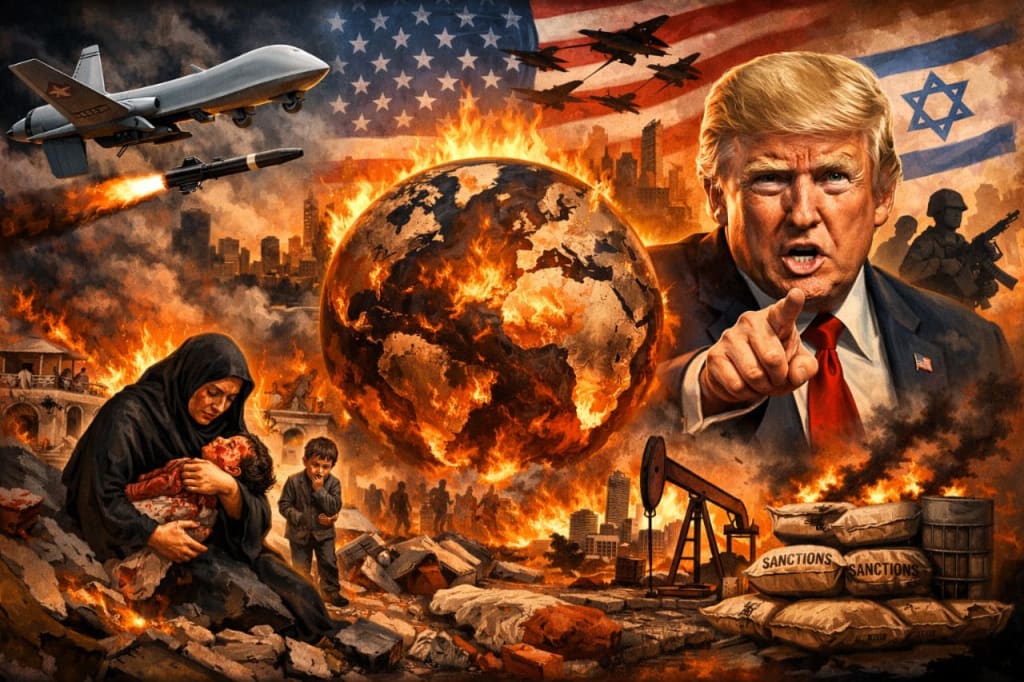
**Is the United States a “Terrorist Country”?
And Are Trump’s Policies Dangerous for the World?
When people call the *United States* a “terrorist country,” what they mean is not that the U.S. is exactly like al-Qaeda or ISIS. Instead, critics argue that some U.S. actions — especially military interventions, drone strikes, and economic sanctions — *look similar to terror tactics in their impact on civilians and societies. To understand this, we must examine **policies, consequences, and expert criticism based on data. **
*1. What Is “State Terrorism”?* In strict legal terms, terrorism usually describes *non-state actors* (like *A. Broader Use of Military Force* During the Trump era and afterward, the U.S. government expanded the use of military force in new ways: * In *2025, Trump informed Congress that the U.S. was in a *“non-international armed conflict” * with drug cartels to justify lethal strikes at sea — an approach critics said **lacks a clear legal basis* and could set dangerous precedents. * Trump administration military strikes against ISIS affiliates extended into *Nigeria and Syria*, described by officials as consistent with longstanding U.S. counter-terrorism policy.
These actions make many observers worry that the U.S. is *normalizing the use of military force without clear international support*, which can destabilize regions and harm civilians.
*B. Yemen Bombings and Civilian Deaths* Independent monitoring groups reported that a U.S. bombing campaign in Yemen under Trump’s leadership killed *almost as many civilians in two months (224) as all previous U.S. attacks over 23 years in the same country (258) *. This sparked international concern about the humanitarian impact of American operations. This example is often used to argue that U.S. interventions under Trump — even when aimed at militant groups — resulted in *high civilian suffering*, strengthening claims of state violence.
*4. Economic Sanctions and Their Human Impact* Terrorism isn’t only bombs and bullets. Many scholars argue that economic sanctions can also act like terror when they cause widespread suffering among ordinary people.
Research shows that U.S. sanctions — especially when they are unilateral — have often *failed to achieve political goals* and instead *hampered the everyday lives of civilians* by limiting access to food, medicine, and basic services. For example: Sanctions on *Cuba* contributed to shortages of medicine and other essentials.
* Health studies estimate that broad economic embargoes have sometimes been associated with *hundreds of thousands of excess deaths annually* due to indirect effects. Critics therefore describe sanctions as a form of *economic coercion* that can trap civilians in hardship — again drawing parallels to how terrorism inflicts fear and suffering
*5. Legal and Moral Debate* Supporters of U.S. foreign policy argue: ✔ The United States operates within international law or national self-defence. ✔ Drone strikes and military force are targeted at militant groups posing real threats. ✔ Sanctions are lawful tools of diplomacy. But critics say that many U.S. actions — especially when executed with *limited transparency, minimal oversight, or high civilian cost* — fail the test of humane policy. While not classified legally as “terrorism,” critics use that term to condemn the *impact on civilians*, saying the results resemble terror more than security.
*6. Is Trump’s Policy a Threat to the World? * Whether Trump’s foreign policy is a threat depends on perspective: * Expanded military actions without broad international backing. * Use of force in new domains (e.g., against drug cartels). * Continued or renewed interventions in volatile regions. Such moves can lead to *regional wars, civilian casualties, and geopolitical instability*, which critics say fuels more conflict. *Why some see it as defensive: * * Officials argue actions protect American national security. * Military force targets groups labelled as threats. * Sanctions are diplomatic tools to pressure governments.
So, the debate is *not simple. It’s not just about labels like “terrorist country,” but about **whether these policies make the world safer or more violent*.
*Conclusion* Calling the United States a “terrorist country” is not a neutral legal classification — it’s a *politically charged criticism* based on how U.S. military force, drone strikes, and sanctions have affected civilians globally.
* Evidence shows *civilian harm from U.S. military interventions* and controversial new uses of force under Trump. * Economic sanctions have caused humanitarian suffering. * Trump’s policies expanded threats into new arenas, raising global concerns about stability.
Whether one agrees or disagrees with the label, the *impact on civilians and world stability is a matter of documented debate* — and understanding these facts helps us have a clearer conversation about power, accountability, and peace.
About the Creator
Junaid Shahid
“Real stories. Real emotions. Real impact. Words that stay with you.”
“Observing society, challenging narratives, and delivering stories that matter.”
“Questioning power, amplifying the unheard, and writing for change—one story at a time.”
Keep reading
More stories from Junaid Shahid and writers in Criminal and other communities.
Push To Prevent Catapults Being Bought By Children
MP’s have been warned to put new legislation in place that will help to close a loophole in the law which allows people including children to legally buy weapons which is capable of killing wildlife. The alert was issued during a briefing in parliament which set out growing evidence that catapults were being misused against animals and to damage other people’s private property. The Naturewatch Foundation who hosted the session expanded on their message that at the moment there is a completely unregulated system where people of any age can buy weapons and there are no meaningful controls on sale or power.
By Ashish Prabhu6 days ago in Criminal
A Transparent Look at Vocal Challenges and Top Stories
Almost three years ago, we shared a resource article that served as a place for people to suggest new challenge prompts. We thought it would be a good idea to refresh that thread, and take the opportunity to answer a few common questions about top stories, how challenges are judged and how submissions are reviewed.
By Vocal Curation Team4 days ago in Resources



Comments
There are no comments for this story
Be the first to respond and start the conversation.