

THEY ARRIVED EARLY, per usual. The house was an old Victorian on Senator Highway, wrapped by a lacey iron gate with a little front garden. The driver pulled parallel to the curb and put the van in park. The passenger exited and walked through the gate up to the front door and knocked and waited for it to be answered.
“Piano guys,” he said routinely after being greeted by an elderly woman. He brushed past her without saying anything more and found the piano in the living room and laid down next to it to examine the hardware underneath. He rose to his feet and walked back through the tchotchke-clad room and out to the van.
“Just need a flat screwdjie and a mallet,” he said as the driver grabbed moving blankets and ratchet straps and a six-foot piano board. “I’ll grab the dolly,” he added and they silently approached the house and slipped by the elderly woman who stood in the doorway of the living room.
The driver wedged one end of a blanket in the key cover as the passenger held the lid open and pulled the rest of the blanket through to the tail. He closed the lid and the driver placed a velvet fitted cover on top that draped over the body. They worked silently and fluidly.
“Do you boys do this often?”
“It’s all we do, ma’am,” said the driver as he got on all fours and propped the piano up with his back and slid a folded blanket under the lyre, raising the front-left leg off the ground. The passenger removed the screws from the floating leg and knocked it off with the mallet and set it aside. The driver placed the board onto the dolly and rolled it parallel to the flat, legless side and they slowly lowered the piano down onto the board and walked around to the curved side and lifted it upright, the piano resting on its side. They paused briefly and wiped their brows. The elderly woman watched on quietly, intrigued by the process.
“Have you had the piano long? It looks pretty old,” the driver said.
“It’s been in my family as long as I remember. It was made in 1912.”
“If it was made on Valentine’s Day then it shares a birthday with the state,” the passenger added, hands on his hips.
“Oh wouldn’t that be lovely?” She noticed their fatigue. “Can I get you boys some water?”
“That’d be great,” the driver said breathily. She exited the room as he slid one end of the piano toward him until the lid hit the board. The passenger grabbed the back leg with his right hand and slid his left under the ribs and felt something bulky attached to them. He ignored it and pulled the tail-end flush to the board.
“Go ahead and strip the legs and the pedals but I need to grab another blanket from the van before we strap it down,” said the driver and he left the room. The passenger looked around the vacant room then reached back underneath the ribs and freed a large manilla envelope. It was dusty and coarse and carried an odor of old lady perfume. He stood transfixed, tunnel vision pulling him into the package, time melting away around him. A bead of sweat slipped off his forehead and onto the item, breaking his stupor. He wedged it back underneath the piano as the woman re-entered the room, two glasses of water in hand.
“They’re gonna be so happy to get the piano,” she said as she came into the room. “I’m so glad it’s staying in the family. You boys got the directions out to the ranch, yes? It can be tricky getting out there.”
THE ROAD OUT TO THE RANCH was unpaved and ungraded. The day was flat and warm and the sun shone unfettered. They cut across the high desert, down into a valley, and passed over a dry riverbed that weaved through saguaro and palo verde and mesquite. The creosote crackled in the dry wind.
“There’s the sign, right after the riverbed. Goldwater Ranch,” he said, pointing from the passenger seat.
“You think it’s Barry’s? Or his family’s, at least?”
“Gotta be.”
They kept on. He kept re-reading the directions, making sure he didn’t miss anything to call out from the passenger seat. They hit a big pothole and bounced out of their seats.
“Hey Dad I’m gonna double check the straps, make sure they’re not getting loose.” He squeezed between the seats and walked to the back of the van. He clicked the ratchets a few times and looked up at the driver’s seat to see if he was being watched then back at the piano. The lid-side was against the wall, exposing the ribs. He dug the envelope out from the innards and held it flat in his palm and slowly slid his other hand across its surface. He flipped it over and saw a red string wound around two black rings. He slowly unwound it, enjoying the tension a little longer. Once free, he opened the flap and pulled out a little black book. It was made of black leather and was held shut by a thin strip of the same making. He unwrapped it and opened the cover and studied the first page.
First National Bank of Dixon, California, carrying notes issued from The National White River Bank of Bethel, Vermont, hereby issues $20,000, in denominations of one hundred, to
The name was smudged. He couldn't make it out. He flipped through the proceeding pages and found a ledger of accounts payable. Money owed to souls long dead and gone.
He put the notebook back inside then pulled out a stack of bound hundred dollar bills. The notes were old, foreign to his eyes. They featured a man he didn’t recognize by sight or name and were stamped with a red seal in the bottom-right corner. They were still crisp. He slid one bill out from the stack and studied it intently, hunched over, unfazed by the rocky road upon which they drove.
THE SHERIFF DROVE UP from Maricopa County and arrived in the faint light of morning. A Yavapai county deputy greeted him as he emerged from his cruiser.
“Figured since they was from Phoenix you might wanta take a look and see if you’d seen ‘em before down in the city," said the deputy. "How was the drive up?” The sheriff didn’t answer and the two men walked wordlessly toward the ranch house. The sheriff took off his white cowboy hat as he crossed the threshold into the house. His boots clicked on the dusty hardwood floors as the deputy led him to the parlor.
The first thing he saw was the piano, a light brown Chickering made of spruce. The lid was propped up and it was centered under the chandelier. Then he saw the two men underneath. He walked to the piano and stooped down.
“Somehow he got one of ‘em in the back and the other in the front,” the deputy said as the sheriff looked upon the men. The elder was face down, his arms and legs tucked neatly into his sides. The younger was on his back, eyes wide open as if the last thing they saw was a ghost. On his chest was a small leatherbound black book.
About the Creator
Keep reading
More stories from writers in Criminal and other communities.
He Was Innocent Until Midnight
M Mehran At exactly 11:59 p.m., the prison loudspeaker crackled to life. “Inmate 3021, prepare for transfer.” Jacob Reeves stopped breathing. Transfer meant only one thing on death row. Execution. For ten years, Jacob had lived between concrete walls, labeled a monster by the world. Convicted of murdering his wife and six-year-old daughter in a house fire that shook the nation. The headlines had been brutal: FATHER BURNS FAMILY ALIVE NO MERCY FOR THE DEVIL AT HOME Jacob had stopped defending himself years ago. No one listened anyway. But tonight—one minute before midnight—everything was about to change. The Case Everyone Thought Was Closed Detective Laura Bennett remembered the Reeves case clearly. It had launched her career. Clean evidence. Quick conviction. Public applause. Too clean. Jacob’s house had burned down in 2015. Investigators found traces of accelerant. Jacob’s fingerprints were on the gas can. Motive? Insurance money. An open-and-shut criminal case. At least, that’s what they wanted it to be. Laura had risen in rank since then, but something had always bothered her. The fire report. The witness statements. The speed. Crimes were never that simple. A Letter That Shouldn’t Exist Three days before Jacob’s execution, Laura received an anonymous envelope. Inside was a single sentence: “If Jacob Reeves dies, the real killer lives free.” And a USB drive. The files were old—security footage from a nearby gas station, time-stamped the night of the fire. Footage that had never made it into evidence. Laura’s stomach dropped. At 10:41 p.m., a man filled a gas can. At 10:44 p.m., he drove away—toward Jacob’s neighborhood. Jacob was at work until 11:10 p.m. The fire started at 10:55 p.m. Jacob physically couldn’t have done it. The Criminal Inside the System Laura dug deeper. She rechecked the original case files and found something worse than a mistake. Tampering. The accelerant report had been altered. Witness statements rewritten. Evidence “lost.” Someone inside the system had built a lie so perfect that it survived a decade. And Laura knew exactly who. Captain Henry Wallace. Her mentor. The man who trained her to “protect justice.” A Race Against Time Laura stormed into Wallace’s office. “Jacob Reeves is innocent,” she said. Wallace didn’t flinch. “You should let the past stay buried.” “Why?” Laura demanded. “Why frame him?” Wallace sighed. “Because the real killer was untouchable.” The truth spilled out like poison. Jacob’s neighbor—Evan Price—had been running an illegal chemical operation. Jacob discovered it and threatened to expose him. The fire was meant to silence him. But Evan Price was an informant. Protected. Valuable. “So you sacrificed an innocent man?” Laura whispered. Wallace’s eyes hardened. “I protected the city.” Midnight Approaches Laura ran. She sent the footage to the district attorney. Contacted the media. Filed an emergency injunction. At 11:57 p.m., Jacob was strapped to the execution table. His final words echoed through the chamber. “I forgive you,” he said calmly. “All of you.” Laura burst into the room screaming, waving the court order. “STOP!” The clock hit 12:00 a.m. The needle never dropped. The Real Criminal Exposed Within hours, Evan Price was arrested trying to flee the country. Captain Wallace resigned “for health reasons” before formal charges could be announced. The media turned savage. INNOCENT MAN NEARLY EXECUTED JUSTICE SYSTEM BUILT ON A LIE Jacob Reeves walked out of prison at dawn—a free man with nothing left to return to. No house. No family. No decade. Laura stood beside him as reporters shouted questions. “Do you hate them?” someone asked. Jacob shook his head. “Hate doesn’t bring back the dead,” he said. “Truth might save the living.” The Quiet After the Storm Months later, Laura visited the burned land where Jacob’s house once stood. Jacob was there, planting a small tree. “For my daughter,” he said. Laura swallowed hard. “I’m sorry.” Jacob looked at her. “You were brave when it mattered.” As Laura walked away, she understood something chilling. The most dangerous criminals don’t carry weapons. They carry authority. Final Thought Jacob Reeves was innocent—until midnight. And the system almost killed him to protect itself. SEO Keywords: criminal story, crime fiction, death row story, false conviction, justice system crime, psychological crime story, true crime inspired, Vocal Media criminal stories, murder mystery
By Muhammad Mehran5 days ago in Criminal
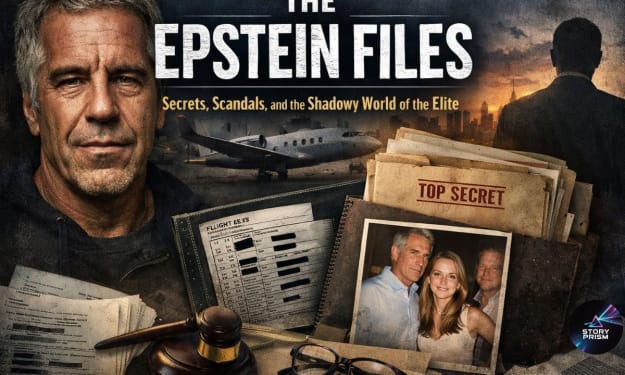
The Epstein Files: Power, Silence, and the Paper Trail That Refused to Disappear
The phrase “Epstein Files” doesn’t point to a single document or dramatic reveal. Instead, it refers to a sprawling collection of court records, depositions, flight logs, emails, and unsealed testimonies connected to financier Jeffrey Epstein and his network. Together, these files form a disturbing paper trail—one that exposes how wealth, power, and silence collided for decades before the truth began leaking into public view.
By Story Prismabout 18 hours ago in Criminal
Trouble at the Tea Leafing Café
The rain had started right around the time that Annie was buttering her second thick slice of homemade toast for breakfast, and hadn’t paused since. Not that anyone could tell. The windows of the café were fogged over, and with every seat filled with happy customers munching on fresh baked pastries or steaming bowls of the delicious soup of the day, it was hardly surprising. Annie looked around the room, finally taking a moment to breathe after the lunch time rush. Her old life already felt like a bad memory, a part of her history, always, but just that. History.
By Hannah Moore5 days ago in Fiction



Comments
There are no comments for this story
Be the first to respond and start the conversation.