
Five Children Perish in a Sealed Room, Parents Found on a Desolate Mountain Nine Years After Disappearing
True crime in Taiwan


Family annihilation cases have occurred quite frequently around the world.
They generally fall into two categories:
- An outsider commits the crime, killing the adult victims along with their children.
- Someone within the family commits the crime, killing other family members before committing suicide.
The case we are discussing today occurred in 2006 in Ji'an Township, Hualien County, Taiwan. A family of seven – parents and five children – met unnatural deaths one after another. The process, motive, and purpose of the crime have many irrational aspects that remain unanswered to this day.
The unfortunate family belonged to Liu Chih-chin and his wife.
Liu Chih-chin (劉志勤) was born in 1958, making him 48 years old at the time of the incident. He had previously worked in intelligence for Taiwan and later became a photographer. At the time of the incident, he operated three branches of "Magic Family" (魔幻家族), including the Yiyuan store. Magic Family primarily provided digital composite photography services for tourists in recreational areas.

Liu Chih-chin's wife at the time, Lin Chen-mi (林真米), was 13 years younger than him. Lin Chen-mi was from Changhua; her parents had four daughters and one son. Thirty-five-year-old Lin Chen-mi was the youngest child.

The couple was raising five children together:
- Eldest son: Liu Yu-chen (劉昱辰), 18 years old. Graduated from Hualien Szu Wei High School, first-year student in the Medical Technology department at Yuanpei University of Medical Technology in Hsinchu.
- Second son: Liu Hsin-chen (劉昕辰), 17 years old. Third-year student in the general studies track at Szu Wei High School.
- Eldest daughter: Liu Chi-chen (劉其臻), 12 years old. First-year student in the general studies track at Szu Wei High School.
These three children were born to Liu Chih-chin and his ex wife.
After marrying Lin Chen-mi, the couple had two more children:
- Second daughter: Liu Chi-en (劉其恩), 9 years old. First-year student at Ji'an Junior High School.
- Youngest son: Liu Pei-chen (劉北辰), 8 years old. Fourth-grade student at Ji'an Elementary School.
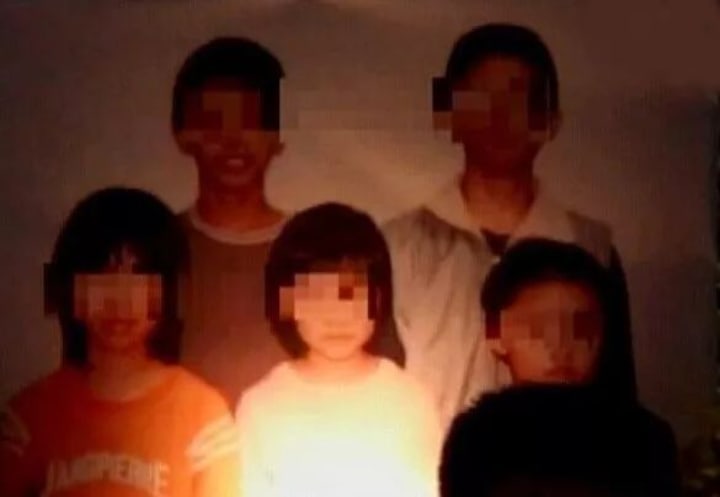
On September 8, 2006, police in Hualien County received a report about a foul odor emanating from the drainage pipes of a residence in Ji'an Village. When police knocked on the door with no response, they forced entry.
Upon entering the house, they discovered it was effectively a sealed room. All doors and windows were locked from the inside, and the bolt on the main door was also engaged from within.
After opening a bathroom door on the third floor, officers found five bodies piled up in the small space. They were in two stacks: three larger bodies near the entrance, and two smaller children beneath the sink. They were covered with quilts, and the floor was covered in dark decomposition fluid, emitting a strong corpse odor.
The killer, perhaps worried about the smell spreading, had sealed the bathroom vents and door cracks layer by layer with beige tape. The crack under the back door on the first floor was also stuffed with a towel.
It was summer, and decomposition was rapid. Despite the killer's efforts, the stench eventually alerted neighbors.
Due to the rigidity of the bodies, they were difficult to separate. Police initially thought it was a complete family annihilation, including the parents, Liu Chih-chin and Lin Chen-mi. However, after counting, they realized only the five children's bodies were in the bathroom.
All five children were fully dressed. Their faces were wrapped with beige tape, covering their eyes and noses. Iron wire was wrapped around their necks, and their hands and feet were bound separately with iron wire, white rope, or beige tape.
Black plastic garbage bags were placed over their heads, and the bodies were covered with quilts. One child's head was wrapped in a scarf.
Police found two SOS notes inside the house.
One, written on A4 paper, said: "Kidnapped, children under control, situation critical, call police quickly." The back read: "Lane 258, SOS." The note was rolled up and stuffed into the crack of the main door.
Another note, written on a thousand-dollar banknote, read: "No. 25, Lane 258, under control, critical, please report to police quickly." It was found pressed under an ashtray in the living room.

No. 25, Lane 258 was the Liu family's address. Handwriting analysis later confirmed that Liu Chih-chin himself wrote the SOS notes.
Police found NT$15,200 at the scene. The couple's mobile phones, batteries, and ID cards were laid out on a table.
Additionally, police found a digital camera in the house, but the memory card had been removed, making its contents inaccessible. This camera later provided crucial clues.
Autopsies confirmed that the five children died from asphyxiation due to strangulation. However, before being strangled, at least four of them were already unconscious.
The internal organs of the five children were sent for forensic examination, revealing signs of poisoning, but no traces of sleeping pills or tranquilizers were detected.
A potted Derris plant (fish poison vine) was found at the crime scene, leading police to suspect the children were drugged with it.
According to information, Derris is a toxic plant; its leaves, roots, stems, and fruits are all poisonous. It is mainly used externally to treat conditions like rheumatism and is prohibited for internal consumption.

Accidental ingestion can cause poisoning. Main symptoms include: paroxysmal abdominal pain, nausea, vomiting, paroxysmal generalized convulsions, muscle tremors, slowed breathing, and finally death due to respiratory center paralysis.
So, who killed Liu Chih-chin's five children? Why commit such a brutal act? Why did Liu Chih-chin write SOS notes and leave them inside the house?
Naturally, finding Liu Chih-chin and his wife would reveal the truth, but the couple had vanished.
Police launched large-scale searches in the mountainous areas of Hualien and Taitung, reviewed footage from over 500 surveillance cameras across the county, and checked mountains, vacant houses, coastlines, and other potential hiding or illegal departure points.
They also pursued leads provided by the public, tracking potential sightings to Taitung and Yilan, but unfortunately, all were fruitless.
The Liu couple seemed to have vanished into thin air.
Although a male skeleton was found in a Hualien reservoir a few years later, and a female floating corpse was discovered by the sea, both were eventually confirmed not to be the Liu couple.
What Kind of People Were the Liu Couple?
Liu Chih-chin, originally from Taitung, had worked for Taiwan's National Security Bureau in his early years, possessing certain counter-surveillance skills. After moving to Hualien over a decade ago, he cut off contact with his family in Taitung, not even returning to his father's funeral. This suggests he was rather indifferent to family ties and ruthless in his dealings.
It was rumored that Lin Chen-mi was his third wife.
Judging by the birth date of their first child together, Lin Chen-mi became pregnant in early 1993. Liu Chih-chin's third child with his previous wife was born only in August 1991, a gap of just over a year.
Interviews with Lin Chen-mi's family later revealed that Liu Chih-chin had an affair with Lin Chen-mi while still married. Lin's family strongly opposed their relationship. Although Liu later divorced and married Lin, this caused resentment towards the Lin family.
Lin Chen-mi initially had a good relationship with her family, but after marrying Liu, she had less contact. In 2004, Lin Chen-mi's parents died in a car accident. When Lin returned home for the funeral and was supposed to kneel upon entering according to custom, Liu Chih-chin reportedly said, "The people are dead, what's the point of kneeling?" and stopped her.
Lin's third sister, who was closest to her, stated that Liu Chih-chin was withdrawn and spoke little. She and her husband visited her sister in Hualien in 2005 and felt that Liu's children were very afraid of him. A mere glance from him would make the children show fear and shrink back; they would stay quietly at home after school and not go out.
Although the five children had different mothers, neighbors reported that the Liu family got along well. Harmony in blended families often depends on the step-parent's acceptance and attitude towards non-biological children.
This suggests Lin Chen-mi had a relatively tolerant and kind personality.
Considering their ages, personalities, and experiences, Liu Chih-chin likely held absolute authority in the household, with Lin Chen-mi being merely submissive.
Timeline of Events
August 28, 2006: A week before the incident, Lin Chen-mi's third sister spoke with Lin on the phone. Since Lin's marriage, their contact had decreased, usually calling only once every month or two. The sister sensed Lin was depressed during the call but Lin wouldn't explain why.
The sister invited her to Yuanlin Town to relax, but Lin said the shop was too busy, and she couldn't get away. She didn't mention money or other family issues during the call.
September 4, 2006: After inspecting his business operations, Liu Chih-chin suddenly told his employees he was taking his children to Taipei for surgery and wouldn't be at the company for a few days.
On that day, the other children went to school, but the eldest son's university hadn't started yet, so he was home. Police suspect he was the first target.
Noon: The youngest son, Liu Pei-chen, returned home from school. Police suspect he was the second victim.
His hands were bound behind his back with wire, and wire was wrapped from his neck to his mouth, dislocating his jaw. This led to speculation he was either force-fed poison or was conscious and struggled violently while being bound.
Evening: The second son, Liu Hsin-chen, returned home late due to heavy homework. Police suspect he was the third victim.
According to autopsy results, the eldest, second, and youngest sons had no food in their stomachs, suggesting they were attacked before mealtime.
September 5, 2006 (Morning): The eldest and second daughters went to their high school and junior high school as usual. The second daughter also requested leave for her younger brother (youngest son) at the elementary school division of her school, citing fever.
7:50 AM: The second son didn't arrive at school. A teacher from Szu Wei High School called the Liu residence. Lin Chen-mi answered, saying he was unwell and resting at home. Clearly, Lin Chen-mi lied.
7:20 PM: A neighbor saw Lin Chen-mi taking out trash at the alley entrance. Later, when trying to deliver fish to the Liu family, the neighbor knocked but got no response. The car was also gone.
11:30 PM: Liu Chih-chin hurriedly drove to buy needle-nose pliers, paid, immediately made a U-turn, and sped away.
Evening to Early Morning: The eldest and second daughters were killed. They had undigested food in their stomachs, indicating they had eaten dinner. They were still wearing their school sportswear from that day, not having had time to change.
September 6, 2006 (10:00 AM): Teachers from Ji'an Elementary School visited the Liu home to inquire why Liu Chi-en and her brother hadn't attended class, but no one answered. Lin Chen-mi's mobile phone was unreachable, and the car was not there.
Evening, Sep 6: Surveillance footage showed the couple driving near their home. Only the two of them were in the car. Police believe they killed all the children by the early morning of the 6th, spent the day cleaning up, and left home that evening.
September 7, 2006: Teachers and the principal from Ji'an Elementary School visited the Liu residence in the afternoon and evening, respectively, but got no response.
2:00 PM, Sep 7: A neighbor claimed to have seen Liu Chih-chin nearby around this time, possibly returning home to check or retrieve something.
September 8, 2006: Neighbors reported the odor; bodies discovered.
September 11, 2006 (Morning): Someone claimed to have seen Liu Chih-chin at Ji'an Train Station, looking around nervously.
His car was later found parked at Ji'an Train Station, suggesting the couple had left by train.
Same day: Police discovered that Lin Chen-mi had transferred NT$39,000 from the Hualien First Credit Cooperative to Wu Chi-cheng (吳紀政), a police officer with the Hualien Police Bureau. Based on this, police judged the couple was still alive.
October 16, 2006 (Evening): In a grocery store next to the Ji'an Police Precinct, a man strongly resembling Liu Chih-chin bought a bottle of Kaoliang liquor. Surveillance footage showed the man wearing gold-rimmed glasses, a white undershirt, and an orange shirt. As he paid, he looked up at magazines on the wall, the cover featuring a report on this case. He stared for 10 seconds, then left after paying.
Evidence Pointing to Liu Chih-chin and Lin Chen-mi as the Killers
The timeline above shows Liu Chih-chin had prepared for an abnormality in his life; the couple deliberately lied about and concealed their children's deaths; they intentionally avoided teachers and neighbors. Whether they were coerced is another matter.
Additionally, the following series of evidence points to the couple as the killers:
- Before the incident, Liu Chih-chin suddenly withdrew all the savings, about NT$100,000, from accounts opened for his children. This amount should have been sufficient for the couple's short-term escape expenses.
- After the incident, forensic personnel recovered fibers from the tape used to bind the victims' faces. These fibers matched glove material. Police found a pair of white cotton gloves in the house, on which DNA from both Liu Chih-chin and Lin Chen-mi was found.
- Police recovered a fingerprint from the leftover beige tape outside the bathroom door. Comparison confirmed it matched Liu Chih-chin's fingerprint.
- Police found three cigarette butts at the crime scene with DNA not belonging to the Liu family. DNA comparison identified them as belonging to Liu Chih-chin's friend, surnamed Hsiao (蕭). Mr. Hsiao stated he visited the Liu residence on September 1st but only smoked in the first-floor living room, leaving the butts in an ashtray. He didn't understand why they were found on the second and third floors.
- Apart from Mr. Hsiao's cigarette butts, police found no traces of a third party in the house.
- The task force found the toxic plant, Taiwan *Derris*, at the scene. This plant's toxicity is potent and difficult to detect. According to testimony from a man surnamed Lin, Liu Chih-chin obtained Taiwan Derris through him about a week before the incident. Police also found this plant in the Liu family's flower garden.
- The crime scene was staged as a sealed room, with all doors and windows locked from the inside. Investigators speculated that after committing the crime and leaving, the couple used a wire inserted through a small hole in the screen next to the door lock to engage the latch from the outside, creating the illusion of a sealed room murder.
Why create a sealed room? Police believe this, along with Liu writing SOS notes and scattering his friend's cigarette butts, served the same purpose: to mislead the investigation.
8. Remember the camera found at the scene? The memory card was missing, making content recovery impossible. However, in 2010, using more advanced techniques, police recovered several photos. Most were partial shots of empty rooms, like the bathroom photo shown earlier, but one was shockingly a photo taken during the crime!
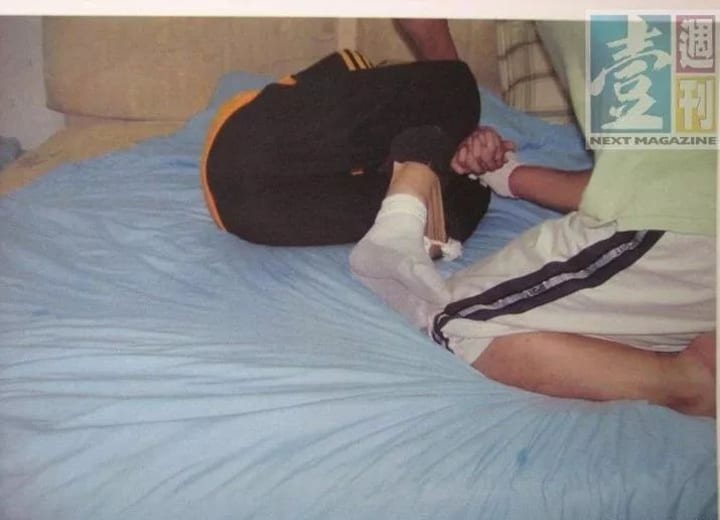
The photo shows a man wearing white gloves binding a girl's hands. The girl's ankles are double-bound with white rope and beige tape.
Her clasped fingers suggest she might have been conscious when bound.
The girl in the photo is believed to be Liu Chih-chin's eldest daughter. She had physical education class that day, hence wearing the orange sports uniform.
Although the man's face isn't visible, police determined Lin Chen-mi took the photo, and the man was Liu Chih-chin. The couple might have taken a series of photos. Because the camera had some internal storage, a few photos were saved directly onto the camera, allowing recovery even without the memory card.
9. Media reported that a video, possibly filmed by Lin Chen-mi, was found on the camera, showing her crying while recording Liu attacking the five children. However, due to the sensitive nature, all officers were reportedly gagged. This report remains unconfirmed, and police have consistently denied its existence.
S find the existence of such a video unlikely. First, video files are too large; they would surely be stored on the memory card, not the camera's internal memory. Without the card, recovery is virtually impossible. Second, if such a video existed, I can't imagine why the police would deny it.
Liu Chih-chin went to great lengths to create confusion and frame others, which doesn't suggest an intention to commit suicide immediately. Therefore, police inferred he likely did not kill himself right away but was hiding elsewhere under a false identity.
However, after the Hualien District Prosecutors Office formally issued arrest warrants for Liu Chih-chin and Lin Chen-mi on November 14, 2006 (statute of limitations until March 2044), the couple never reappeared, until nine years later...
Discovery of the Bodies
Nine years passed. On June 10, 2015, a hunter placing rat traps on a slope near Ciyun Mountain in Ji'an Township, Hualien County, unexpectedly discovered two skeletons in dense bushes just 10 meters from the road.
The skeletons, one male and one female, were about 3-4 meters apart and covered in moss. The hunter reported it to the police.
Because the location was only 2 kilometers from the site of the shocking five-children murder case, the news immediately sparked speculation that these were the remains of Liu Chih-chin and Lin Chen-mi.
Before DNA results were available, other features pointed towards the couple.
A pair of gold-rimmed glasses found at the scene was nearly identical to those Liu Chih-chin wore when he disappeared – metal frames, rimless at the bottom.
The skeletons were clothed in summer-weight attire, matching the early September season of the crime. Neighbors identified the male's sleeveless undershirt as a style Liu often wore. The two pairs of sneakers found were brands the couple usually wore.
Furthermore, height estimates based on shoe size and skeletal structure – approximately 175 cm for the male and 155 cm for the female – perfectly matched the couple.
A sleeping bag found near the bones fit the scenario of fugitives. A bottle of pesticide found at the scene had a production date of 2006, the same year as the murders.
On June 15, 2015, the DNA identification results finally confirmed the skeletons on the desolate mountain were the missing couple from the five-children murder case, Liu Chih-chin and Lin Chen-mi.
Traces of the pesticide Methomyl were detected in the bone powder. No opiates, amphetamines, sedatives, sleeping pills, or other poisons were found. The conclusion was that the two died from shock induced by ingesting pesticide; it was suicide.
The whereabouts of the parents from the nine-year-old five-children murder case were finally clear. But the discovery of Liu Chih-chin and Lin Chen-mi's remains brought new questions.
First, Han Hsiu-ai (韓修愛), head of the Hualien Police Bureau's investigation team, had stated that within six months of the incident (September 2006 to early 2007), police had conducted almost grid-like searches of all mountainous areas in Ji'an, including Ciyun Mountain where the skeletons were found. The location was only 2 km from the crime scene and 10 meters from the paved road. If they had been hiding there all along, how could they not have been found?
There are only two possibilities: 1. The police search at the time was negligent and not thorough; 2. The couple hid elsewhere for several months after the incident and only returned to this location after the searches stopped.
I suspect the second possibility is more likely.
The second question: When did they commit suicide?
Assuming they killed themselves after the police searches stopped, the bodies and sleeping bag were only 10 meters from the road, not particularly hidden. Why weren't they discovered by other hunters or passersby during the intervening eight years?
Police suspect Liu Chih-chin and his wife committed suicide out of guilt.
Why did Liu Chih-chin and Lin Chen-mi kill their five children? Why did they use the cruel method of strangulation with iron wire? What was their escape and hiding route after the crime?
To this day, these questions remain unanswered.
Other Suspects
1. The Suspicious House Sale
After the incident, police investigation revealed that the house Liu Chih-chin and his wife lived in no longer belonged to them. In December 2005, they had sold it for NT$3.7 million to Wu Chi-cheng (吳紀政), a police officer with the Hualien Police Bureau.
At the time, similar houses nearby were valued at only about NT$2 million. Wu Chi-cheng bought the house for a price far exceeding the market value. Through internal bank manipulations, the house, actually sold for NT$3.7 million, was appraised at NT$4.4 million, allowing for an 80% loan of NT$3.7 million.
Liu Chih-chin then rented the house back from Wu Chi-cheng, paying the mortgage installments for him in the form of rent.
On September 8, 2006, police discovered the bodies. On September 11, Lin Chen-mi transferred NT$39,000 to officer Wu Chi-cheng – this amount represented the mortgage payment and interest disguised as rent.
Why did the Liu couple sell their home only to rent it back?
My speculation is that the Liu couple's house originally had no mortgage, and they urgently needed cash, seeking to leverage the property. Selling at market price would only yield NT$2 million. They likely colluded with Wu Chung-hsien (Wu Chi-cheng's brother, the actual buyer, using Wu Chi-cheng's name due to his own debt preventing him from getting a loan), deliberately inflating the price to NT$3.7 million, with Wu Chung-hsien receiving NT$500,000 as a commission. This means the Liu couple could cash out NT$3.2 million.
Why would Wu Chi-cheng (acting for his brother) agree?
Wu Chi-cheng claimed the actual buyer was his brother, Wu Chung-hsien, who worked at the Yuli Police Precinct. Wu Chung-hsien couldn't get a loan due to his debts, so the property title was put in Wu Chi-cheng's name, who then took out the loan.
Wu Chung-hsien was willing to pay above market price because: 1. He received a NT$500,000 commission, meaning his actual loan burden was NT$3.2 million; 2. He colluded with the bank to inflate the appraisal, securing a 100% loan, meaning he didn't use his own money, only the bank's. Of course, he had to repay the loan; but 3. Liu Chih-chin agreed to include a lease agreement in the contract, paying the loan installments for him as rent.
Unfortunately, this scheme didn't work out as planned. Liu Chih-chin's NT$3.2 million didn't last long. After receiving the money, he paid off previous debts. The remainder had to cover the mortgage (rent), credit card debt, and the substantial living expenses of a family of seven, running out in less than a year. By September 2006, before the incident, Liu's account had only NT$100,000 left.
One theory suggests Liu Chih-chin suddenly refused to continue payments, angering Wu Chung-hsien, who was stuck with a high-priced house and a large loan. Enraged, Wu Chung-hsien killed Liu's children for revenge.
Personally, I find this speculation completely illogical. Murder offered Wu Chung-hsien no benefit, only harm. The Liu family needed a place to live and would have had to rent somewhere, meaning even if they couldn't afford the full loan payment, they'd still pay some rent. Even if Liu defaulted entirely, Wu could evict them and find new tenants.
Without murder, Wu Chung-hsien still had potential income and a debt to collect. Committing murder meant no one would pay the loan back. Besides, why commit murder in a house registered under his brother's name?
The house became a stigmatized property ("凶宅"), its value plummeting. Wu Chung-hsien, who initially sought a profit, was trapped, burdened by the loan.
He listed the house for eight years before finally selling the infamous property in 2015.
During those years, Hualien real estate prices soared, with new houses nearby selling for tens of millions. Yet, this stigmatized house was listed at only NT$3.8 million and eventually sold for around NT$3 million. Wu Chung-hsien accepted the loss just to get rid of it.
2. Revenge by Business Partner
Although the "Magic Family" business was doing well, it had many financial problems. One theory is that Liu's partner, Lin Ching-sheng (林暻胜, around 56 at the time), who had a criminal record for theft and fraud, had a falling out with Liu Chih-chin due to unclear partnership accounts, check theft, etc. There was a NT$6 million debt issue between them, attracting involvement from underground loan sharks. The disgruntled Lin had allegedly threatened to "kill Liu Chih-chin's entire family."
However, police investigations ruled out his involvement.
3. Crime by Underground Loan Sharks
Chou Szu-chieh (周思潔), a Taiwanese woman in her 50s with various titles (singer, actress, financial guru, spiritual teacher, self-proclaimed psychic), claimed she sensed through "energy shifting" that there were four killers, including 2-3 police officers and loan shark members, motivated by financial disputes.
She theorized the killers deliberately misled the police, staging it to look like Liu Chih-chin and his wife killed their children. The next day, they allegedly took the couple to the mountain where their remains were found, force-fed them poison, and buried them alive.
Many people still believe similar theories.
However, the killers were undoubtedly Liu Chih-chin and his wife.
According to the speculations of Chou Szu-chieh and others: a group of criminals burst into the Liu home on September 4th, disrupting the family's normal life, killing the five children, and then, before the police arrived on September 8th, took the couple to the outskirts and killed them.
This theory has many flaws:
1. According to police, the murders occurred on September 4th and 5th. From those days until November, there were witness sightings of Liu Chih-chin and his wife moving freely outside the home. The couple deliberately didn't answer the door and lied to school teachers over the phone.
While witness misidentification is possible, Liu Chih-chin driving alone to buy pliers on the evening of September 5th is confirmed.
One might argue, perhaps criminals held his family hostage, threatening him to buy the pliers and return immediately or they would harm his family?
According to police speculation, his children were already dead when he bought the pliers.
Even assuming his children were still alive then, how could Liu Chih-chin, with his intelligence background, not use this golden opportunity of being alone outside to seek help via a note or other means, asking passersby or shopkeepers to alert the police?
Furthermore, assuming criminals entered the Liu home on the evening of September 4th and controlled the family, why let the two daughters attend school normally on September 5th? The risk was too great; the girls could have done anything uncontrollable, like telling teachers or police, or simply not returning home that night.
And how could the two girls remain so calm after strangers invaded their home and their brothers were killed, acting as if nothing happened, even requesting sick leave for their brother?
The daughters' lack of awareness surely indicates that someone they trusted and held in authority lied to them, dispelling their suspicion and fear. This person could only be their parents.
On the evening of September 6th, surveillance video showed the couple driving away from home.
On September 11th, Liu Chih-chin was again witnessed alone at the train station. By then, his children were dead; he had no leverage left with any supposed captors. If he were truly under surveillance, he could easily have escaped and alerted police in the crowded station, yet he didn't.
In summary, various signs indicate Liu Chih-chin and his wife had freedom of movement throughout, were not held hostage, and concealed everything from their two daughters on the night they killed their three sons.
2. If multiple attackers committed the crime inside the house, it would usually be difficult to erase all traces of DNA, fingerprints, footprints, etc. Yet, apart from Mr. Hsiao's cigarette butts, police found no traces of others. Of course, one could argue they were extremely careful.
3. According to this theory, the attackers' ultimate goal was to kill the entire family and create the illusion that the parents killed the children and then themselves. If so, there would be no reason to leave Liu Chih-chin's SOS notes on the coffee table and in the door crack. Especially the one in the door crack, which was almost certainly left by the last person to leave the house.
If criminals were in control, they would surely have left after the couple and would have removed the notes, as the SOS messages contradicted the scenario they were supposedly setting up – that Liu Chih-chin was the killer.
Motive and Process
Although I believe the possibility of the Liu couple committing the crime is far higher than that of outsiders, there are indeed many questions difficult to explain.
The main one is motive.
Motive 1: Financial Crisis.
Reports state police found Liu Chih-chin had two major debts in 2005: a NT$3 million mortgage and NT$1.68 million in credit card debt, requiring monthly interest payments of at least NT$30,000. However, Liu's Magic Family photography business only netted NT$12,000 per month, resulting in a deficit.
Another account claims police investigation revealed the couple had 17 credit cards, with irregular payments starting in June and no payments at all in August. Liu Chih-chin's total debt allegedly reached NT$16 million.
Additionally, Liu had a NT$3 million dispute with another former employee, which once involved the police. Some say his deficit resulted from rapid business expansion; others claim a failed investment in mainland China led to losses of about NT$8 million.
Motive 2: Religion.
The couple might have joined some cult and acted under its instructions to kill their children and commit suicide.
If religion were involved, some contradictions might be explained. However, investigations found no evidence of the couple engaging in religious activities. The only connection was a Tibetan Buddhist Thangka found on their wall. I don't believe Tibetan Buddhism has any link to massacring children. Even if religion led him to renounce the material world, it wouldn't be the primary reason for murder.
Motive 3: Relationship Crisis.
Some believe financial problems caused the couple's relationship to deteriorate. Rumors suggested they often argued about money, and tensions escalated when Liu insisted on paying the NT$100,000 tuition for his eldest son, who was about to start university.
Murder-suicides resulting from relationship crises usually involve one partner killing the other and the children. In this case, the couple acted with high coordination and cooperation, showing no signs of marital discord.
Considering these three points, the most likely scenario involves a financial crisis leading to desperation, combined with Liu Chih-chin's inherently extreme, ruthless, and volatile personality, prompting him to kill his family as a way to vent frustration and escape his predicament.
Why Did the Couple Jointly Kill Five Children?
When couples facing insurmountable problems contemplate suicide to escape reality, they sometimes kill their young children out of concern that the children will have no one to care for them after their death, or will face the burden of parental debt and public stigma.
However, in this case, the eldest son was 18, an adult entering university, and the second son was 17, capable of caring for himself. Killing them clearly wasn't motivated by such concerns.
Cases where both parents cooperate to kill all their children are extremely rare because individuals have their own thoughts, interests, and wills, making agreement on such an inhuman act highly unlikely. Such cases typically involve one person killing everyone else.
Liu Chih-chin himself might have been that ruthless, extreme, and deviant, but was Lin Chen-mi also like that? This is a point of confusion for many.
Killing her own biological children and committing suicide clearly went against Lin Chen-mi's interests. Couldn't she have taken her children and remarried? Logically and emotionally, she should have been positioned to stop Liu Chih-chin from killing the children.
I believe their relationship strongly resembles that of a "hermit crab" personality and a victim. (Translator's note: "Hermit crab" here likely refers to a controlling, parasitic personality type identified by some psychologists/authors, where the controller gradually takes over the victim's life and will.)
Based on Lin Chen-mi's other behaviors, she appeared to be a caring, loving, virtuous, and weak woman. Her eventual cooperation with Liu Chih-chin in killing her own biological children, as well as her three stepchildren, can only suggest she had completely lost her independent will and the ability to say "no" to him. Therefore, her will and motive in this case can almost be disregarded.
Only by understanding relationships like the "hermit crab" dynamic can we better comprehend why Liu Chih-chin's utterly depraved plan could gain his wife's cooperation. Because, before killing the children and committing suicide, Lin Chen-mi was already "dead" – merely a walking corpse, a shell controlled by the "hermit crab."
Cults can erase humanity, making victims act against their own will, instincts, and interests; a "hermit crab" personality can do the same.
Why Use Such a Cruel Method of Murder?
Derris vine: If ingested, can cause poisoning. Symptoms include paroxysmal abdominal pain, nausea, vomiting, convulsions, muscle tremors, slowed breathing, eventually leading to death by respiratory paralysis.
Based on some case studies, Derris does not have a sedative effect; instead, it causes abdominal pain and headaches in the victim. Even if the victim eventually loses consciousness, it's a pre-death state.
Therefore, drugging the children into unconsciousness before strangling them was likely not the couple's initial plan. For achieving anesthesia, sleeping pills or similar tranquilizers would have been far more effective.
I believe the couple initially intended to poison the five children using Derris in soup. However, when killing the eldest son, they discovered the plant only induced poisoning symptoms and loss of resistance, leaving him suffering for a long time without dying. So, they switched to strangling him with iron wire.
Once the first was killed, time became extremely pressing, leaving no opportunity to switch drugs. They had to use the same method on the others.
What Were Liu Chih-chin's Actual Intentions?
- Writing SOS notes, scattering someone else's cigarette butts, wearing gloves – all aimed at concealing his identity as the killer and misleading police into suspecting others.
- Sealing the bathroom and back door – intended to prevent odor leakage and delay the discovery of the bodies.
- Paying rent was unnecessary whether they planned to flee or commit suicide. Yet Lin Chen-mi transferred nearly NT$40,000 to the landlord on September 11th. This can only be understood as them being unaware the crime scene had already been discovered; paying the rent was meant to placate the landlord, prevent him from visiting the house, and further delay discovery.
- Before the incident, Liu withdrew all NT$100,000 from the accounts, suggesting they planned to "live" for a while longer.
- Creating a sealed room seems somewhat redundant. Was it meant to suggest the children committed suicide? It only suggests his main goal was to obstruct the investigation, without a consistent, clear purpose.
All these points lead to the same conclusion: If they intended to die together with their children, why do all these things?
Various signs indicate that after the children's deaths, Liu Chih-chin seemingly did not intend to commit suicide, at least not immediately. This is perhaps the most chilling and thought-provoking aspect of the case.
Did the couple kill all their children merely to shed the burden and escape debts unencumbered? Was it just to frame their partner/loan sharks who had threatened them?
If that were the motive, it would truly be lower than any beast.
My speculation includes another possibility: Liu Chih-chin did intend to commit suicide eventually. After all, the scenario they staged was far from perfect, and they didn't flee abroad, seemingly staying local.
Even with the extremely low probability of successfully framing his partner for the children's deaths, how could they reappear and explain to the police where they had been for so long and why they didn't report the crime? How could they survive the public outcry?
The fact that the pesticide they ingested was produced in 2006 suggests Liu might have bought it before fleeing. Perhaps they hoped to live for a while, observe developments, see if anyone would be suspected by the police and pay the price. He might have inwardly hoped to implicate and punish certain people, including the police officer involved in the house transaction.
The later purchase of Kaoliang liquor suggests the couple remained local, possibly hiding out guerrilla-style in the mountains. Only after the manhunt subsided did they return to the vicinity where their bodies were found. By November 2006, when the court issued formal arrest warrants, they knew their plan to frame others had failed, the outcome was clear, and there was no escape. Liu Chih-chin decided on suicide.
As for why their bodies remained undiscovered for so long – the forest there is very dense. Perhaps, by chance, no one happened to walk to that exact spot.
The greatest tragedy in the human world is perhaps this: children trusted their parents, a wife revered her husband, yet all became sacrificial victims of Liu Chih-chin's shattered worldly desires.
About the Creator
Helen Sato
share job hunting tips
Keep reading
More stories from Helen Sato and writers in Criminal and other communities.
The Cannibalism Case: Insurance Employee Missing After Dinner, Discovered Remains Lack Internal Organs
Twenty-two years ago, a series of extremely vicious and heinous crimes occurred in Taiwan, which remain among the most discussed cases in Taiwan's criminal history to this day. A seemingly harmless, perverted man murdered multiple people and consumed their flesh, employing exceedingly cruel methods. However, regarding the exact number of victims, precisely how many bodies were cannibalized, and the deeply unsettling speculations surrounding this "series of cases," there has never been a unified consensus, not even among the Taiwanese police themselves. Perhaps these mysteries will never be solved.
By Helen Sato7 months ago in Criminal
He Was Innocent Until Midnight
M Mehran At exactly 11:59 p.m., the prison loudspeaker crackled to life. “Inmate 3021, prepare for transfer.” Jacob Reeves stopped breathing. Transfer meant only one thing on death row. Execution. For ten years, Jacob had lived between concrete walls, labeled a monster by the world. Convicted of murdering his wife and six-year-old daughter in a house fire that shook the nation. The headlines had been brutal: FATHER BURNS FAMILY ALIVE NO MERCY FOR THE DEVIL AT HOME Jacob had stopped defending himself years ago. No one listened anyway. But tonight—one minute before midnight—everything was about to change. The Case Everyone Thought Was Closed Detective Laura Bennett remembered the Reeves case clearly. It had launched her career. Clean evidence. Quick conviction. Public applause. Too clean. Jacob’s house had burned down in 2015. Investigators found traces of accelerant. Jacob’s fingerprints were on the gas can. Motive? Insurance money. An open-and-shut criminal case. At least, that’s what they wanted it to be. Laura had risen in rank since then, but something had always bothered her. The fire report. The witness statements. The speed. Crimes were never that simple. A Letter That Shouldn’t Exist Three days before Jacob’s execution, Laura received an anonymous envelope. Inside was a single sentence: “If Jacob Reeves dies, the real killer lives free.” And a USB drive. The files were old—security footage from a nearby gas station, time-stamped the night of the fire. Footage that had never made it into evidence. Laura’s stomach dropped. At 10:41 p.m., a man filled a gas can. At 10:44 p.m., he drove away—toward Jacob’s neighborhood. Jacob was at work until 11:10 p.m. The fire started at 10:55 p.m. Jacob physically couldn’t have done it. The Criminal Inside the System Laura dug deeper. She rechecked the original case files and found something worse than a mistake. Tampering. The accelerant report had been altered. Witness statements rewritten. Evidence “lost.” Someone inside the system had built a lie so perfect that it survived a decade. And Laura knew exactly who. Captain Henry Wallace. Her mentor. The man who trained her to “protect justice.” A Race Against Time Laura stormed into Wallace’s office. “Jacob Reeves is innocent,” she said. Wallace didn’t flinch. “You should let the past stay buried.” “Why?” Laura demanded. “Why frame him?” Wallace sighed. “Because the real killer was untouchable.” The truth spilled out like poison. Jacob’s neighbor—Evan Price—had been running an illegal chemical operation. Jacob discovered it and threatened to expose him. The fire was meant to silence him. But Evan Price was an informant. Protected. Valuable. “So you sacrificed an innocent man?” Laura whispered. Wallace’s eyes hardened. “I protected the city.” Midnight Approaches Laura ran. She sent the footage to the district attorney. Contacted the media. Filed an emergency injunction. At 11:57 p.m., Jacob was strapped to the execution table. His final words echoed through the chamber. “I forgive you,” he said calmly. “All of you.” Laura burst into the room screaming, waving the court order. “STOP!” The clock hit 12:00 a.m. The needle never dropped. The Real Criminal Exposed Within hours, Evan Price was arrested trying to flee the country. Captain Wallace resigned “for health reasons” before formal charges could be announced. The media turned savage. INNOCENT MAN NEARLY EXECUTED JUSTICE SYSTEM BUILT ON A LIE Jacob Reeves walked out of prison at dawn—a free man with nothing left to return to. No house. No family. No decade. Laura stood beside him as reporters shouted questions. “Do you hate them?” someone asked. Jacob shook his head. “Hate doesn’t bring back the dead,” he said. “Truth might save the living.” The Quiet After the Storm Months later, Laura visited the burned land where Jacob’s house once stood. Jacob was there, planting a small tree. “For my daughter,” he said. Laura swallowed hard. “I’m sorry.” Jacob looked at her. “You were brave when it mattered.” As Laura walked away, she understood something chilling. The most dangerous criminals don’t carry weapons. They carry authority. Final Thought Jacob Reeves was innocent—until midnight. And the system almost killed him to protect itself. SEO Keywords: criminal story, crime fiction, death row story, false conviction, justice system crime, psychological crime story, true crime inspired, Vocal Media criminal stories, murder mystery
By Muhammad Mehranabout an hour ago in Criminal
Speed, Greed, and the Dangerous Game of Revenge
There are some things in the world that are not just symbols of wealth, but become identities of power, arrogance, and obsession. The rare 1937 Bugatti is one of those things. The film begins with a grand and luxurious auction, where this legendary car stands on stage as the center of everyone’s attention. The auctioneer announces that it is one of the rarest cars in the world, with only two models existing globally. This announcement ignites greed in the hearts of every wealthy person present in the crowd. The bidding starts at thirty million dollars and keeps increasing moment by moment. Someone bids thirty-two, someone thirty-four, and finally the bid reaches forty-one million dollars. This final bid is placed by a man named Jack, who is in contact with his boss. On the surface, he appears to be a rich buyer, but in reality, he is working for a powerful and dangerous criminal. The Bugatti is not going to belong to him, but to his boss. At the same time, the film introduces us to two brothers—Andrew and Garrett. Both are world-famous and highly skilled car thieves. Luxury and supercars are their obsession, and they have stolen some of the best cars in the world. The reason both brothers are connected to the Bugatti’s path is because they want to steal this rare car. The Bugatti theft on the highway is one of the most thrilling scenes of the film. High-speed vehicles, jumping onto a truck using ropes, a shower of bullets, and the shadow of death—Andrew and Garrett risk their lives to steal the Bugatti. This is not just a theft, but a practical demonstration of skill, nerves, and madness. After the theft, both brothers celebrate, but this happiness does not last long. When they go to a man named Jimmy to sell the Bugatti, he refuses to buy it. Jimmy knows that this car does not belong to an ordinary person, but to a very powerful and dangerous businessman named Morrier. Morrier is not only a wealthy man, but also runs an entire criminal empire. Soon, Andrew and Garrett are captured and presented before Morrier. Morrier tells them his story—a journey that started from poverty, an empire built through crime, and an obsession with rare cars. For him, these cars are not just a hobby, but symbols of his power and ego. The theft of the Bugatti becomes a personal insult to him. Morrier gives both of them one chance to stay alive, but his condition is extremely dangerous. They must steal a 1962 Ferrari belonging to a man named Max—a car that is one of a kind in the world and worth more than millions of dollars. Max is a young but exceptionally intelligent business tycoon, and also Morrier’s old enemy. From here, the story moves beyond a simple theft and turns into a battle of minds. Andrew and Garrett form an entire team, including Stephanie, Devon, bomb expert Lane, and skilled race drivers. Every person has a specific role, and every mistake can lead to death. The character of Max adds more depth to the story. He appears to be a polite and successful businessman, but behind him is an extremely sharp mind. He is both impressed by Andrew and Garrett’s abilities and cautious of them. His Ferrari is not just a car, but his identity. The story takes a new turn when it is revealed that the real plan was never to steal the Ferrari. The Bugatti was merely a move, a trap—used to ensnare Morrier along with his arrogance. Andrew, Garrett, and Max were actually playing the same game from the very beginning, where the real target was Morrier’s treasure of rare and valuable cars. In the climax, speed, explosions, and intelligence collide together. A collapsing bridge, long car chases, betrayal, sacrifices, and finally Morrier’s fate—all symbolize that the game of power and greed ultimately ends in destruction. In the end, Andrew proposes marriage to Stephanie, Garrett finds love, and the team completes an impossible mission. But the biggest lesson remains that in this world, the most dangerous weapon is not a gun or speed, but the mind, patience, and the final move played at the right time. Final Question Is power really found only in money and weapons, or is true power hidden in the mind that silently turns the entire game around?
By Filmon Ke Raaz | Movie Mysteries Explained5 days ago in Criminal
Killing him slowly
There’s an intruder in my house again. He stumbles through the door, wet carrier bags in hand. He’s bought me offerings. I show my appreciation, letting him caress my beautiful body. He wants to touch me. I rub myself against his legs. He sighs, dropping the bags. He can’t resist touching me. Running his hand slowly down my spine, I arch my back towards his caress, let out a low purr. It’s what we both need.
By N J Delmas2 days ago in Horror




Comments (1)
Family annihilation cases are truly tragic. This one in Taiwan from 2006 sounds especially mysterious.