
Bushfires and Bears – What Do They Have in Common?
The potential demise of an icon

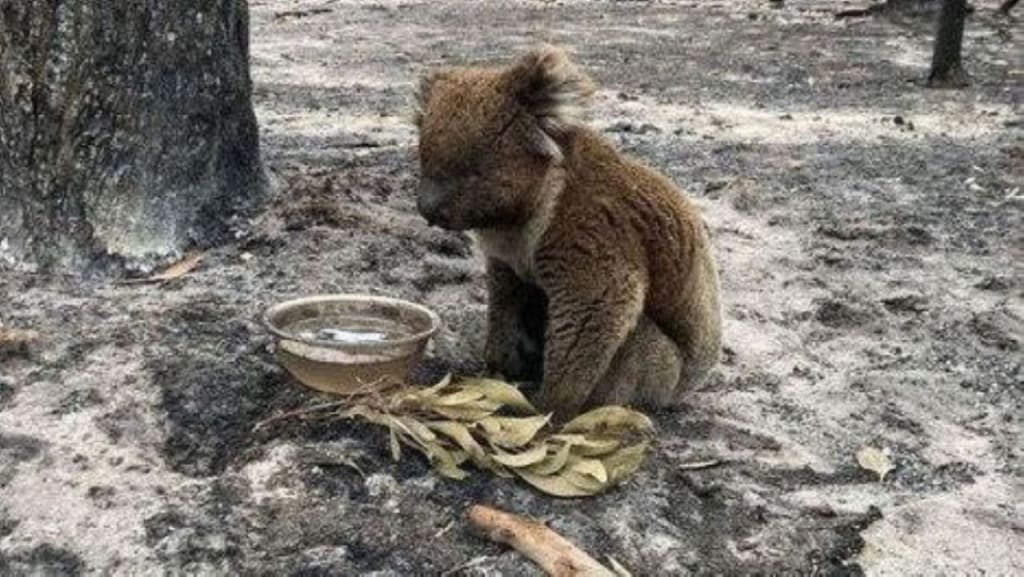
I have written a few stories about Koalas. I studied them for four years when I was doing my Master of Science degree. You can read about this adventure here (My Life with Koalas Part 1: Let the Science Begin.) if you are interested.
The last story I wrote highlighted the plight of one of Australia’s most loved but also most ignored icons. You can read that here:
I have also written about the terrible tragedy and devastation caused by bushfires:
What’s worse is when fires are started on purpose or spread due to careless human actions. It's heartbreaking to see so many innocent animals burned or hurt by bushfires. About three billion animals died or were forced from their homes in the terrible Australian bushfires of 2019-2020.
Two stories in the Australian press caught my attention last week. A grazier was found guilty of starting a bushfire in 2021. The fire scorched around 14,000 hectares. It destroyed three houses and killed thousands of sheep and even more wildlife.
The second was about the New South Wales government. They announced they are creating the largest koala national park ever.
What is the connection between bushfires and bears?
Let me start by saying koalas are not bears. It is a common misconception, but one that is often used. Koalas are facing extinction in the next fifty years. One of the main reasons is the decline in their natural habitat, with a significant portion of this decline attributed to bushfires.
Victim or Villain?
Tom Brinkweorht owned about 1 million hectares of pastoral land in South Australia. A court decided that a big bushfire in South Australia's south-east in 2021 began at a rubbish heap. This heap had been smouldering for six months before it reignited. He lit the fire to burn vegetation on his property.
He was found guilty of negligence for several reasons:
• He didn’t put a firebreak around it.
• He failed to monitor the active heap after it was lit.
• He didn't fully extinguish the heap after it burned.
• He neglected to check it before fire danger season to ensure it was out.
Brinkweorht was a bit of a conundrum. He stepped in to save Larry the Lobster, a giant 17-metre-tall crayfish. If moved, he would leave SA's coast for Western Australia. That made him a bit of a local hero.
He lost several court cases for illegal land clearing and animal cruelty. He faced 113 animal cruelty charges across twelve properties. This case is one of Australia's worst for alleged animal mistreatment.
The case highlights one of the problems that are leading to the potential extinction of koalas. Land clearing lowers the number of trees koalas need. These trees provide shelter from predators and extreme weather, like heatwaves, and serve as a food source.
The plight of the koala
The koala was first listed as vulnerable under national laws in 2012. Its conservation status was upgraded to endangered in 2022. Experts say that without major changes, this species may go extinct in the wild by 2050.
Habitat destruction and fragmentation are identified as a major and increasing threat. Koalas are specialized in eating eucalyptus leaves. They can't survive without their natural habitat.
The numbers become shocking when you add animals lost to bushfires, road accidents, and predators. Reports from the 2019-20 fires estimated that more than 60,000 koalas were killed, hurt, or forced to leave their homes.
Koalas move slowly. When a bushfire occurs, they instinctively climb higher in trees. Unfortunately, this often leads to their downfall. They don’t flee. Instead, they curl into a ball. Then, they either get burned or become confused and fall from the tree. On the ground, they are clumsy and easy targets for predators. Some may even have broken bones that stop them from moving.
Too Little Too Late
From 2011 to 2023, about 2,295,134 hectares of bushland, likely koala habitat, were destroyed.
In 2025, more habitat was legally given up than in any other year since the animals became threatened. The clearing of 3,958 hectares of bush in eight projects includes a coalmine in Queensland. This area is roughly the size of four Sydney airports.
Last week, the New South Wales government confirmed plans for a vast national park. It will safeguard more than 12,000 koalas and span 1,786,000 hectares.
The announcement follows months of pressure from environmental groups. They urged the government to keep its election promise. Along with the new park, a logging moratorium will be added inside its boundaries.
Kudos to this state government for this action, but is it too little too late?
Any effort to try to ensure that these symbols of Australia do not perish is to be applauded. Found nowhere else in the world and instantly recognisable, let’s hope there is hope for them yet.
Till next time,
Calvin
About the Creator
Calvin London
I write fiction, non-fiction and poetry about all things weird and wonderful, past and present. Life is full of different things to spark your imagination. All you have to do is embrace it - join me on my journey.
Keep reading
More stories from Calvin London and writers in Criminal and other communities.
Javed Iqbal: The Monster Who Murdered 100 Boys in Six Months
Javed Iqbal Mughal stands as one of the most horrifying and prolific serial killers in modern history earning the grim distinction of being Pakistan's worst serial killer. Born around 1961 in Pakistan Iqbal came from a relatively affluent background. His family provided him with significant privileges early in life by his late teens his father had purchased a villa for him and gifted him a powerful 200cc motorbike. These luxuries would later become tools in his predatory schemes.In the early 1990s Iqbal's dark tendencies first came to light when he was arrested following allegations from one of his victims. He faced accusations of sexually abusing young boys luring them to his residence with promises of food money or shelter. However, the case did not result in lasting consequences—no formal charges stuck, and he was released. This brush with the law left a deep scar on Iqbal. He later claimed that the stress and humiliation his mother endured during his arrest and the surrounding scandal contributed to her suffering a fatal heart attack. Consumed by grief and rage Iqbal vowed revenge—not directly against the authorities, but against society itself. He declared his intention to inflict the same level of anguish on 100 other mothers by taking their sons' lives.
By Kure Garba3 days ago in Criminal
How To Deal With LEOs And Not Catch A Bullet
Darn it! The newest shooting to enrage people has occurred and again, you’re faced with that werid question, why? Why would guys with families at home, men and women with lives, be using deadly force on American citizens? It’s a puzzler, isn’t it?
By Jason Ray Morton 6 days ago in Criminal
My First Time Skiing and I Got Lost, Alone, in the French Alps
Looking back, I can trace some of my life’s biggest adventures to a simple action from my sister. She’d introduced me to Tommy (a very long time ago), a colleague of hers, who had overshared his penchant for Italian-looking women, and I ticked that box.
By Chantal Christie Weissabout 13 hours ago in Humans


Comments (2)
I hope the koalas get their park! I've been lucky enough to see them and they're cute little fellas.
It’s crazy to think those bushfires happened pre-COVID. Feels way more recent than that, but I guess it’s just one disaster after another these days 😅