
Alert: 16 Billion Passwords Leaked — Check If You’ve Been Hacked
Over 16 billion passwords were recently exposed in what may be the largest data breach in history. Here’s how to check if you’re affected and what steps to take to secure your digital life.

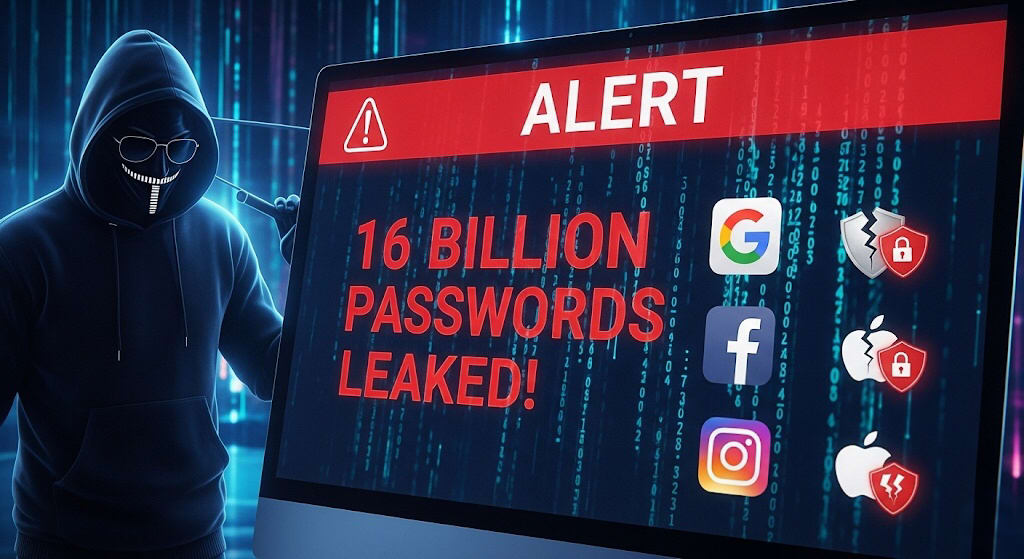
Hello friends! Imagine opening your phone one day only to discover that hackers have your email password, your Instagram login, or worse — your banking credentials. Sounds like a bad dream, right? Unfortunately, this nightmare might already be a reality for many of us.
In a recent and alarming discovery, cybersecurity researchers at CyberNews found a staggering 16 billion login credentials exposed on the dark web. The breach, unearthed in mid-2025, includes email addresses, usernames, and passwords — many of which are unencrypted and easily accessible to cybercriminals.
While some experts argue that the number might be exaggerated due to duplicate or outdated entries, the fact remains: millions — possibly billions — of people’s passwords are floating around the internet. If yours is one of them, your online identity could be at serious risk.
So, what can you do? How can you find out if your information was compromised? And most importantly, how can you protect yourself from being hacked?
Let’s walk through everything you need to know — in simple terms.
How Are Hackers Getting Your Passwords?
Hackers don’t need to be tech geniuses to break into your accounts. Most of the time, they rely on human error and a few clever tricks. Here are four common techniques used to steal your passwords:
1. Phishing
This is the most widespread method. It works like this: you receive an email, SMS, or message that appears to be from a trusted source — maybe Facebook, Instagram, or even your bank. The message might ask you to log in to verify your identity or claim a reward.
But here’s the catch: the link takes you to a fake website, designed to look exactly like the real one. When you enter your login details, you’re actually sending them straight to a hacker.
What to do:
Never click on login links in emails or messages. Instead, open your browser and manually type in the website address. Only log in from there.
2. Credential Stuffing
Let’s say your old Instagram password got leaked in a breach. You might think, “No big deal, I don’t use Instagram much.” But here’s the trick — hackers will try that same password on Facebook, Google, Apple, and other sites.
This technique, called credential stuffing, works surprisingly well because most people reuse the same passwords across platforms.
How to protect yourself:
Use completely different passwords for each website. Don’t worry about remembering them all — we’ll talk about password managers later.
3. Password Spraying
This method involves using a common password — like India123 or Password@123 — and trying it on many usernames. If even a few people used that password, their accounts are compromised.
It’s a low-effort but highly effective technique, especially when targeting large organizations or government databases.
Lesson here:
Never use simple, common passwords. They’re the first ones hackers will try.
4. Brute Force Attacks
This is where hackers use software to try every possible password combination until they find the right one. It’s like guessing a 3-digit suitcase lock, but at lightning speed.
The shorter and simpler your password, the easier it is to crack. A basic 8-character password using only letters or numbers can often be cracked in minutes or hours.
Solution:
Create passwords that are long, complex, and unpredictable. The more characters and the more variety (uppercase, lowercase, numbers, symbols), the better.
How to Create Unbreakable Passwords
If your password is something like “Dhruv@1995” — sorry, but that won’t hold up. Even though it includes a name and a number, hackers can break it in under three minutes.
Here are two easy methods to build strong passwords:
Method 1: First Letter Sentences
- Think of a sentence you’ll never forget, like:
“My first car was a 1995 Honda Civic that I loved.”
- Now take the first letter of each word:
Mfcwa1995Hctil
- Add a symbol or two and some capitals, and you’ve got a powerful password.
Method 2: Passphrases
- Pick four random words you’ll remember:
coffeeMountainBicycleJustice
- Even without symbols, this passphrase would take years to crack. Add a few special characters or numbers, and it becomes virtually uncrackable.
Common Passwords You Should Never Use
Here are some of the most frequently hacked passwords:
- 123456
- password
- India123
- 1qaz@wssx (seems complex but is just a keyboard pattern)
- Any name + birthday combo (e.g., Rahul@1998)
Avoid these at all costs.
Still Struggling to Remember Passwords? Use a Password Manager
No one expects you to remember 50 different complex passwords. That’s where password managers come in.
Both Android and iOS now offer built-in secure password managers, protected by your fingerprint or PIN. Apps like Bitwarden, 1Password, or LastPass are also great options.
These tools store your passwords safely and can even generate strong ones for you.
Final Tips to Stay Safe:
- Use a different password for each website or service.
- Turn on Two-Factor Authentication (2FA) — it adds a second layer of protection like an OTP or fingerprint.
- Never share your OTP with anyone, no matter how urgent the request sounds.
- Educate your family, especially parents and elders who may not be as tech-savvy. Show them how phishing works and help them update their passwords.
Conclusion
This is not just a tech issue — it’s a life issue. In an age where our data is currency, your password is often the only thing standing between a hacker and your personal life.
Yes, the internet can be dangerous, but with a few smart habits and some awareness, you can stay safe and secure.
So take a few minutes today to change your passwords, enable 2FA, and protect the digital version of you. And if this article helped you, do your part — share it with your family and friends.
Their digital lives might just depend on it.
About the Creator
Taimoor Khan
Hi, I’m Taimoor Khan. Writing is my way of capturing the quiet moments of life that often go unnoticed.
Keep reading
More stories from Taimoor Khan and writers in Criminal and other communities.
They Turned My Private Moment Into a Global Joke”: Former Tech CEO to Sue Coldplay After Concert Scandal
It was supposed to be just another magical night under the stars, with thousands of fans swaying to the music of Coldplay. But for Andy Byron, former CEO of U.S.-based tech company Astronomer, that night became the start of a personal and professional nightmare.
By Taimoor Khan6 months ago in Criminal
Multinational Crisis
Part One: Nigeria You have all heard about Nigerians, Nigeria in general. The infamous scammer country. But let’s have a real conversation. Let me give you some extremely boring stats, so we are on a level playing field, on my thoughts. I’ll be as brief as possible considering, no one wants an hour long dissertation on economic issues.
By Alexandra Grant2 days ago in Criminal
Oklahoma Murder for Hire
Murder for hire in 1988 must have been a real monster of a time to find for a woman who was bored, and just lazy. A woman that claimed she was abused, knew how to work a young man up, back in those days it was much easier to find “a knight in shining armor”. Men all over wanted to be one, no man how scuzzy they really were.
By Cassie Moore4 days ago in Criminal


Comments
There are no comments for this story
Be the first to respond and start the conversation.