
A Little Black Book Called Crime
Robbing a bank comes with its surprises...

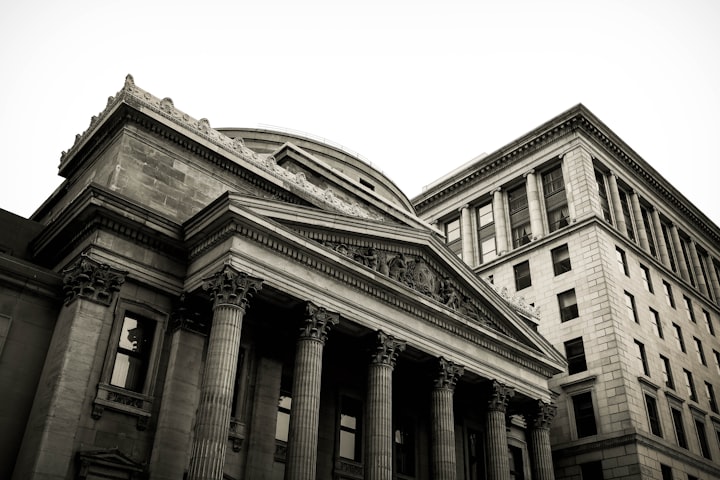
THE PLAN WAS FAILING.
It was supposed to be a quick split: go into the bank, get the money, and get out. No one would get hurt, no one would catch us, and we’d have whatever was hidden away in that fancy, little safe Quentin told us about.
But the plan was failing due to three things:
#1. Isabel and I suck at crime.
There’s the ‘eating a burrito horizontally’ type of crime, but then there’s ‘robbing a bank because you need the money’ type of crime. We aren’t criminals, we’re survivors. There’s just a little grey area when it comes to getting the money, because we don’t like to hurt people when it comes down to it.
No weapons, no threats, just old-fashioned lies and manipulation. But even with those arbitrary skills, we still had two other problems.
#2. Isabel forgot to keep tabs on the Manager.
Quentin, an ex-teller we met at a pub, told us about the safe in the first place. He got fired a fews weeks back, and was red-faced enough over three pints of beer to tell us about the money in the back of the bank. He also told us about the Manager’s key. The key was to get into the safe, obviously, and the safe was where the money was.
Which leads us to the third problem.
#3.The Manager isn’t here, and the Manager is the only one with the key.
“What do you mean ‘he isn’t here’?” I scowled from under my mask, both of my palms pressing hard into the marble counter.
I was talking to a teenager who seemed like he’d only been working here for a couple of days—and probably won’t be ever again after today. Traumatizing people isn’t my forte, but other people’s problems are the least of my worries either.
After watching the bank operate for a few days, Isabel and I took notice of a sweet spot into the clockwork. The older tellers took advantage of the eighteen year old’s naivety so they could smoke in the alley while he looked after the bank on lunch break. We had about an hour before they returned, and we guessed the boy didn’t know there was a silent alarm hidden underneath the checking desk.
This was supposed to make the job easier, not harder.
“He called in sick today,” the teen—whose name tag read Toby—whimpered, “he said he had the flu.”
“See, it’s not entirely my fault,” Isabel whispered from beside me.
I frowned. “Yes, it still is.”
“How was I supposed to know he was sick?”
Ignoring her, I turned back to Toby. We told him we had a gun in our back pockets and that we’d use it if he didn’t tell us where the manager was. It was a lie.
We didn’t have a gun.
Just pocket lint, at most.
“Where does he keep his keys?” I pressed, my eyes piercing through the thin glass separating the three of us.
Toby whimpered again. “Underneath the newspapers.”
“Get it for me.” I said.
Freaking out the kid wasn’t my intention, but two strangers in ski masks might have that effect on someone. When Toby came back, he was holding a large, red, metal box in his arms, and plopped it onto the counter nervously. He lifted the teller-window to slide it underneath.
“Thank you,” I said.
Turning my attention back to the box, I flipped open the lid, peering inside to see what could be of any use. A quick glance at the clock told us we had 45 minutes before the other staff came back. I could make it work.
The contents of the box were surprisingly normal. A CPR case, a bottle of water, a ring of keys with no labels, and…
...a black book.
“Looks like the Manager keeps a diary,” Isabel said curtly, although I could sense her stupid grin from underneath her mask.
I ignored her again and ran my fingers along the side of the book. It was worn on the edges, with a broken spine and a tattered cover, which meant it was of some recurring importance. I flipped it open to see what was inside.
IN CASE OF EMERGENCY, it read, followed by, HOW TO OPEN THE SAFE.
“Bingo,” I smiled, waving my hand at Iz, “go watch the kid.”
Ignoring the sputters that followed out of her mouth, I traced my eyes along the page of the book, pacing over to the other side of the bank counter. There wasn’t a window there, just a flap that lifted up to allow passage behind the counter. To allow me passage behind the counter, that is.
The book was a journal with chicken scratch scribbles for the words. I assumed the Manager was careless enough to lose his keys every now and then—just like he was careless enough to get himself sick—and needed a step-by-step process to open the safes.
The first step was highlighted: George Washington.
Maybe the Manager wasn’t as careless as I thought. The vague answer threw me off, and I spent a good minute wondering what the first President of the United States had to do with a local bank in Missouri.
Tucked away on the left wall, I caught sight of a small painting of Washington hanging alongside hideous flower-print wallpaper. Great, one step closer to getting the hell out of this bank.
Sliding the book under my arm, I rushed over to the picture, taking the frame off of the nail holder and flipping it over. Sure enough, there was a key pressed into the velvet backing. Manager-Man left a spare. Tossing the painting onto a nearby desk, I took the key and slipped it into the pocket of my black cargo pants.
The book’s next step was: Sherlock Holmes.
Well, I’ve got the key to the safe, so what else was there to find?
“Hey kid,” I yelled, cocking my head to the side, “where’s the safe?”
The boy was crouched in a corner. “Behind that door.”
He pointed towards a large mahogany door at the furthest end of the room, with an ominous gold plate tacked onto the front. It looked like a janitorial room—maybe a place where the buckets and mops were kept, but most certainly not valuables—but when I saw the digital lock on the handle, I knew he told the truth.
Sherlock Holmes must have had something to do with the password. Walking over to the door (so much walking, I know) I bent down to observe the silver plate of numbers. There were three lights running along the top, which told me there were three digits.
“Anyone here read Sherlock Holmes?” I called out.
I heard Isabel snort. “Anyone here read?”
I cast a wary glance to the clock again. Thirty minutes. “Kid, what about you? Any idea of three numbers in Sherlock Holmes?”
He blinked. “No.”
“Think a little harder, please, or you’ll be stuck here with us for a lot longer.”
That seemed to get him thinking.
Isabel and I shared a glance as he began to mutter things under his breath, mulling the question over.
“His address,” Toby finally choked out, “two-two-one-b, Baker Street, London.”
“Didn’t need the entire thing, but nice work,” I said, already punching the numbers into the lock.
Three green lights, one successful beeping, and the swinging open of a door followed suit. I caught sight of the glorious safe perched in the back of the new room I’d discovered, just waiting to be raided by two amature robbers. A gold mine. The safe was shinier than any of the other stuff that withered away in this old bank, and it was so polished that I could see the blurry reflection of my ski mask all the way from where I stood.
Bingo.
“Iz, get the duffel bags,” I said, reaching into my pocket for the key, “it’s time we make a withdrawal.”
As the clock’s hands twisted towards the time limit, my partner and I spent the entire time furiously stuffing money into the bags we brought. Bills were scattered all over the ground, bills were in the air, but most were in my hands—a rough count of all the packs tossed in made it clear there was more than $20,000.
Bingo again.
“Let’s go,” I said, cocking my head towards the doorway, “if we leave now, we’ll make it out with time to spare.”
Isabel nodded, gathering up her bags like they were made out of a ton of bricks.
But as I walked back into the bank, I saw a woman, her grey hair pinned up into a bun, a maroon cardigan around her shoulders, and—as plan-ruining as it was—her hand on the silent alarm.
Toby snitched.
“Go,” I said, the words slipping out of my mouth before I could even think, “Isabel, let’s go!”
The thing about silent alarms, is that they’re, well, silent.
I didn’t know how long it had been since she pressed it, but I knew the police were only a few blocks away at most. Small towns have small distances, and I’ve got a small amount of time before I get thrown in a cell for the rest of my life.
Tick, tick, tick, went the voice in my brain, counting down the minutes till it was too late, tick, tick, tick…
“Leave the bags,” I yelled to Isabel, who’d tripped over the counter-flap and was sprawled out on the ground.
Tick, tick, tick…
Pushing through the doors, I caught a fleeting glimpse of the faces we’d abandoned in the room. Toby’s face was smug. The woman was angry. Mine was hidden under a mask, and I wanted it to stay that way.
Tick, tick, tick…
I could hear the siren of a sheriff’s car on its way towards the bank.
Isabel and I do what we call ‘bank-crashing’; we go to small towns with little to no security, scout the area for information, devise a plan, and then rob them of their valuables. Going to jail is not part of that.
Tick, tick, tick…
“We’ve got a minute to scram,” I spat out, “just drive!”
Isabel’s foot was on the pedal before I could slam my door shut.
Tick, tick...
Boom.
We were getting farther away from the bank, and that meant closer to freedom. But this sucked. We usually had a process: duffel bags in the trunk, masks off, and eyes on the road as we planned our next outing.
This time it was money on the ground, half-empty bags in our laps, and tension in the air.
“How much did we get?” Isabel said, making a sharp left towards the interstate, “please tell me we got something.”
I exhaled, bending forward to dig through the duffel bag in my lap. The money packs inside were unorganized and falling out of their wrappings, and even if I wanted to count them, we’d be in California by then.
But something caught my eye. Tucked underneath the mint-faces of Benjamin Franklin, the small, black book was folding over itself. I picked it up, flipped through the pages again.
There were notes, tables, and instructions that I’d missed before, but what caught my eye was the trail of numbers near the end.
Transfer numbers.
For every bank in South Missouri.
“Yeah, we got something,” I grinned, snapping the book shut, “I wouldn’t worry about the missing money.”
Isabel gave me a pointed glance. “Why?”
I didn’t answer, tucking the black book back into the duffle bag.
Here’s the thing about transfer numbers—they connect the banks, which connect the money, which then makes transfers—and if you know the codes, swapping out money into (our) accounts is easy.
And now I know them.
Ironically, the little black book was worth more than all the money in that bank combined. It was the source of all future robberies. The source of Isabel’s and my fortune.
It was our little black book called crime.
About the Creator
Bernie
Life's a mystery, but so are the books I write...
"Magpie" Magness
“The Magnesses Don’t Divorce,” that’s what Michael Magness told his friends when asked about why he hadn’t divorced his wife, Beth, after complaining about the marriage. Michael had been firm about this “no divorce” issue. It could be assumed he was thinking about the children.
By Cassie Moore6 days ago in Criminal


Comments
There are no comments for this story
Be the first to respond and start the conversation.