
A dentist, gambler, gunslinger.
Doc Holiday, an American gangster.
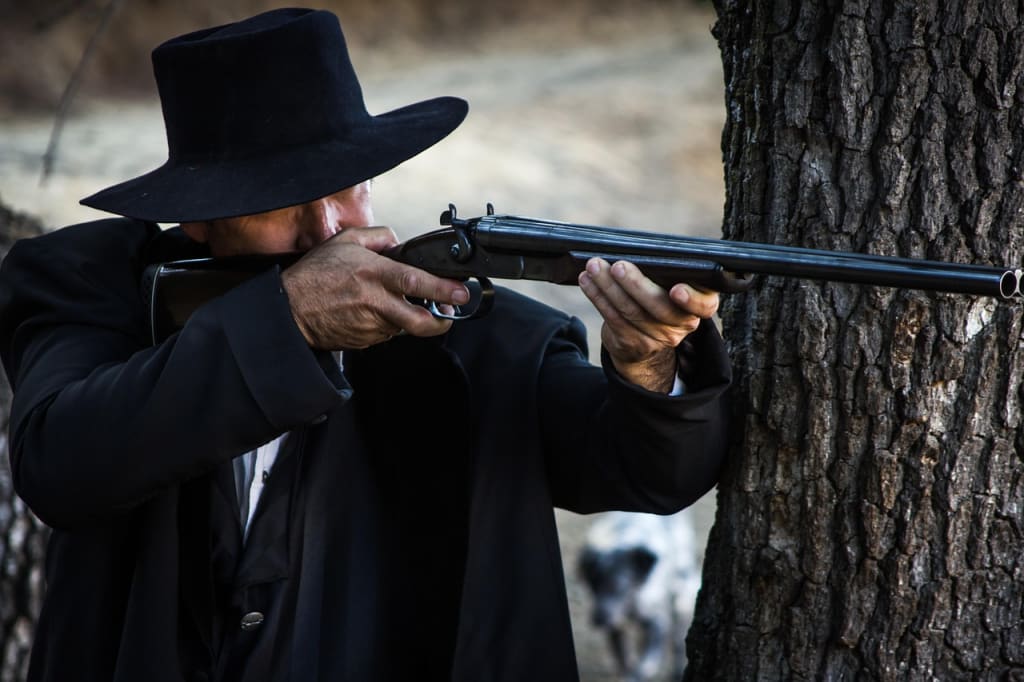
In the 1993 film Tombstone, Doc Holliday, portrayed by Val Kilmer, is depicted as a good-hearted gunslinger who aids Wyatt Earp in maintaining law and order in the perilous Old West town of Tombstone, Arizona. However, much like Earp, historical evidence suggests that the real Doc Holliday was far from the noble figure portrayed in popular culture. Here is the true story behind the legend of the "slickest gunslinger in the West."
Born John Henry Holliday on August 4, 1851, in Griffin, Georgia (now a suburb of Atlanta), Doc was the second child of Henry (“Major”) and Alice Jane Holliday. Unfortunately, his older sister died at birth, making John their only surviving child. His father, a veteran of multiple wars, including the Cherokee Indian War and the Mexican-American War, returned from the latter in 1848 with an orphaned Mexican boy named Francisco Hidalgo. According to some accounts, Francisco taught young John Henry the skills that would later earn him a reputation as the fastest draw in the West.
Growing up on a Southern frontier farm was challenging, with humid air and unpredictable weather. The Hollidays, of Scottish-Irish descent, were Protestant. While his mother instilled in him manners and etiquette, his father shared war stories and survival skills. In 1861, when John was just nine, the Civil War broke out, prompting his father to move the family further south to the Georgia-Florida border before leaving for battle. John excelled in school but was also known for his rebellious streak.
Tragedy struck in May 1866 when John’s mother succumbed to tuberculosis, the same disease that would later plague him. Soon after, his father remarried a neighbor’s daughter, eight years John’s senior, causing a rift between them. Seeking independence, John left home in 1869 to attend the Pennsylvania College of Dental Surgery, one of the nation's finest dental schools. He graduated in 1872 and briefly joined a friend’s dental practice in St. Louis before returning to Georgia.
Holliday’s life took a darker turn in 1872. According to Doc Holliday: The Life and Legend by Gary Roberts, a story first popularized in 1907 by writer Bat Masterson claims that Holliday killed a man in Georgia during a racial altercation. The account states that Holliday, angered by the presence of a group of African-American men at a watering hole, demanded they leave. When they refused, he allegedly shot and killed between one and three men. Some historians question the accuracy of this story due to inconsistencies, but given Holliday’s known predisposition toward violence, it remains plausible.
Around this time, Holliday was diagnosed with tuberculosis, the same illness that had taken his mother. With no cure available, a dry climate was believed to ease symptoms. Whether forced out of town due to the shooting or seeking relief from his illness—or both—Holliday relocated to Dallas in 1872.
Initially, he attempted to practice dentistry, but his persistent coughing deterred patients. To make a living, he turned to gambling, particularly Faro, a popular card game in which he became both a player and a dealer. Highly intelligent and skilled at deception, he was either exceptionally talented at the game or adept at cheating—perhaps both. His success earned him wealth but also numerous enemies. Arrested multiple times for illegal gambling, Holliday moved frequently, dealing Faro in saloons across Texas, Kansas, Wyoming, and New Mexico. His reputation for violence grew as he engaged in multiple gunfights and once even disemboweled a man who refused to abide by his Faro rules. At one point, it is believed that U.S. Marshals and Texas Rangers pursued him.
By 1879, Holliday had amassed enough wealth to open a saloon in New Mexico, where he continued gambling and drinking heavily. One fateful night, an army scout fired shots into Holliday’s establishment after being rejected by one of his saloon girls. Holliday retaliated, killing the man. The following year, he arrived in Tombstone, Arizona, setting the stage for his most famous chapter.
Holliday and Wyatt Earp first crossed paths at a Faro table. At the time, Earp, a deputy from Dodge City, was chasing train robber Dave Rudabaugh, traveling nearly 400 miles beyond his jurisdiction into Fort Griffin, Texas, motivated more by the hefty reward than justice. Holliday, who had encountered Rudabaugh, shared intelligence that led to the outlaw’s capture. Whether Earp split the reward with him remains unknown.
Their bond reportedly deepened in 1879 when, according to legend, Holliday saved Earp’s life. During a visit to Dodge City with his girlfriend, “Big Nose Kate,” Holliday allegedly thwarted an assassination attempt by cowboy Tabo Driskell, placing a gun to Driskell’s temple just as he was about to shoot Earp. While the story's authenticity is uncertain—given Earp’s well-documented tendency for embellishment—it cemented Holliday’s reputation as Earp’s loyal ally.
In 1881, Earp invited Holliday to Tombstone, suggesting the town needed a dentist. More likely, he wanted his trusted Faro dealer by his side to exploit the town’s booming silver-mining economy. Holliday’s legend was truly forged in Tombstone, particularly in the infamous Gunfight at the O.K. Corral. The shootout, which actually took place in a vacant lot near the corral, saw Holliday and the Earps facing off against Ike Clanton and his men. Historians debate the exact reasons behind the fight—Clanton may have accused Holliday of stagecoach robbery, insulted his girlfriend, or claimed the Earps had cheated him at Faro. Regardless, the confrontation lasted only thirty seconds, leaving three men dead and several wounded. Though the first shot’s origin remains unclear, Holliday is credited with delivering the first fatal bullet. Some accounts suggest Clanton was unarmed, further complicating the historical record.
After the shootout, Holliday and the Earps were tried for murder but acquitted. However, Holliday became a target for retaliation. Fleeing attempts on his life, he eventually settled in Colorado, where his health rapidly declined. Dependent on alcohol and opium, he died in 1887 at the age of 37 in Glenwood Springs, succumbing to tuberculosis.
Wyatt Earp, in contrast, lived well into the 20th century and moved to Los Angeles, where he influenced Hollywood’s portrayal of the Old West. The largely fictionalized biography Wyatt Earp: Frontier Marshal helped perpetuate the myth of Earp as a law-abiding hero and Holliday as his loyal gunslinging sidekick. In reality, historical records suggest that Holliday was more of a violent gambler than a noble outlaw. However, as with Earp’s Hollywood-embellished tale, the legend of Doc Holliday remains a compelling—and enduring—story.
About the Creator
Keep reading
More stories from Anthony Maghanga and writers in Criminal and other communities.
Jack the Ripper finally identified.
Jack the Ripper Mystery Potentially Solved Through DNA Evidence For over a century, the identity of Jack the Ripper has remained one of the world's most infamous unsolved mysteries—until now. DNA evidence from a shawl recovered at one of the crime scenes has been found to be a 100% match, potentially revealing the killer's true identity.
By Anthony Maghangaabout a year ago in Criminal
Push To Prevent Catapults Being Bought By Children
MP’s have been warned to put new legislation in place that will help to close a loophole in the law which allows people including children to legally buy weapons which is capable of killing wildlife. The alert was issued during a briefing in parliament which set out growing evidence that catapults were being misused against animals and to damage other people’s private property. The Naturewatch Foundation who hosted the session expanded on their message that at the moment there is a completely unregulated system where people of any age can buy weapons and there are no meaningful controls on sale or power.
By Ashish Prabhu3 days ago in Criminal
Becca
"Everything is so... flat." Denille said stupidly as she looked around her new neighborhood. She looked around at the muted desert where even the smallest sign of life seemed to have given up. The plant life was shrubs that were half cooked by the heat and where there should have been a lawn, a mess of white rocks laid glistening in the sun. Even the sky looked stretched thin, like the sun had ironed it smooth. She’d moved from Riverside, where at least there were hills, but here in Barstow, everything felt baked and brittle.
By Sara Wilson7 days ago in Fiction



Comments
There are no comments for this story
Be the first to respond and start the conversation.