
A Cold Echo
The Setagaya Murders


In the quiet Setagaya ward of Tokyo in 2000, a horrifying crime scene was discovered that sent the community into a state of shock and mourning.

On the evening of December 30, 2000, an intruder broke into the home of Mikio Miyazawa, 44. Mikio, employed by the international marketing firm Interbrand, was a typical middle-class Japanese family man. He shared his home with his wife Yasuko, 41, and their two young children, 8-year-old Niina and 6-year-old Rei. What happened inside that home that night sent a shockwave of fear and sadness careening across Japan.
Upon entering the home the following day, investigators found a horrific crime scene. Mikio and Yasuko, along with their daughter Niina, had been brutally stabbed to death. Their son, Rei, had died from asphyxiation. The times of death were established to be between 11:30 pm and 12:05 am. The killer had approached the house from nearby Setagaya Park and gained entry through a second-floor bathroom window by climbing a tree and removing a window screen.
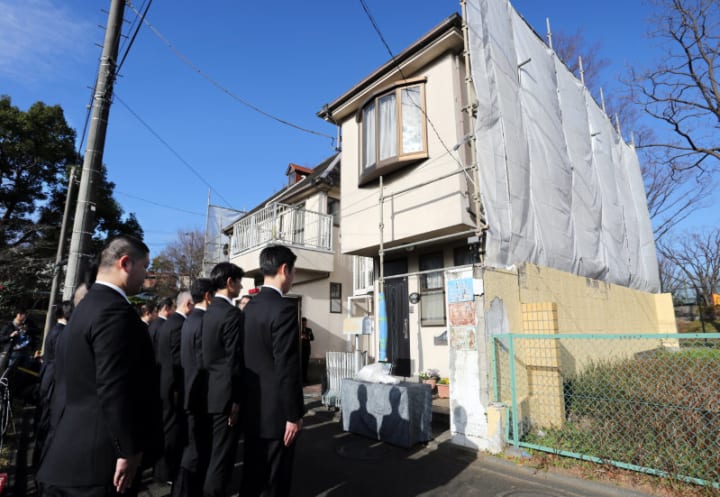
The first victim was Rei. The killer used his bare hands to strangle the young boy in his bed. It is believed that Mikio interrupted this assault and was subsequently stabbed in the head with a sashimi bōchō, a long, thin knife used in preparing sashimi. The killer then used a standard Santoku kitchen knife to stab Yasuko and Niina to death. Neither of these weapons was a weapon of opportunity. The killer had them in his possession before arriving at the house. Both of the knives were found to have been purchased in the Kanagawa prefecture.
Following the murders, the killer remained in the house for at least 2 hours, possibly even staying the night, putting his total time in the residence at ten hours. Investigators into the brutal slaying found a wealth of evidence. The killer left personal belongings behind. Ten items to be exact. These included a sweater and a hip bag. The sweater had been purchased in the Kanagawa prefecture, just like the knives, but what they found inside the hip bag was perplexing. Sand. And not just any sand, but sand from the area in and around Edwards Air Force Base in the Nevada desert.
There was also a wealth of DNA evidence gathered, including the killer’s fecal matter from one of the toilets in the house. This evidence held the promise of identifying the perpetrator. However, the DNA profiles did not yield any matches in the existing DNA database, meaning the killer either had no existing criminal record or operated outside the scope of the DNA databases used. The killer also left fingerprints and footprints. At approximately 1 am he used the family computer to access the internet, leaving full impressions on the keyboard. And at one point, he removed his shoes and walked across the house barefoot. These impressions also reached a dead end as they did not reflect any records in the criminal databases.

Very little is known about the man who killed the Miyazawa family except that he was indeed male as discovered in the DNA evidence, and that in the year 2000, he was between 15 and 35, given the strength and physicality required to restrain and murder his victims. The investigation into these murders was one of the largest in Japanese history, employing nearly 250,000 investigators and uncovering a little over 12,500 pieces of evidence. 20 million yen, or $140,000 USD, is still being offered for evidence pertaining to the case.
The Japanese tv station JOEX-DTV, also known as TV Asahi, aired a documentary in 2015 about the case in which a former FBI agent and a reporter from TV Asahi presented a profile of the killer, citing that he or she likely committed these murders out of spite or resentment of the Miyazawa family, casting a pall of suspicion over Yasuko Miyazawa’s sister An Irie, a children’s author. This nearly baseless profile was done for dramatic effect but done so without consideration of the consequences. Irie claims that since the program aired her life has been destroyed, and her livelihood jeopardized.
The enduring mystery of Miyazawa family murders has created many questions, some of which will likely never be answered. What was the motive? The killer ransacked the house, destroying the family’s possession, and while he took some money, he didn’t take all of it. The killer removed his clothes to clean up after the attack, but why did he leave them behind for the police to find? Rei was strangled when the killer could have quickly dispatched him with a knife without waking Mikio. Despite the chaotic nature of the crime scene, the killer lingered, surfed the internet, possibly even took a nap. What was the provenance of the mysterious sand? Certainly, the killer could have stolen the bag, or gotten it second-hand, and this was just particulate matter left over from its journey across the Pacific.
Whatever the answers might be, the murders in Setagaya are a clear reminder of the depravity of human nature and that monsters do not merely live in the shadows of our imagination.
About the Creator
Mack Devlin
Writer, educator, and follower of Christ. Passionate about social justice. Living with a disability has taught me that knowledge is strength.
We are curators of emotions, explorers of the human psyche, and custodians of the narrative.
Keep reading
More stories from Mack Devlin and writers in Criminal and other communities.
The Criminal Justice Process
In the United States, the criminal justice process occurs in several stages. Each of these stages contains a number of complex contingencies and procedures. Some of these procedures are so complicated that they are beyond the understanding of most laymen. Lawyers are interpreters of the law employed not only for criminal cases but also civil matters, such as lawsuits. There are two sides to every trial, the defense and the prosecution. To prove beyond a reasonable doubt that the accused is indeed guilty of the crime for which they are being tried is the job of the prosecution. Defense takes on the greater burden of refuting the evidence provided by the prosecution, usually through the cross-examination of prosecution witnesses and discrediting the prosecution’s evidence by way of expert counter-testimony.
By Mack Devlin5 years ago in Criminal
The Man Who Stole Silence
M Mehran The city of Karachi never truly sleeps. Even at 3 a.m., when the street vendors have packed their carts and the traffic thins into an occasional growl, there is a pulse beneath the silence. It’s the hum of secrets. And in that hum lived a criminal no one could catch. His name was Farhan Qureshi, though the newspapers would later call him The Whisper Thief. Farhan didn’t carry a gun. He didn’t break locks. He didn’t leave fingerprints. What he stole was far more valuable than gold—he stole silence. For two years, the wealthiest neighborhoods of Karachi reported strange incidents. No jewelry missing. No cash gone. Yet every victim insisted something had been taken. A private conversation. A hidden confession. A secret buried in the dark. The police were baffled. Inspector Danish Malik, a decorated officer known for dismantling organized crime rings, was assigned the case. At first, he dismissed it as paranoia. “People lose money and invent drama,” he told his team. But then he listened to the recordings. Each victim had received a single audio file. In it, their most private moment—an argument with a spouse, a confession of bribery, a hidden affair—played back in chilling clarity. Attached was a simple message: “Pay for your silence.” This wasn’t theft. It was psychological warfare. It was criminal extortion crafted with surgical precision. And Farhan was brilliant. A Criminal Mind Built on Observation Farhan had once studied sound engineering at a local university. He was gifted—top of his class. Professors predicted he would work in film or music production. But talent doesn’t always walk the straight path. After his father’s sudden death, debts swallowed his family. Scholarships vanished. Dreams collapsed. Bitterness replaced ambition. Farhan discovered something during his final semester: people reveal everything when they believe no one is listening. From rooftops, parked cars, and disguised maintenance visits, he planted tiny listening devices in homes of influential businessmen, politicians, and social elites. He never targeted the poor. He chose people with reputations to protect. He didn’t rush. He collected months of conversations before making a move. He built profiles. Studied behavior patterns. Understood their fears. Unlike typical criminals driven by impulse or greed, Farhan thrived on control. And control is addictive. The First Crack in the Perfect Crime Inspector Danish noticed something others ignored. None of the devices were ever found. “Not one?” he asked his forensic team. “Not one,” they confirmed. That meant the criminal wasn’t breaking in repeatedly. He was installing something permanent—or something invisible. Danish reviewed architectural plans of the targeted houses. He discovered a pattern: all the homes had recently installed high-end smart sound systems from the same supplier. The company? EchoWave Solutions. Danish paid them a visit. The office was small, modern, and surprisingly minimal. Only three employees were listed. One of them—Farhan Qureshi. Clean record. No prior arrests. Soft-spoken. Intelligent eyes. When Danish shook his hand, he felt it—the calm confidence of a man who believed he was untouchable. Psychological Cat and Mouse Danish didn’t arrest him immediately. There was no direct evidence. Instead, he started surveillance. Farhan, however, sensed it. Criminal psychology often reveals a dangerous truth: the smartest criminals are hyper-aware. Farhan noticed the unmarked car parked across his apartment. He noticed the unfamiliar number calling and hanging up. So he escalated. Instead of extorting quietly, he released a politician’s secret recording publicly. It exploded across social media. News channels debated ethics, privacy, and corruption. The city panicked. Was he a villain—or a vigilante exposing hypocrisy? That moral confusion protected him. Some citizens secretly admired him. “He only targets the corrupt,” online forums argued. But Danish knew better. A criminal who justifies his actions is still a criminal. The Mistake Every Criminal Makes Arrogance. Farhan believed he understood fear better than anyone. But he underestimated something—human unpredictability. One of his victims refused to pay. Instead, she invited him to release everything. Her name was Samina Rahman, a school principal with nothing to hide. Farhan sent the audio. It was harmless—her crying over financial struggles, her doubts about leadership. Instead of shame, she received sympathy. The public response shifted. If he could invade her privacy, he could invade anyone’s. Now fear replaced fascination. Danish used that moment. He publicly announced a digital trace had been found—bluffing. He described a fictional encryption flaw in the criminal’s system. Farhan panicked. Not outwardly—but digitally. He logged into his secure server from a backup connection he believed was untraceable. It wasn’t. Cybercrime units tracked the IP to a warehouse near the port. Inside, they found walls lined with monitors. Audio feeds labeled with names. Dates. Addresses. And Farhan. He didn’t run. He simply removed his headphones and said, “You’re late.” Inside the Criminal’s Mind During interrogation, Farhan remained composed. “Why?” Danish asked. Farhan’s answer was chilling. “Because silence is power. The wealthy use it to hide corruption. I just borrowed it.” “But you sold it,” Danish replied. Farhan smiled faintly. “Everyone sells something.” Psychologists later analyzed him as highly intelligent, emotionally detached, and morally rationalizing—traits common in non-violent white-collar criminals. Yet what made him truly dangerous wasn’t cruelty. It was patience. The Aftermath The case became one of Karachi’s most discussed criminal investigations. It reshaped conversations about digital privacy, surveillance, and smart home vulnerabilities. EchoWave Solutions shut down. New cybersecurity laws were proposed. And Farhan Qureshi was sentenced to twelve years in prison for extortion, illegal surveillance, and cybercrime. But even behind bars, rumors circulate. Some say he’s writing a book. Some say he’s helping authorities understand criminal behavior. Others whisper that he left hidden recordings no one has found. Because the scariest criminals don’t always steal money. They steal peace of mind.
By Muhammad Mehran3 days ago in Criminal



Comments
There are no comments for this story
Be the first to respond and start the conversation.