
10 Ways Family Courts Hide Misconduct
A Deep Dive into the Shadows of Justice


Introduction
While family courts claim to act in the best interests of children and families, a growing chorus of parents, whistleblowers, and legal advocates say otherwise. Beneath the surface of closed courtrooms and sealed records lies a troubling reality: misconduct is often ignored, minimized, or actively concealed. Judges, attorneys, and court-appointed professionals can operate with little to no accountability—leaving families, especially pro se parents, at the mercy of a system that often protects its own.
This investigation exposes ten ways family courts hide misconduct—from manipulating procedures to weaponizing confidentiality—and explores how these tactics compromise justice for countless families.
1. Sealing the Record Under the Guise of Privacy
Family courts frequently seal records to "protect children," but critics argue this shield often serves to protect the court itself. Sealing prevents public scrutiny, media coverage, and access by watchdog organizations. While privacy is essential in sensitive cases, blanket sealing policies prevent any meaningful oversight.
➡ Real-world effect: Judges who violate due process, attorneys who coerce confessions, and evaluators who ignore abuse can operate behind closed doors.
2. Labeling Misconduct as a “Parenting Dispute”
When misconduct by court actors or the custodial parent is raised, courts often reframe these allegations as “ongoing parental conflict.” This linguistic sleight-of-hand turns criminal or ethical violations—like perjury, evidence tampering, or child endangerment—into civil matters, conveniently outside the court’s purview.
➡ Translation: Even if one parent lies under oath or manipulates evidence, the court may call it “high-conflict co-parenting” and do nothing.
3. Appointing “Gatekeepers” with Conflicts of Interest
Family courts routinely appoint Guardians ad Litem (GALs), custody evaluators, and parenting coordinators—many of whom maintain financial relationships with judges, law firms, or therapeutic programs. These actors often enjoy immunity and are rarely subject to complaint review, especially when recommendations align with judicial preferences.
➡ What this means: A GAL with ties to one party’s attorney may recommend custody decisions that serve political, not child-centered, interests.
4. Weaponizing Contempt and Sanctions Against Whistleblowers
Parents who speak out about judicial misconduct or file complaints often find themselves punished. Courts can use contempt powers, gag orders, or sanctions to silence criticism. In extreme cases, parents are labeled “delusional,” “uncooperative,” or even “abusive” for raising legitimate concerns.
➡ Outcome: Speaking truth to power in family court can get you labeled unstable—and stripped of custody.
5. Using “Judicial Discretion” as a Legal Escape Hatch
Judicial discretion is intended to allow flexibility, but in family court, it often functions as an unchallengeable shield. When a judge makes a ruling unsupported by evidence or contrary to law, appeals are notoriously difficult. The standard is often whether the judge abused discretion—not whether they were right.
➡ Reality check: A judge can ignore evidence, exclude witnesses, or refuse a hearing—and appellate courts often uphold it.
6. Dismissing or Delaying Pro Se Litigant Motions
Self-represented parents frequently face insurmountable procedural hurdles. Motions filed by pro se litigants are often denied without explanation, or “deferred” indefinitely. Some courts schedule pro se motions only after months of delay—if at all—while granting fast-track hearings to represented parties.
➡ Effect: The longer it takes to get into court, the easier it is to claim a “status quo” that favors the abusive or obstructive party.
7. Favoring Court-Appointed Evaluations Over Evidence
Even when a parent presents strong documentary evidence—texts, videos, police reports—it is often disregarded in favor of a court-appointed evaluator’s subjective opinion. These evaluations are expensive, unregulated, and almost impossible to challenge in court.
➡ What this does: It allows courts to ignore facts in favor of a hired narrative, especially when it justifies predetermined outcomes.
8. Suppressing Evidence Through "Irrelevance" Rulings
Evidence of false allegations, perjury, or past abuse is often excluded with the stroke of a pen: “irrelevant.” Judges can deem entire lines of questioning inadmissible—not because they’re untrue, but because they don’t serve the court’s procedural agenda.
➡ Who benefits: The party making false allegations or withholding information—because the court refuses to consider it.
9. Turning a Blind Eye to Perjury and Fraud
Despite being a criminal offense, perjury is almost never prosecuted in family court—even when there is clear evidence. Courts rationalize this inaction by claiming their docket is too full or that such matters are “civil in nature.”
➡ Bottom line: Lying under oath is effectively legal in family court if you do it convincingly enough.
10. Blaming Mental Health or Disability to Discredit Dissent
Parents who advocate too strongly, file too many motions, or challenge court authority are often labeled as unstable. In many cases, neurodivergence or past trauma is twisted into a weapon—used to strip parents of credibility, and in extreme cases, parental rights.
➡ In practice: ADHD, PTSD, or anxiety can be misconstrued as dangerous, unfit, or uncooperative—especially in fathers.
Conclusion: A System Without Accountability Is a System Without Justice
Family courts were never designed for transparency. With closed doors, unchecked discretion, and built-in immunity, they function more like administrative tribunals than constitutional courts. The result is a system that protects itself, not the families it serves.
The solution? Demand real oversight, judicial transparency, and enforceable consequences for misconduct. Otherwise, the family court system will remain what many already believe it to be: a shadow government of unchecked power, trading children’s futures behind closed doors.
About the Creator
Michael Phillips
Michael Phillips | Rebuilder & Truth Teller
Writing raw, real stories about fatherhood, family court, trauma, disabilities, technology, sports, politics, and starting over.
Keep reading
More stories from Michael Phillips and writers in Criminal and other communities.
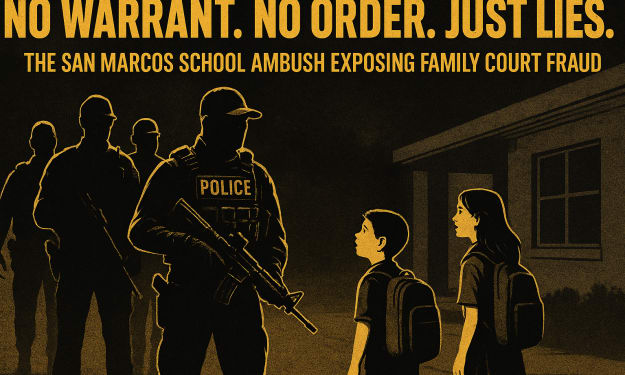
No Warrant. No Order. Just Lies. — The San Marcos School Ambush Exposing Family Court Fraud
This is the deeply disturbing and harrowing account of an incident that took place on May 1, 2025, in San Marcos, California — where heavily armed individuals allegedly posing as law enforcement — entered not one, but two public school campuses and attempted to abduct two siblings. They carried no lawful sui juris authority — no valid warrant, no court order, and no parental notification. Siblings, facing down armed strangers, without an attorney, and the school not on their side, had to act to protect their own rights.
By Michael Phillips8 months ago in Criminal
Minneapolis ICE Shooting Updates
In recent weeks, Minneapolis has found itself at the center of a growing legal and political controversy following a shooting involving Immigration and Customs Enforcement (ICE) agents. What initially appeared to be a straightforward federal use-of-force investigation has evolved into a broader dispute between state authorities and federal officials, raising serious questions about transparency, jurisdiction, and accountability. The most significant development so far is the state’s claim that it has been denied access to key evidence related to the incident. As public attention intensifies, the case is no longer just about what happened during the shooting. It is increasingly about who controls the facts, who gets to investigate them, and how justice is supposed to function when federal and state systems collide. What We Know About the Minneapolis ICE Shooting The shooting occurred during a federal immigration enforcement operation in Minneapolis. ICE agents were reportedly conducting official duties when gunfire erupted, resulting in injuries and immediate emergency response. Federal authorities confirmed the incident and stated that internal protocols were activated, including an automatic review by federal oversight bodies. From the beginning, details were limited. Officials cited the ongoing nature of the investigation and concerns about officer safety. This lack of information, while not unusual in federal cases, quickly became a point of friction for Minnesota state authorities, who argued that the public deserved clarity and that the state had a legal role to play in examining the incident. State Authorities Push for Transparency Minnesota state officials, including investigators and legal representatives, formally requested access to evidence connected to the shooting. This evidence reportedly includes body camera footage, surveillance recordings, forensic reports, and internal communication logs from the operation. According to state representatives, these requests were either delayed or denied outright. The state has since gone on record stating that it cannot independently assess the legality of the shooting without full access to the materials. This denial has fueled concerns that federal agencies are operating without sufficient external oversight, especially in incidents involving potential civilian harm. State leaders emphasized that their position is not adversarial by default. Rather, they argue that cooperation between federal and state agencies is essential to maintain public trust, particularly in communities already wary of immigration enforcement. Federal Response and Jurisdictional Limits Federal officials, for their part, maintain that the investigation falls squarely under federal jurisdiction. ICE operates as a federal agency, and shootings involving federal officers are typically reviewed internally and, when appropriate, by federal prosecutors or inspectors general. In statements released following the controversy, federal representatives cited legal restrictions that limit the sharing of evidence during an active investigation. They also stressed that premature disclosure could compromise witness testimony or investigative integrity. This explanation, while legally grounded, has done little to ease state frustrations. Critics argue that “ongoing investigation” has too often been used as a blanket justification for withholding information, even in cases where transparency could prevent misinformation and public unrest. Community Reaction and Public Trust The Minneapolis community has responded with a mix of concern, anger, and fatigue. For many residents, particularly in immigrant and marginalized communities, the shooting has reopened long-standing fears about aggressive enforcement tactics and lack of accountability. Community leaders and advocacy groups have called for the immediate release of non-sensitive evidence, arguing that transparency is a prerequisite for trust. Peaceful demonstrations and public forums have highlighted a broader demand: that no law enforcement agency, federal or otherwise, should be beyond scrutiny. Local officials echoed these concerns, noting that Minneapolis has spent years attempting to rebuild trust between residents and law enforcement. The perception that evidence is being withheld threatens to undermine that progress. Legal Implications of Denied Evidence From a legal standpoint, the state’s inability to access evidence raises complex questions. While federal agencies do have authority over their operations, states also have a responsibility to investigate deaths or injuries occurring within their borders. Legal experts suggest that this dispute could set a precedent. If states are routinely blocked from reviewing evidence in federal use-of-force cases, it may limit their ability to pursue independent inquiries or bring charges under state law when applicable. Some analysts believe the issue could ultimately be resolved in court, with judges determining whether the state has a legal right to access certain materials. Such a ruling could have national implications, influencing how future federal-state conflicts are handled. Political Dimensions of the Case The Minneapolis ICE shooting has also taken on a political dimension. Immigration enforcement remains a deeply divisive issue, and incidents like this tend to amplify existing ideological divides. State officials critical of federal immigration policies view the denial of evidence as symptomatic of a larger lack of accountability. Meanwhile, supporters of strict federal enforcement argue that state interference could hinder effective operations and put officers at risk. This political tension complicates the path forward. What might otherwise be a procedural disagreement risks becoming a symbolic battle over immigration, law enforcement authority, and states’ rights. What Happens Next? As of now, the investigation continues under federal oversight, while the state explores its legal options. Negotiations between state and federal officials have reportedly not been ruled out, suggesting that a compromise could still be reached. Potential next steps include limited evidence sharing under confidentiality agreements, congressional inquiries, or judicial review. Each option carries its own risks and consequences, both legally and politically. What remains clear is that public pressure is unlikely to fade. Minneapolis residents, like many Americans, are demanding clarity, fairness, and accountability in cases involving law enforcement use of force. A Broader Conversation About Accountability The Minneapolis ICE shooting is no longer just a single incident under investigation. It has become a lens through which broader issues are being examined: the balance of power between federal and state authorities, the limits of transparency, and the role of public oversight in a democratic society. Whether or not the state ultimately gains access to the evidence, the controversy has already sparked an important conversation. How that conversation translates into policy, practice, or reform remains to be seen, but its impact will likely extend far beyond Minneapolis. In the end, accountability is not only about assigning blame. It is about ensuring that systems function openly and fairly, especially when lives are affected. The outcome of this case may help determine how well those principles are upheld in the future.
By Saboor Brohi 6 days ago in Criminal



Comments
There are no comments for this story
Be the first to respond and start the conversation.