
When Speaking the Truth Meant Death
The historians, thinkers, and rebels silenced for challenging power
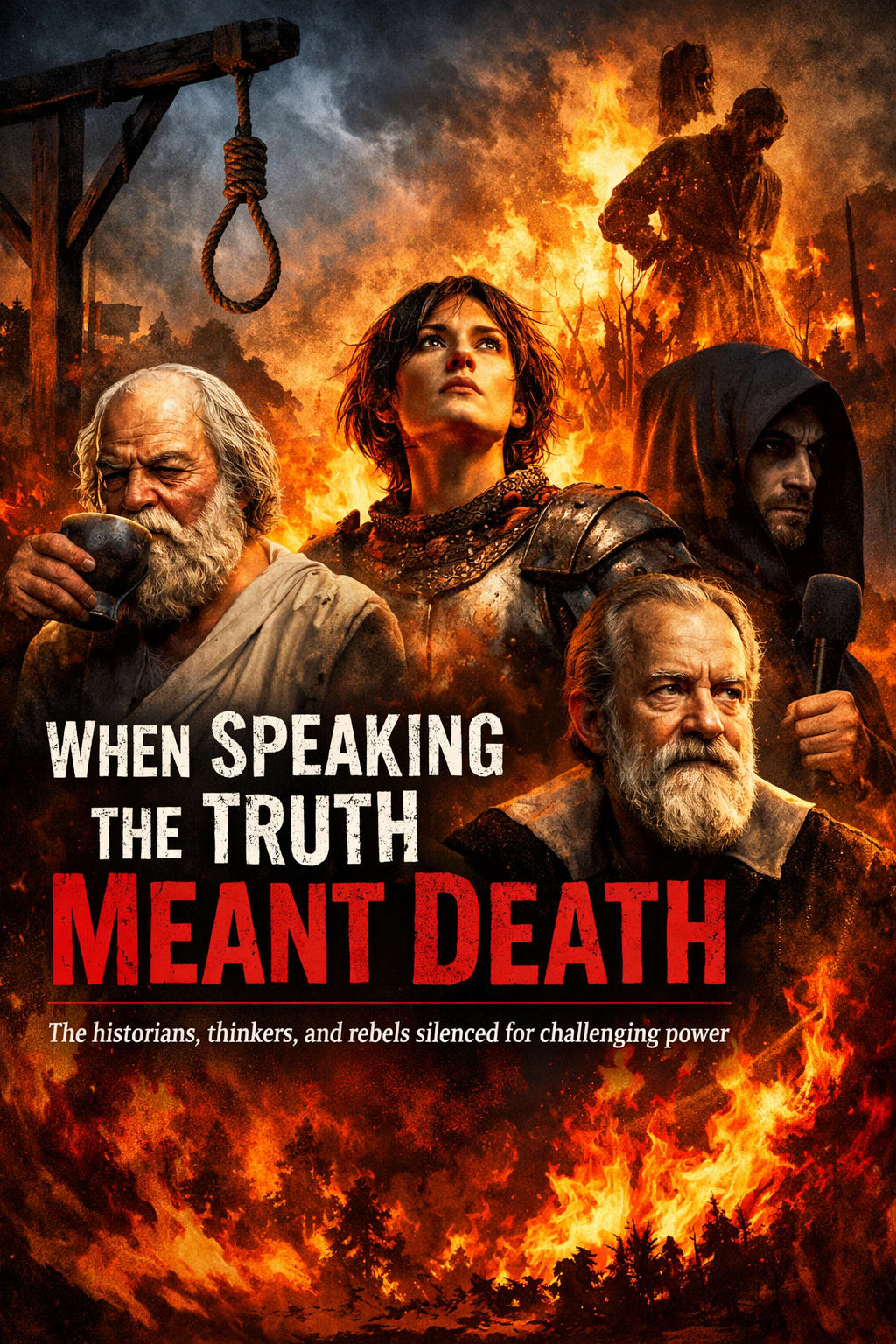
Throughout history, truth has rarely been neutral. It has threatened kings, embarrassed empires, exposed religious authority, and shaken political systems built on fear and illusion. For many who dared to speak it aloud, truth was not rewarded with recognition—but with exile, imprisonment, or death.
This is the story of those moments in history when speaking honestly was an act of rebellion, and silence was the price of survival.
Truth as a Threat
Power depends on control—of land, of people, and most importantly, of narratives. Those in authority have long understood that if people begin questioning why things are the way they are, power starts to weaken. As a result, truth-tellers have often been labeled heretics, traitors, or enemies of the state.
In ancient societies, rulers claimed divine authority. Questioning a king was equivalent to questioning God. In medieval Europe, the Church defined truth, and alternative ideas were considered dangerous lies. In modern authoritarian regimes, governments suppress journalists, scholars, and activists because facts themselves become revolutionary.
Across eras and cultures, one pattern repeats: when truth exposes injustice, it becomes dangerous.
Socrates: Executed for Asking Questions
In 399 BCE, Socrates stood trial in Athens, accused of corrupting the youth and disrespecting the gods. His real crime, however, was far simpler—and far more threatening. He asked questions.
Socrates challenged powerful Athenians by exposing their ignorance. He believed wisdom began with admitting what one does not know. This philosophy humiliated politicians and elites who relied on the illusion of authority.
Rather than flee into exile, Socrates accepted death by hemlock. His execution became one of history’s earliest examples of a society killing a man not for violence, but for thought. His death proved a grim lesson: even democracies can fear the truth.
Hypatia: Knowledge Silenced by Fanaticism
In 5th-century Alexandria, Hypatia was a philosopher, mathematician, and astronomer—an extraordinary figure in a world dominated by men. She taught openly, challenged superstition, and represented reason in a city torn by religious conflict.
Her independence and influence made her a target. In 415 CE, a Christian mob brutally murdered her, tearing her body apart and burning the remains.
Hypatia’s death symbolized more than religious violence. It marked the destruction of intellectual freedom and the silencing of scientific inquiry. Her murder sent a chilling message: knowledge that challenges belief systems will be destroyed.
Galileo Galilei: Forced to Deny the Truth
By the 17th century, science had begun to challenge centuries of religious doctrine. Galileo Galilei supported the Copernican theory that the Earth revolved around the Sun—an idea that contradicted Church teachings.
For this, he was tried by the Roman Inquisition. Under threat of torture and death, Galileo publicly recanted his findings. He spent the rest of his life under house arrest.
Though he escaped execution, Galileo’s punishment demonstrated the power of enforced silence. The truth survived—but only because it was whispered, hidden, and passed quietly through generations of thinkers.
Joan of Arc: Burned for Speaking Divine Truth
Joan of Arc was a teenage peasant girl who claimed divine visions instructing her to lead France against English occupation during the Hundred Years’ War. Against all odds, she succeeded, turning the tide of war.
Her influence terrified political and religious leaders. Captured by the English, Joan was put on trial for heresy. The court dismissed her testimony, mocked her faith, and condemned her to death.
In 1431, she was burned alive at the stake. Years later, the Church reversed its judgment and declared her a saint. But that recognition came too late. Truth often finds validation only after its speaker is gone.
Giordano Bruno: Burned for an Infinite Universe
Giordano Bruno believed the universe was infinite and that Earth was not unique—a radical idea in the 16th century. His beliefs challenged not only Church doctrine but humanity’s perceived central place in creation.
Bruno refused to recant. After years of imprisonment, he was burned alive in Rome in 1600.
His death was not about astronomy alone. It was about the refusal to submit intellectually. Bruno’s execution revealed how deeply institutions fear ideas they cannot control.
Truth in the Age of Empires
As empires expanded, truth became even more dangerous. Colonial powers relied on myths of superiority to justify conquest, slavery, and exploitation. Those who challenged these narratives were silenced.
In British-ruled India, journalists and freedom fighters were imprisoned or executed for exposing colonial brutality. In Africa, indigenous leaders who spoke against European domination were assassinated or erased from history books.
Truth threatened the moral legitimacy of empire. And empires responded with violence.
Journalists Who Paid with Their Lives
In the modern world, the executioner is often quieter—but no less deadly.
Journalists exposing corruption, war crimes, and human rights abuses are frequently targeted. From Latin America to the Middle East, reporters have been kidnapped, murdered, or “disappeared” for refusing to stay silent.
Anna Politkovskaya, who exposed human rights violations in Chechnya, was assassinated in 2006. Jamal Khashoggi, a critic of Saudi leadership, was murdered inside a consulate in 2018. Their deaths remind us that truth remains dangerous—even in the 21st century.
Whistleblowers and the Cost of Honesty
Truth-tellers are not always killed—but they are often punished. Whistleblowers who expose government surveillance, corporate crimes, or military abuses face exile, imprisonment, and lifelong persecution.
Edward Snowden revealed mass surveillance programs and was forced into permanent exile. Chelsea Manning was imprisoned for leaking evidence of war crimes. Their experiences show that even democratic societies struggle to tolerate uncomfortable truths.
The method has changed, but the message remains: speak carefully—or pay the price.
Why Truth Is Always Feared
Truth destabilizes power structures. It forces societies to confront injustice, hypocrisy, and cruelty. It demands accountability from those who benefit from silence.
Lies are easy to manage. Truth is not.
Those who speak it often do so knowing the risk. They understand that silence might keep them alive—but truth might save others.
The Legacy of the Silenced
Ironically, many who were killed for speaking the truth are remembered far more powerfully than those who silenced them. Socrates is studied worldwide. Galileo is celebrated as a scientific hero. Joan of Arc is immortalized in art and history.
Their persecutors are often footnotes.
This suggests a quiet but profound reality: truth may be suppressed, but it is rarely destroyed.
Conclusion: The Price—and Power—of Speaking
“When speaking the truth meant death” is not just a historical phrase—it is a recurring warning. Across centuries, truth-tellers have faced fire, blades, prisons, and exile. Yet they spoke anyway.
Their courage reminds us that freedom of speech was not freely given. It was earned through sacrifice. Every right to question authority, publish facts, or challenge injustice exists because someone before us paid a terrible price for honesty.
History teaches us that silence may protect the individual—but truth, spoken bravely, has the power to change the world.
And sometimes, that power is worth everything.
About the Creator
Keep reading
More stories from Aiman Shahid and writers in Confessions and other communities.
When Science Dared to Disagree
For much of human history, disagreement was dangerous. To question accepted truths was not just to risk embarrassment—it was to risk exile, imprisonment, or death. Knowledge was guarded by tradition, authority, religion, and power. Yet progress has never belonged to the obedient. It has belonged to those who dared to ask, “What if we’re wrong?”
By Aiman Shahid2 months ago in Confessions
Icons: Between Belief and Doubt-Part 8
If someone sees Christ as the only point of contact, then any other form of mediation feels unnecessary or even wrong. If someone sees the Church as a single living body that includes both the living and the departed, then asking for intercession feels natural.
By CA'DE LUCE3 days ago in Confessions




Comments
There are no comments for this story
Be the first to respond and start the conversation.