
When Science Dared to Disagree
The moments curiosity challenged belief—and changed the world.
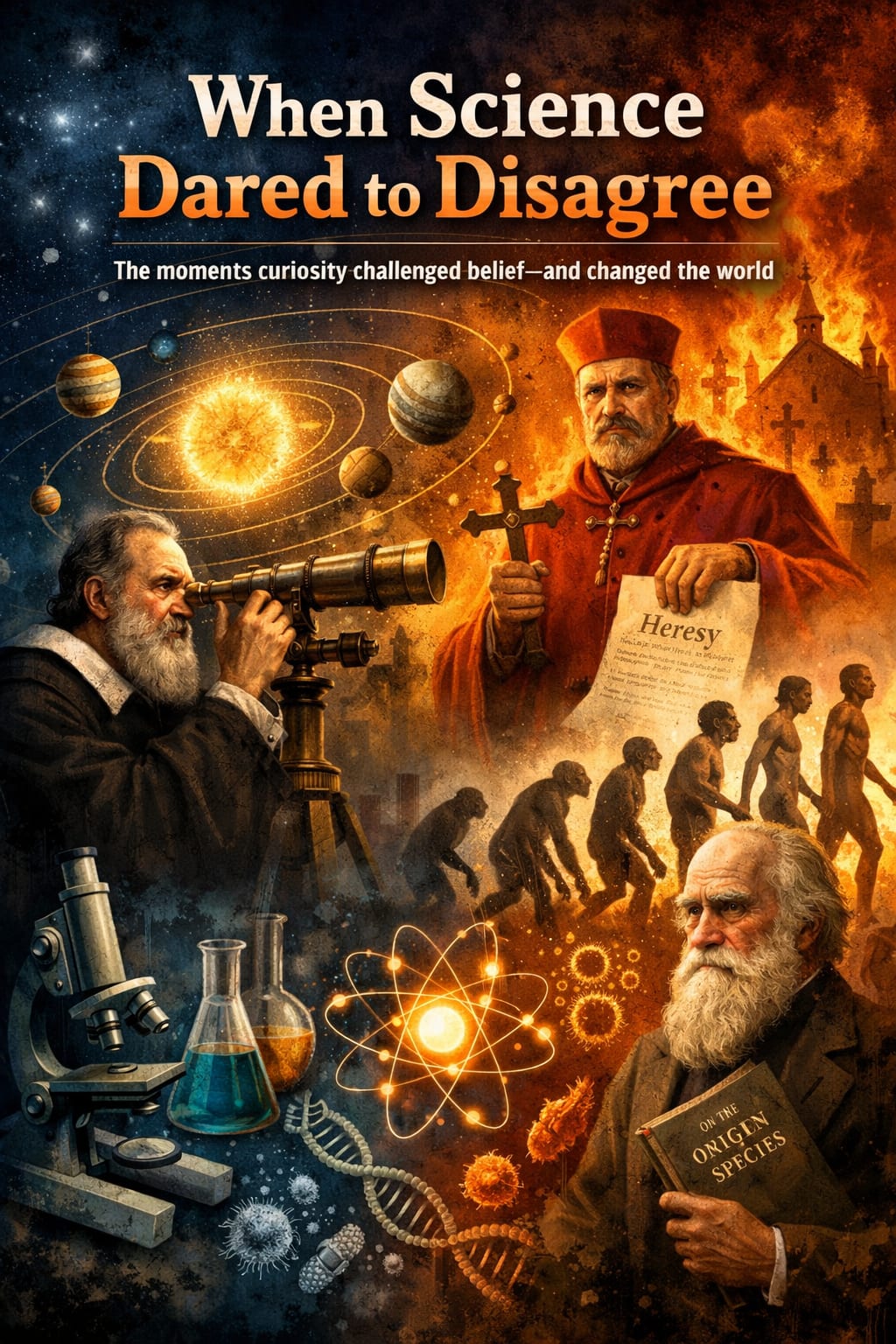
For much of human history, disagreement was dangerous. To question accepted truths was not just to risk embarrassment—it was to risk exile, imprisonment, or death. Knowledge was guarded by tradition, authority, religion, and power. Yet progress has never belonged to the obedient. It has belonged to those who dared to ask, “What if we’re wrong?”
This is the story of when science dared to disagree—and in doing so, reshaped how humanity understands the world.
The Comfort of Certainty—and Its Cost
Certainty feels safe. It gives societies stability and shared meaning. When everyone agrees on how the world works, life seems predictable. Ancient civilizations built entire systems—social, political, and spiritual—around fixed explanations of nature. The Earth stood still at the center of the universe. Illness came from curses or divine punishment. Heavy objects fell faster than light ones because it “made sense.”
But certainty has a hidden cost. When beliefs harden into dogma, questions become threats. Curiosity becomes rebellion. And science, by its very nature, is rebellious. It does not accept truth because it is ancient, popular, or comforting. It demands evidence. It invites doubt. And that invitation has often been met with fear.
Looking Up—and Being Told Not To
Perhaps no disagreement was more explosive than science’s challenge to humanity’s place in the universe. For centuries, the geocentric model ruled: Earth was the unmoving center of everything. This belief was not merely scientific—it was philosophical and religious. To move Earth from the center was to move humanity from its privileged position in creation.
When Nicolaus Copernicus proposed that the Earth orbited the Sun, he did so cautiously, almost apologetically. His work circulated quietly, more mathematical curiosity than open challenge. But the idea was radical. It whispered a dangerous thought: What if we are not the center?
Galileo Galilei dared to say it out loud. Using his telescope, he observed moons orbiting Jupiter—clear evidence that not everything revolved around Earth. He saw phases of Venus that only made sense if it orbited the Sun. The universe, he insisted, did not match the accepted story.
The response was swift and brutal. Galileo was tried, condemned, and forced to publicly recant. Science had disagreed—and power struck back. Yet even silenced, the evidence remained. The universe did not rearrange itself to preserve human pride.
Medicine Against Myth
Disagreement in science has also unfolded inside the human body. For centuries, medicine relied on the theory of the four humors—blood, phlegm, black bile, and yellow bile. Disease was thought to arise from imbalance. Treatments like bloodletting persisted for generations, not because they worked, but because they were familiar.
Then came physicians who noticed inconvenient truths. Patients were not improving. Some were dying faster. Ignaz Semmelweis, a Hungarian doctor in the 19th century, observed that women giving birth in hospitals died at far higher rates than those assisted by midwives. His conclusion was shocking: doctors themselves were spreading deadly infections because they did not wash their hands after performing autopsies.
The idea was offensive. It implied that respected professionals were responsible for death. Semmelweis was mocked, dismissed, and eventually institutionalized. He died before germ theory was widely accepted. But his disagreement saved millions of lives. Today, handwashing is one of the most basic medical practices—proof that science’s quiet defiance can echo for centuries.
When Evolution Challenged Identity
Few scientific disagreements struck as deeply as Charles Darwin’s theory of evolution by natural selection. It did not merely challenge biology—it challenged identity. If humans evolved from earlier life forms, what did that mean for ideas of divine creation, purpose, and uniqueness?
Darwin himself hesitated for years before publishing On the Origin of Species. He knew the storm it would unleash. And unleash it did. Critics accused him of degrading humanity, of turning people into animals, of destroying morality.
Yet evolution did not erase wonder—it expanded it. It revealed a story billions of years old, written in DNA, shaped by adaptation and survival. Science dared to disagree with a literal reading of creation—and offered instead a narrative of deep time, shared ancestry, and constant change.
Even today, this disagreement remains emotionally charged. It reminds us that scientific truth does not ask permission to be comfortable.
The Resistance to the Invisible
Some of science’s most difficult disagreements involved things no one could see. Germs, atoms, radiation—entities invisible to the naked eye. When Louis Pasteur proposed that microorganisms caused disease, many dismissed the idea as absurd. How could unseen creatures overpower the human body?
Similarly, the concept of atoms—once a philosophical guess—was ridiculed for centuries. The idea that matter was made of tiny, indivisible units seemed unnecessary when solid objects felt continuous and whole.
But invisibility did not mean inexistence. As microscopes improved and experiments accumulated, the unseen became undeniable. Science had disagreed with common sense—and common sense had to yield.
Power, Politics, and Punishment
Scientific disagreement does not happen in a vacuum. It collides with power. Governments, institutions, and industries often resist findings that threaten control or profit. From climate science to public health, evidence has repeatedly clashed with political convenience.
History shows a pattern:
First, the data is ignored.
Then it is attacked.
Then the scientists are discredited.
Finally, when reality becomes undeniable, the disagreement is quietly absorbed.
Science does not win arguments by shouting. It wins by being correct long enough that denial collapses under its own weight.
Why Disagreement Is the Engine of Progress
At its core, science is not a collection of facts—it is a method of disagreement. Peer review exists so scientists can challenge one another. Experiments are designed to fail hypotheses, not confirm comfort. Every major advance began as a question that irritated the status quo.
Disagreement sharpens understanding. It exposes error. It prevents stagnation. A science that never disagrees is not science—it is doctrine.
And yet, disagreement requires courage. It demands patience in the face of ridicule, resilience in isolation, and humility to accept being wrong when evidence demands it. The scientists we now celebrate were often lonely, doubted, and dismissed in their own time.
The Ongoing Dare
The story of science daring to disagree is not finished. It continues in debates about artificial intelligence, climate change, genetic engineering, and the origins of consciousness. Each generation inherits not only knowledge, but the responsibility to question it.
The greatest danger is not that science will disagree—but that society will stop listening.
Progress depends on protecting the space where uncomfortable questions can be asked. Where evidence matters more than authority. Where curiosity is valued over certainty.
Conclusion: The Quiet Bravery of Truth
When science dares to disagree, it does so without anger or ideology. It simply points to reality and says, “Look again.” That quiet insistence has moved planets, saved lives, redefined humanity, and expanded the boundaries of the known universe.
Disagreement is not disrespect. It is devotion—to truth, to understanding, and to a future shaped by knowledge rather than fear.
Every time science challenges what we think we know, it offers us a choice: cling to certainty, or grow.
History shows which choice moves the world forward.
About the Creator
Keep reading
More stories from Aiman Shahid and writers in Confessions and other communities.
The Day Science Questioned Everything
There are moments in history when progress doesn’t arrive gently. It doesn’t knock. It crashes through the door, flips the table, and forces everyone in the room to reconsider what they thought was settled truth. Science, for all its reputation as calm and methodical, has had many such moments. But one stands above the rest—the day science questioned everything.
By Aiman Shahid2 months ago in Confessions
The Royal News That Made Me Pause: Why This Upcoming Visit Feels Different
There are moments when a piece of celebrity news makes you stop and think a little deeper than usual. For me, that moment happened recently when I heard that Prince Harry and Meghan Markle might soon visit Australia again.
By CelebCast Centrala day ago in Confessions


Comments
There are no comments for this story
Be the first to respond and start the conversation.