
The Day Science Questioned Everything
How a single experiment changed what we thought we knew

There are moments in history when progress doesn’t arrive gently. It doesn’t knock. It crashes through the door, flips the table, and forces everyone in the room to reconsider what they thought was settled truth. Science, for all its reputation as calm and methodical, has had many such moments. But one stands above the rest—the day science questioned everything.
It wasn’t a single calendar date. It wasn’t one lab, one country, or one scientist. It was a turning point in human thought, when centuries of certainty began to crumble under the weight of evidence. A moment when humanity realized that knowledge was not fixed, authority could be wrong, and reality itself might be far stranger than we imagined.
Before that day, the world felt orderly. Predictable. Comfortably understood.
And then, science asked a question no one wanted to answer.
When Certainty Was the Default
For most of human history, knowledge flowed downward from authority. Kings ruled by divine right. Religious texts explained the universe. Philosophers reasoned from first principles, not experiments. If something had been believed long enough, it became truth by tradition alone.
The Earth stood still at the center of the cosmos. Time flowed evenly. Space was absolute. Heavier objects fell faster than lighter ones. Disease came from bad air or divine punishment. These ideas weren’t merely theories—they were foundations. To question them was to question the structure of society itself.
Science, as we understand it today, didn’t exist yet. There were thinkers, observers, and natural philosophers, but not a system built on doubt. Curiosity existed, but skepticism was dangerous.
Then came a quiet rebellion: observation.
The Dangerous Power of Asking “Why?”
The first crack in certainty didn’t come from arrogance. It came from humility—the willingness to admit, “I might be wrong.”
When early scientists began measuring instead of assuming, testing instead of trusting, everything changed. Galileo didn’t just look at the sky; he wrote down what he saw. Copernicus didn’t challenge Earth’s place in the universe for attention; he did it because the math worked better.
These were not small adjustments. They were existential threats to established power. If Earth wasn’t the center of the universe, what did that say about humanity’s importance? If ancient authorities were mistaken, who else might be wrong?
Science wasn’t just questioning nature. It was questioning us.
The Day the Universe Lost Its Center
Perhaps the most symbolic moment when science questioned everything was the shift from a geocentric universe to a heliocentric one. For centuries, humanity believed the universe revolved around Earth. It made sense. We felt still. The sky moved. Surely, we were the center.
But observations told a different story.
Planets didn’t move as expected. Stars didn’t behave as predicted. Mathematical “fixes” piled on top of a flawed assumption. Finally, science did something radical—it let go of pride and followed evidence instead.
The Earth moved.
That realization did more than rearrange planets. It humbled humanity. We were no longer the center of creation. We were participants in something far larger, governed by laws that didn’t care about our beliefs.
Science didn’t just change astronomy that day. It changed philosophy, theology, and the human ego.
When Time and Space Stopped Being Solid
Centuries later, science questioned reality again—this time at its core.
Isaac Newton gave the world a universe that behaved like a machine. Predictable. Measurable. Comforting. Time ticked forward evenly. Space was a fixed stage where matter performed.
Then Albert Einstein arrived and calmly dismantled it all.
Time slowed. Space bent. Gravity wasn’t a force but a distortion. Two people could experience reality differently—and both could be correct.
This wasn’t just complicated math. It was a direct challenge to human intuition. Common sense failed. Reality refused to behave the way we expected.
Science didn’t just ask “How does the universe work?”
It asked, “What is reality made of?”
And the answers were unsettling.
The Microscopic Revolution
While physics questioned the vastness of the cosmos, biology questioned life itself.
The discovery of cells, evolution by natural selection, and later DNA, dismantled the idea that life was static or specially designed in fixed forms. Life changed. Adapted. Mutated. Failed. Survived.
Darwin’s theory didn’t just challenge biology—it challenged purpose. Humanity wasn’t crafted separately from nature; we emerged from it. Slowly. Accidentally. Beautifully.
For many, this felt like loss. For others, it was liberation. Meaning didn’t disappear—it became something we create.
Science questioned not just where we came from, but what it means to be human.
The Resistance Was Inevitable
Every time science questioned everything, the response followed a familiar pattern: denial, ridicule, fear, and eventually acceptance.
New ideas were dismissed as heresy or nonsense. Scientists were mocked, silenced, imprisoned, or worse. But evidence has a stubborn quality. It doesn’t fade because it’s inconvenient.
What history teaches us is not that science is always right—but that it corrects itself. It invites challenge. It evolves. That willingness to be wrong is its greatest strength.
Truth doesn’t arrive fully formed. It’s built, dismantled, and rebuilt—again and again.
The Day Isn’t Over
Here’s the uncomfortable truth: The day science questioned everything is still happening.
Dark matter and dark energy make up most of the universe, yet we barely understand them. Consciousness remains unexplained. We don’t fully know what time is, why the universe exists, or whether reality is fundamentally deterministic or random.
Even the most successful theories are incomplete.
Science hasn’t reached certainty—it has embraced uncertainty.
And that may be the most radical shift of all.
Why This Moment Matters Now
In an age flooded with information, misinformation, and manufactured certainty, science’s greatest lesson feels urgent: question everything—but responsibly.
Question claims, not evidence. Question authority, not expertise. Question conclusions, but respect the process.
Science doesn’t promise comfort. It promises honesty.
And honesty, while unsettling, is the foundation of progress.
The Courage to Not Know
The day science questioned everything wasn’t about destruction. It was about courage—the courage to admit ignorance, to face uncomfortable truths, and to rebuild understanding from the ground up.
It taught humanity that knowledge isn’t inherited; it’s earned. That certainty is temporary. That reality doesn’t owe us simplicity.
Most importantly, it taught us that asking the right question can be more powerful than having the right answer.
And perhaps that is science’s greatest gift—not answers, but permission to wonder.
About the Creator
Keep reading
More stories from Aiman Shahid and writers in Confessions and other communities.
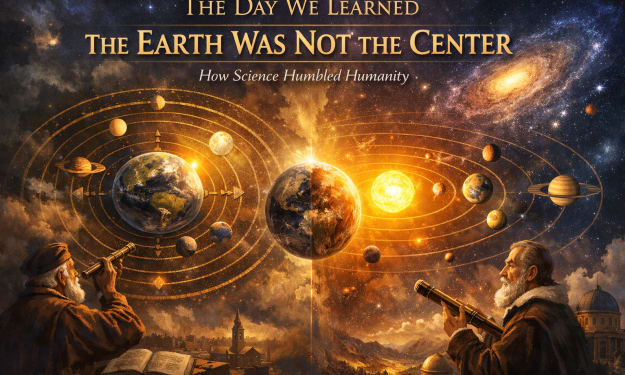
The Day We Learned the Earth Was Not the Center
For thousands of years, humans believed they stood at the center of everything. The sky revolved around us. The stars existed for us. The universe, vast and mysterious, was thought to circle the Earth like a grand stage designed for human life. This belief wasn’t just scientific—it was emotional, spiritual, and deeply personal. To say Earth was the center meant we mattered most. Then one day, science quietly but firmly changed that story forever.
By Aiman Shahid2 months ago in Confessions
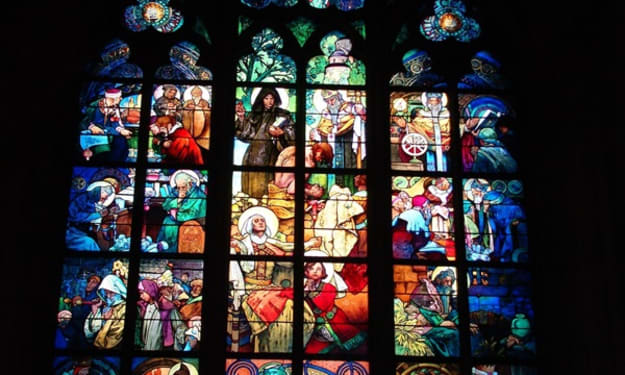
Icons: Between Belief and Doubt
The origin and theological justification is based on the idea that God became incarnate in Christ, therefore He can be represented visually. Saint Paul says in Colossians 1:15 that Christ is ‘the image of the invisible God.’ In the Old Testament, God Himself commands the making of sacred images, such as the cherubim on the Ark of the Covenant (Exodus 25:18).
By CA'DE LUCE3 days ago in Confessions


Comments
There are no comments for this story
Be the first to respond and start the conversation.