
Voices That Changed the World
Ordinary People Who Refused to Stay Silent
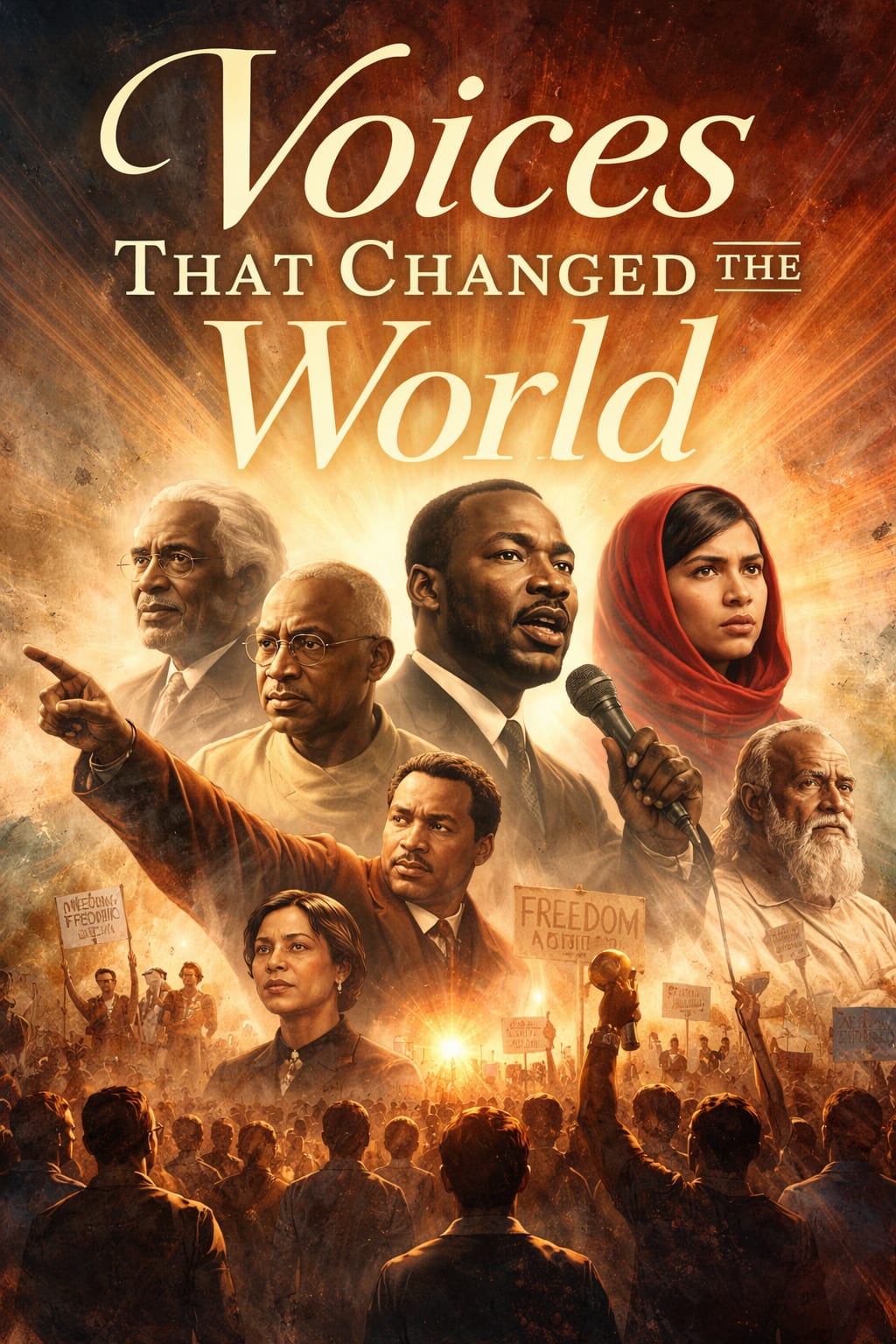
History often remembers dates, wars, and rulers—but it is voices that truly move the world forward. Long before armies marched or laws were written, someone spoke. Sometimes it was a whisper shared in secret, sometimes a speech that echoed across generations. These voices didn’t always belong to the powerful. In fact, many came from ordinary people who simply refused to stay silent.
Words have an unusual kind of power. They cannot be touched, yet they can dismantle empires. They do not bleed, yet they have started revolutions. This is the story of voices—spoken, written, and remembered—that changed the direction of humanity.
The First Power Humanity Ever Had
Before technology, before borders, before written law, humans had speech. Early societies passed knowledge, values, and survival strategies through stories. A voice could warn of danger, unite a tribe, or preserve identity.
As civilizations grew, so did the importance of controlling voices. Kings ruled not only through force, but through proclamations. Religions spread through sermons. Empires expanded through language as much as through swords.
Because rulers understood one truth: whoever controls the narrative controls the people.
That is why voices that challenged authority were often feared, punished, or erased.
Socrates: The Man Killed for Asking Questions
In ancient Athens, Socrates didn’t lead armies or write books. He asked questions—dangerous ones. He encouraged people to think critically, to challenge tradition, and to question power.
To the state, this was a threat.
Accused of corrupting the youth and disrespecting the gods, Socrates was sentenced to death. His crime was not violence—it was thought. His execution sent a clear message: some voices are too powerful to allow.
Yet killing Socrates failed to silence him. His ideas lived on through his students, shaping philosophy, education, and democracy itself.
Sometimes, a voice becomes louder after it is silenced.
Religious Voices That Redefined Civilizations
Throughout history, religious voices have transformed societies. Prophets, reformers, and spiritual leaders spoke words that reshaped moral systems and collective identities.
Jesus of Nazareth preached compassion, justice, and humility—ideas that challenged both religious elites and imperial authority. He was executed as a political threat, yet his teachings spread across continents, influencing laws, ethics, and culture for centuries.
Similarly, the Prophet Muhammad’s revelations united fragmented tribes and laid the foundation for a civilization built on faith, law, and learning. His words—preserved and recited—continue to guide millions.
These voices were not just spiritual. They were social and political, redefining how people lived together.
When One Speech Ignites a Revolution
Sometimes history turns on a single moment—one speech delivered at the right time.
In 1775, Patrick Henry stood before the Virginia Convention and declared, “Give me liberty, or give me death.” His words fueled the American Revolution, turning fear into resolve.
In 1789, revolutionary ideas in France spread through pamphlets and speeches. Ordinary citizens began to speak openly against monarchy, forever changing Europe’s political landscape.
Revolutions rarely begin with violence. They begin with words that awaken people to the possibility of change.
The Written Voice: When Paper Became a Weapon
Not all voices are spoken aloud. Some are written—and their impact can be even greater.
Karl Marx’s The Communist Manifesto was not a call to immediate action, yet its ideas reshaped global politics. Entire governments were formed, challenged, and dismantled because of words written on paper.
Thomas Paine’s Common Sense used simple language to argue for independence, reaching people who had never read political theory before. His writing turned abstract ideas into a shared conviction.
The written voice has the power to cross borders, outlive its author, and influence people who were never meant to hear it.
Voices That Fought Slavery and Injustice
Some of the most transformative voices in history rose against injustice.
Frederick Douglass, once enslaved, used his voice to expose the brutality of slavery. His speeches and writings forced people to confront a reality many wanted to ignore. He didn’t just argue for freedom—he proved the humanity of those denied it.
Similarly, abolitionists across the world used sermons, essays, and public debates to challenge systems that had existed for centuries.
Their voices didn’t just free individuals; they reshaped moral standards.
Gandhi: The Quiet Voice That Shook an Empire
Mahatma Gandhi proved that a voice does not need to be loud to be powerful. He spoke of nonviolence, truth, and moral resistance—concepts that seemed weak against an empire.
Yet his words mobilized millions. Through speeches, letters, and symbolic acts, Gandhi challenged British rule in India without weapons.
His voice demonstrated a radical idea: moral authority can be stronger than military power.
Martin Luther King Jr.: A Dream Spoken Aloud
Few speeches have shaped modern history like Martin Luther King Jr.’s “I Have a Dream.”
In a time of racial violence and deep division, King’s voice offered hope without denying pain. He used language rooted in justice, faith, and shared humanity.
His words didn’t end racism—but they changed the conversation. They gave a movement clarity and purpose. They reminded the world that equality was not a demand—it was a promise.
Sometimes, a voice doesn’t end injustice immediately. It makes injustice impossible to ignore.
Women’s Voices Breaking Centuries of Silence
For much of history, women were denied platforms, education, and political rights. Yet their voices persisted.
From Mary Wollstonecraft’s early feminist writings to Emmeline Pankhurst’s fiery speeches for women’s suffrage, women challenged systems designed to silence them.
In more recent times, voices like Malala Yousafzai’s remind the world that even a young girl’s words can confront extremism and violence.
Every time a woman speaks where she was once forbidden to speak, history shifts.
The Digital Age: Voices Without Borders
Today, voices travel faster than ever. Social media allows individuals to reach millions without permission from gatekeepers.
This has empowered movements, exposed injustice, and challenged authority—but it has also raised new questions about truth, responsibility, and noise versus meaning.
Yet the pattern remains the same: change begins when someone speaks and others listen.
Why Voices Still Matter
History shows us one undeniable truth: the world changes when people refuse to be silent.
Not every voice becomes famous. Not every speaker is remembered. But each time someone speaks truth in the face of fear, they add to a long tradition of courage.
You don’t need a stage to change the world. You need conviction.
Because history isn’t only written by the powerful—it is shaped by those brave enough to use their voice.
About the Creator
Keep reading
More stories from Aiman Shahid and writers in Confessions and other communities.
When Speaking Up Was Dangerous
For much of human history, silence was not a choice—it was a survival strategy. Speaking up could cost a person their freedom, their livelihood, or their life. Yet again and again, individuals chose to speak anyway. They challenged kings, churches, empires, dictators, and deeply rooted social norms. Their voices were often punished in their own time, but their words reshaped the future.
By Aiman Shahid2 months ago in Confessions



Comments
There are no comments for this story
Be the first to respond and start the conversation.