
Trump’s African Summit: A Modern Display of Colonial Power
How Trump’s African Summit Exposed the Colonial Mindset Still Shaping Global Diplomacy
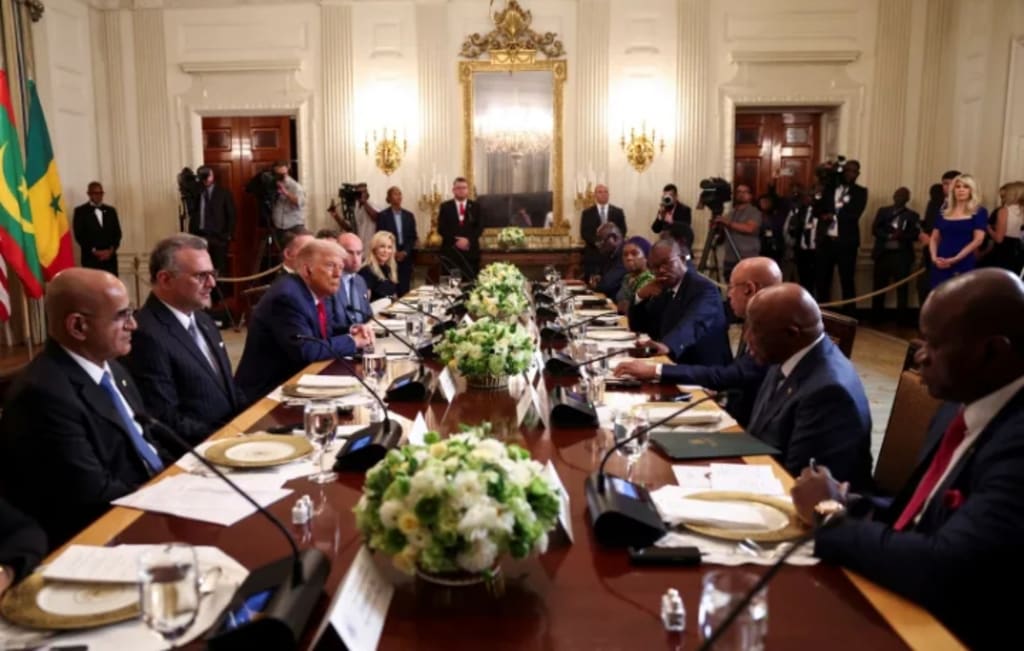
Trump’s African Summit: A Modern Display of Colonial Power
On July 9, 2025, the White House became the stage for a troubling diplomatic theatre, as United States President Donald Trump hosted a mini-summit with the leaders of Gabon, Guinea-Bissau, Liberia, Mauritania, and Senegal. What was billed as a friendly summit about economic cooperation quickly revealed itself as a spectacle of domination and submission, raising critical questions about modern-day power dynamics between Africa and the West.
Diplomacy Disguised as Control
Trump opened the summit with a brief speech, claiming the five visiting presidents were “representing the entire African continent.” This gross oversimplification ignored both the vast cultural, economic, and political diversity of Africa and the reality that these five nations play a relatively minor role in U.S.-Africa trade. Trump’s primary focus was not on partnership but on Africa’s riches: gold, oil, and rare minerals. His praise for these nations centered not on their people, culture, or innovation, but on the wealth buried beneath their soil.
The meeting’s timing only sharpened the contradictions in Trump’s message. On the same day, his administration escalated its global trade war, imposing new tariffs on eight countries, including African nations Libya and Algeria. The contradiction was glaring: while the U.S. president spoke of “strengthening ties with Africa,” he was simultaneously penalizing African economies elsewhere. Critics argue that this is the true face of Trump’s Africa policy—where “partnership” means compliance and where rewards are conditional upon submission.
A Scripted Performance of Deference
The summit quickly turned into a carefully choreographed performance. Trump, playing the role of master of ceremonies, invited—though effectively instructed—his guests to speak to the media. Each African leader played their part, offering Trump glowing praise in a manner that seemed rehearsed and reluctant.
Mauritania’s President Mohamed Ould Ghazouani, who had served as the African Union (AU) Chair in 2024, led this display of flattery. In a particularly surreal moment, he declared Trump a global peacemaker, bizarrely crediting him with stopping a war between Iran and Israel. This narrative ignored the U.S.'s ongoing military support for Israel’s devastating assault on Gaza—an act that the African Union itself had condemned. Ghazouani’s silence on Palestine, in exchange for possible economic favor, was a painful reminder of the compromises leaders sometimes make on the global stage.
Senegal’s President Bassirou Diomaye Faye, once a symbol of anti-imperialist politics and youthful reform, was particularly disappointing. Having campaigned on breaking away from neocolonial structures, Faye instead requested that Trump build a golf course in Senegal—an ask that symbolized not independence, but submission to foreign leisure interests. Trump’s response was to compliment Faye on his youthful appearance, brushing aside the request like a schoolteacher humoring a child.
Gabon’s President Brice Oligui Nguema tried to discuss “win-win partnerships,” only to be met with lukewarm interest. Liberia’s President Joseph Boakai impressed Trump, but not for his policy ideas. Instead, Trump marveled at his English fluency, asking in astonishment, “Where did you learn to speak so beautifully? Where? In Liberia?” The question betrayed not only ignorance of Liberia’s founding by freed American slaves in 1822 but also a racist surprise that an African leader could be articulate in English.
Colonial Attitudes in the Modern Era
Trump’s remarks and attitudes throughout the summit echoed a long history of colonial condescension. His surprise at Boakai’s language skills mirrored the colonial-era belief that Africans who adopted Western customs or languages were anomalies, curiosities to be admired for their proximity to whiteness rather than their own merits. Similarly, at a previous White House event, Trump reduced an Angolan journalist, Hariana Veras, to her looks, publicly calling her “beautiful” during a peace ceremony between the DRC and Rwanda—another deeply inappropriate and objectifying comment that continued the legacy of sexualizing and diminishing Black women.
The summit was not an isolated incident but part of a broader pattern in Trump’s dealings with Africa: transactional, dismissive, and rooted in old imperial power dynamics. His foreign policy has repeatedly shown little regard for Africa’s agency, focusing instead on what the continent can offer in terms of natural resources and political compliance.
Contrast with Biden’s Approach
The contrast with President Joe Biden’s U.S.-Africa Leaders Summit in 2022 could not be starker. Biden welcomed over 40 African heads of state and representatives from the African Union, civil society, and the private sector. His summit emphasized peer-to-peer dialogue, respect for African development agendas like the AU’s Agenda 2063, and sought genuine partnership rather than subordination. Where Biden sought engagement, Trump sought obedience.
The Real Cost of Compliance
Perhaps the most painful aspect of the July 9 summit was the lost opportunity. In a moment when African leaders could have asserted their nations' sovereignty, challenged Trump’s condescending tone, and defended Africa’s dignity, they instead bowed—metaphorically and literally. Their compliance secured a fragile reward: Trump promised that their nations would not face new tariffs “because they are friends of mine now.”
It was a transactional victory purchased at the cost of dignity. For the African leaders present, the choice was stark: protect their economies from Trump’s wrath or risk challenging a president who thrives on punitive diplomacy. But their silence and flattery only emboldened Trump’s imperial performance.
A Reminder of Unfinished Decolonization
The summit’s optics were impossible to ignore: a powerful Western leader extracting loyalty and resources from compliant African heads of state. It was a modern-day colonial tableau, reminiscent of 19th-century encounters where African kings were forced to bow before European emperors. Despite decades of political independence, economic and diplomatic relations between Africa and the West often remain shaped by uneven power dynamics.
President Faye’s capitulation was especially disheartening. He had risen to power as a voice for African dignity, promising to reclaim sovereignty and reject neocolonialism. Yet, in Washington, he followed the script, failing to challenge Trump’s narrative and thus betraying the ideals that brought him to power.
The Illusion of Partnership
In the end, Trump didn’t build bridges; he built a stage. He didn’t engage with equals; he orchestrated a performance where he alone was the master. The African leaders, by participating in this spectacle without protest, helped perpetuate the very systems of control and exploitation they once promised to dismantle.
If Africa is to break free from these cycles of dominance, its leaders must resist such public humiliations and redefine engagement on their own terms. Genuine partnership cannot be built on flattery and fear; it must rest on mutual respect, shared interests, and the courage to speak truth to power.
Until that happens, summits like Trump’s will remain not forums for cooperation but stages of colonial theatre—where the master still holds the script, and Africa plays a supporting role.
About the Creator
Keep reading
More stories from Ikram Ullah and writers in Confessions and other communities.
From Moradabad to Apple’s Global Stage: Sabih Khan Becomes the New COO of Apple
Apple’s new Chief Operating Officer (COO) Sabih Khan—an Indian-origin executive originally from Moradabad, Uttar Pradesh—has been appointed to oversee iPhone manufacturing, especially in India. After over 30 years at Apple, he succeeds Jeff Williams in a strategic move by CEO Tim Cook. This milestone highlights Apple’s commitment to continuing iPhone production in India amid global trade pressures and ambitions of sustainable growth. Born in Moradabad in 1966, Khan later lived in Singapore and then moved to the U.S. for higher education, earning degrees in mechanical engineering and economics from Tufts University and a master’s from RPI. He joined Apple in 1995 and climbed the ranks—from procurement to Senior Vice President of Operations—playing crucial roles in green manufacturing, logistics, and global supply chain management. Tim Cook praised him as “a brilliant strategist” and trusted his leadership to shape Apple’s future. Apple expects India’s share in its global iPhone production to grow significantly under his leadership.
By Ikram Ullah8 months ago in Futurism
How Cross-Cultural Couples Overcome Misunderstandings Respect Traditions And Compromise
There are special opportunities and challenges to cross-cultural relationships. The misunderstandings or misinterpretations may be caused by the differences in language, customs, and expectations within the society. Couples might experience incompatibility in the style of communication, conflict resolution methods, and anticipations on family intervention. Such differences demand knowledge and understanding to sail through them.
By Mark Hipster6 days ago in Confessions




Comments
There are no comments for this story
Be the first to respond and start the conversation.