
The Silent Storm: Facing Our Fears On Stage
A personal essay of my fear of public speaking


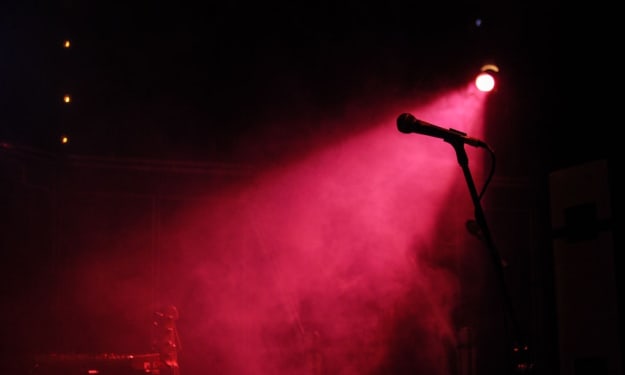
The microphone stands before me like a serpent, ready to strike.
My hands, usually steady and controlled, betray me with subtle tremors as I grip my note cards.
The faces in the audience blur into an indistinct mass, yet somehow each pair of eyes feels like a spotlight, exposing every imperfection, every doubt that lurks beneath my carefully constructed facade.
This moment, standing at the podium, represents more than just public speaking anxiety – it excavates something deeper, more primordial. It unearths our fundamental fear of judgment, of standing naked before the tribe and risking exile.
The racing heart, the dry mouth, the slight dizziness – these physical manifestations of fear are merely echoes of our ancestors' survival instincts, warning us of impending danger. Except here, the danger isn't physical – it's psychological, emotional, and perhaps even more terrifying for its intangibility.
I've often wondered why this fear runs so deep. Why does the prospect of speaking before others reduce even the most competent professionals to nervous wrecks?
The answer, I've come to realize, lies in the complex architecture of self-doubt that many of us have constructed over years of social conditioning. Each brick in this architecture represents a moment of past criticism, a remembered failure, or an internalized message about our unworthiness to command attention.
The shame of potential failure looms largest in these moments. It's not just about forgetting our words or stumbling over syntax – it's about the perceived judgment that follows. We imagine the whispers, the sideways glances, the subtle shifts in how others perceive us. In our minds, a single poor presentation becomes a permanent mark on our professional record, a stain on our social standing that can never be fully erased.
What makes this fear particularly insidious is its self-reinforcing nature. The more we worry about our performance, the more likely we are to falter. Each nervous glance at our notes, each slight tremor in our voice, becomes evidence confirming our worst fears about ourselves. It's a vicious cycle of anxiety feeding poor performance feeding greater anxiety.
Yet paradoxically, this very universality of public speaking fear offers a kind of comfort. When I look out at that audience now, I try to remember that many of them have stood where I stand, felt what I feel. The sweat-slicked palms, the thundering heartbeat, the inner voice screaming to run – these are shared human experiences that connect us rather than isolate us.
Understanding this has helped me reframe my relationship with public speaking anxiety. I've learned to see it not as a weakness to be eliminated, but as a natural response to be acknowledged and managed. The fear doesn't disappear – it probably never will completely – but it becomes more like background noise, a familiar companion rather than an overwhelming force.
According to many famous motivational speakers, the process of overcoming this fear, or at least learning to coexist with it, mirrors larger struggles with self-confidence and self-worth. Each time we step up to speak, despite our fears, we challenge those deep-rooted beliefs about our inadequacy. Every successful presentation, however small, creates a counter-narrative to our internal story of unworthiness.
Standing here now, I still feel the familiar flutter of nerves, the slight tremor in my hands. But I also feel something else – a growing recognition that these feelings are not a judgment of my capabilities, but simply part of the human experience of putting ourselves out there, of daring to be seen and heard. The fear remains, but it no longer defines the moment. Instead, it becomes a reminder of our courage in facing it, in choosing to speak despite its presence.
Perhaps this is the most important lesson public speaking has taught me: that confidence isn't the absence of fear, but the willingness to move forward in its presence. Each time we step up to the podium, we're not just delivering a speech – we're engaging in an act of personal growth, challenging our limitations, and slowly dismantling those walls of self-doubt we've built around ourselves.
About the Creator
Josh Alan
I recently graduated USC and am passionate about entrepreneurship, personal development, and travel. I love writing how to tips and articles that help people become the best version of themselves.
Keep reading
More stories from Josh Alan and writers in Confessions and other communities.
Thoughts on Vocal and the way the world is
"Death cannot stop true love, only delay it." – Wesley in The Princess Bride. I decided to come back to Vocal on a very cold and dark night at the end of December. I had been, and still am, convalescing from a horrible staph infection that had gone misdiagnosed for months. This, paired with the increasing challenges of being healthy, making the best choices for my co-parented child, being a wife, and being a director at a new job, was a lot to manage.
By Jazzy 6 days ago in Confessions
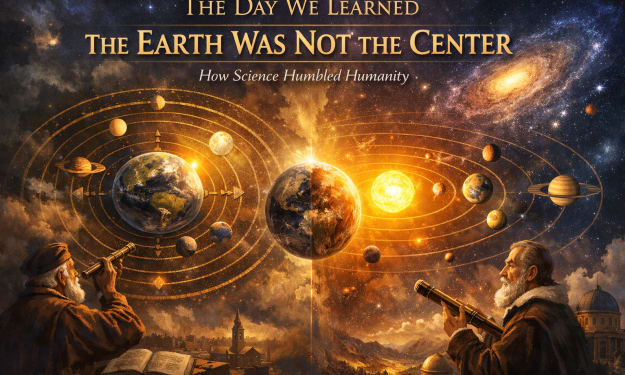
The Day We Learned the Earth Was Not the Center
For thousands of years, humans believed they stood at the center of everything. The sky revolved around us. The stars existed for us. The universe, vast and mysterious, was thought to circle the Earth like a grand stage designed for human life. This belief wasn’t just scientific—it was emotional, spiritual, and deeply personal. To say Earth was the center meant we mattered most. Then one day, science quietly but firmly changed that story forever.
By Aiman Shahid3 days ago in Confessions


Comments