
The Secret My Grandmother Took to Her Grave—And Why I Dug It Up
Some family stories are buried for a reason. I just couldn’t leave ours alone.

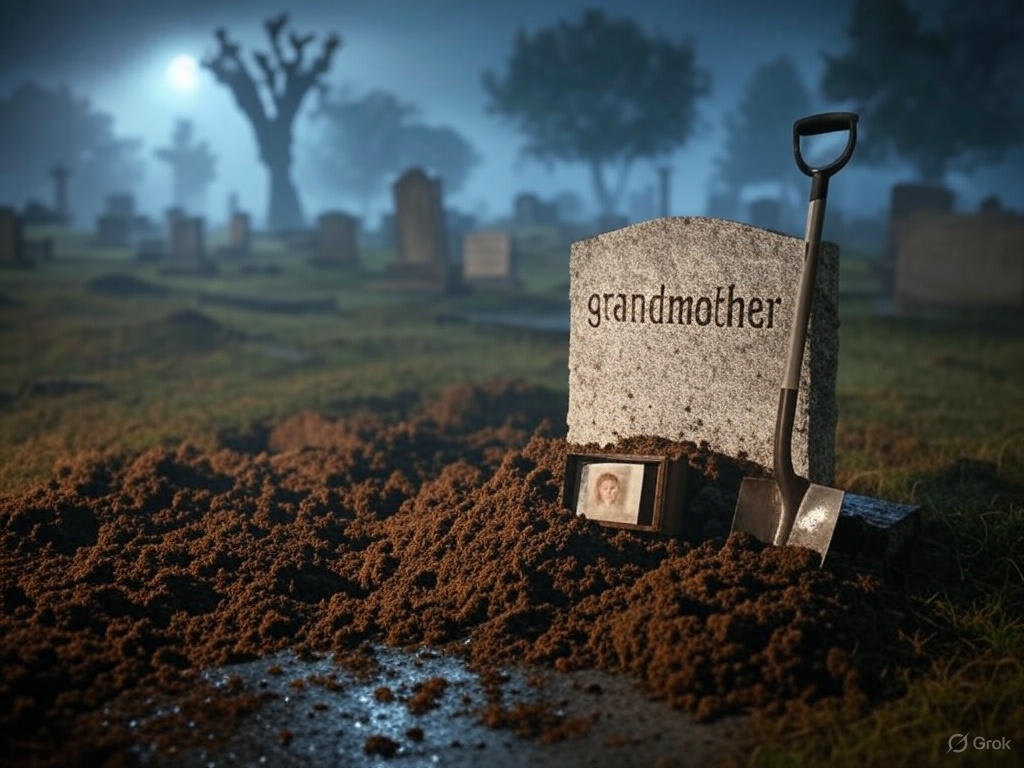
My grandmother, Eleanor, was the kind of woman who spoke in riddles. Stern, devout, always impeccably dressed in wool skirts and pearls, even in the summer heat. She ran our family like a quiet monarchy—respected, feared, and never questioned.
When she passed, the funeral was small. Just immediate family, a few neighbors, and a priest who barely knew her. But I noticed something odd during the service—my father, a usually stoic man, couldn't stop wringing his hands. And my mother kept giving him these quick, nervous glances. Something was off.
Still, I didn’t press. Grief is a strange beast, and Eleanor had been… complicated.
But that night, I heard them arguing in hushed tones in the kitchen. I only caught a few words.
“—should’ve told her.”
“—promised Eleanor.”
“It’s not right… not anymore.”
I leaned in closer, heart racing, but the floor creaked beneath me. Silence.
The next morning, my father avoided my eyes. My mother’s smile was too tight.
I couldn’t shake the feeling that my grandmother hadn’t left this world empty-handed. She’d taken something with her—some unfinished story. And it was gnawing at all of us.
A week after the funeral, I received a letter in the mail. No return address.
Inside was a single index card. Yellowed. Typed, not handwritten. It said:
“Maple Hill Cemetery. Row D, plot 14. Underneath. You need to know.”
No signature. Just that.
It was the same cemetery where we had just buried Eleanor.
I stared at the card for hours, flipping it over, rereading it. My first instinct was to call my father. But something told me not to.
I still don’t know why I went. Curiosity? Closure? A desire to finally understand the matriarch who raised us with iron will and ice-cold tea?
Whatever it was, I found myself there the next night—shovel in hand, flashlight tucked into my jacket, heart pounding in the quiet dark.
Plot 14. Row D.
I stood there a long time, staring at the fresh mound of dirt. Her headstone was already in place:
Eleanor Rose Whitmore
Beloved Mother. Keeper of Grace.
Ironic.
I looked around. No one. Just the rustle of trees and the distant sound of a dog barking.
And then I dug.
Not deep—just a foot or two, where the card had hinted. The dirt was loose from the fresh burial, and soon my shovel hit something hard.
Not a coffin.
A small metal box.
I pulled it out, wiped the mud off with my sleeve, and opened it.
Inside:
A faded black-and-white photograph of a young woman holding a baby.
A birth certificate.
And a letter, written in my grandmother’s unmistakable script.
The letter began:
“If you are reading this, I am gone. And I am sorry you had to find out this way.”
She went on to explain that in 1949, before she met my grandfather, she had a child. Out of wedlock. A daughter.
The woman in the photo was her. The baby—my aunt.
The father was a soldier, killed in Korea before he ever knew he had a child.
Eleanor, 18 and terrified, gave the baby up for adoption. Swore never to speak of it. Then she buried that version of herself and became the Eleanor we all knew: sharp, distant, iron-clad.
My father never knew he had a sister.
None of us did.
I sat there for hours, flashlight flickering, staring at the photo and the confession.
So much of my childhood made sense now—the tension at family gatherings, the way she’d pause when babies cried, the way her eyes lingered a little too long on photos of me as a newborn.
This wasn’t just a secret. This was a fracture running through the entire foundation of our family.
And she’d buried it. Literally.
I confronted my parents the next morning.
My father turned white. My mother cried. They admitted the letter had come years ago—sent to Eleanor by a woman named Miriam. Her daughter. My aunt.
She wanted to meet her. Said she had questions. But Eleanor refused. Said it would undo everything.
She never responded.
They never told me.
I could hardly breathe.
I eventually found Miriam.
She lives in Vermont. Married. Two kids of her own. One grandchild.
When I reached out, she cried over the phone. Said she thought her mother had hated her, or forgotten her. That she never got a reply.
We met a month later. She brought that same photo I’d found. She said she’d carried it for decades, unsure of what it meant, hoping one day she’d understand.
Now she does.
And so do I.
Some secrets are heavy. But keeping them buried only lets them grow roots in silence.
I don’t resent my grandmother. I think, in her own way, she wanted this to come out. That’s why she left the clue. That’s why she told me, and not anyone else.
Maybe she knew I’d be the one to dig it up—literally and figuratively.
All I know is this:
The truth doesn’t die just because someone does.
About the Creator
MALIK Saad
I write because my time is limited and my imagination is not....
Keep reading
More stories from MALIK Saad and writers in Confessions and other communities.
My Blind Date Was Going Perfectly—Until He Mentioned His Wife
It had been a year since my last serious relationship, and my friends were growing impatient. “You need to get back out there,” Michelle said, shoving her phone in my face. “Just one date. You don’t even have to marry him.”
By MALIK Saad9 months ago in Confessions
Thoughts on Vocal and the way the world is
"Death cannot stop true love, only delay it." – Wesley in The Princess Bride. I decided to come back to Vocal on a very cold and dark night at the end of December. I had been, and still am, convalescing from a horrible staph infection that had gone misdiagnosed for months. This, paired with the increasing challenges of being healthy, making the best choices for my co-parented child, being a wife, and being a director at a new job, was a lot to manage.
By Jazzy 2 days ago in Confessions
Two girls, one library, and a hunger for worlds beyond your own—Part 5
A world where purity was called naivety/ A life where exams intertwined us/ A glimpse of an adult you remember for life He saw: • a girl who didn’t pretend • a girl who answered honestly • a girl who didn’t have access to luxuries • a girl who worked hard • a girl who had dignity despite scarcity . His smile wasn’t mocking. It was respectful. He recognized your sincerity — and maybe even admired it.
By C.M.a day ago in Confessions



Comments
There are no comments for this story
Be the first to respond and start the conversation.