
The New World Order in the Post–Cold War Era
From televangelists and militias to pop culture and financial crises: how NWO conspiracies exploded after 1990

The New World Order in the Post–Cold War Era
The end of the Cold War did not bring the world the peace many had hoped for. Instead, it gave new life to old fears—particularly those centered around the idea of a New World Order. During the 1990s and 2000s, the phrase became deeply tied to conspiracy theories, religious prophecy, pop culture, and political rhetoric. It transformed from a hopeful vision of cooperation into one of the most infamous symbols of control, manipulation, and global domination.
Christian Right and Prophecy Culture
One of the strongest sources of New World Order conspiracism in the post–Cold War period came from the American Christian right. Within Protestant prophecy culture, the New World Order was framed as the system of the Antichrist—a global enemy destined to rise against Christianity.
Organizations like the United Nations, the European Union, the World Trade Organization, and the World Health Organization were seen not as forces for cooperation, but as tools of secular globalists. To many evangelicals, movements like feminism, environmentalism, and socialism were part of the same anti-Christian agenda.
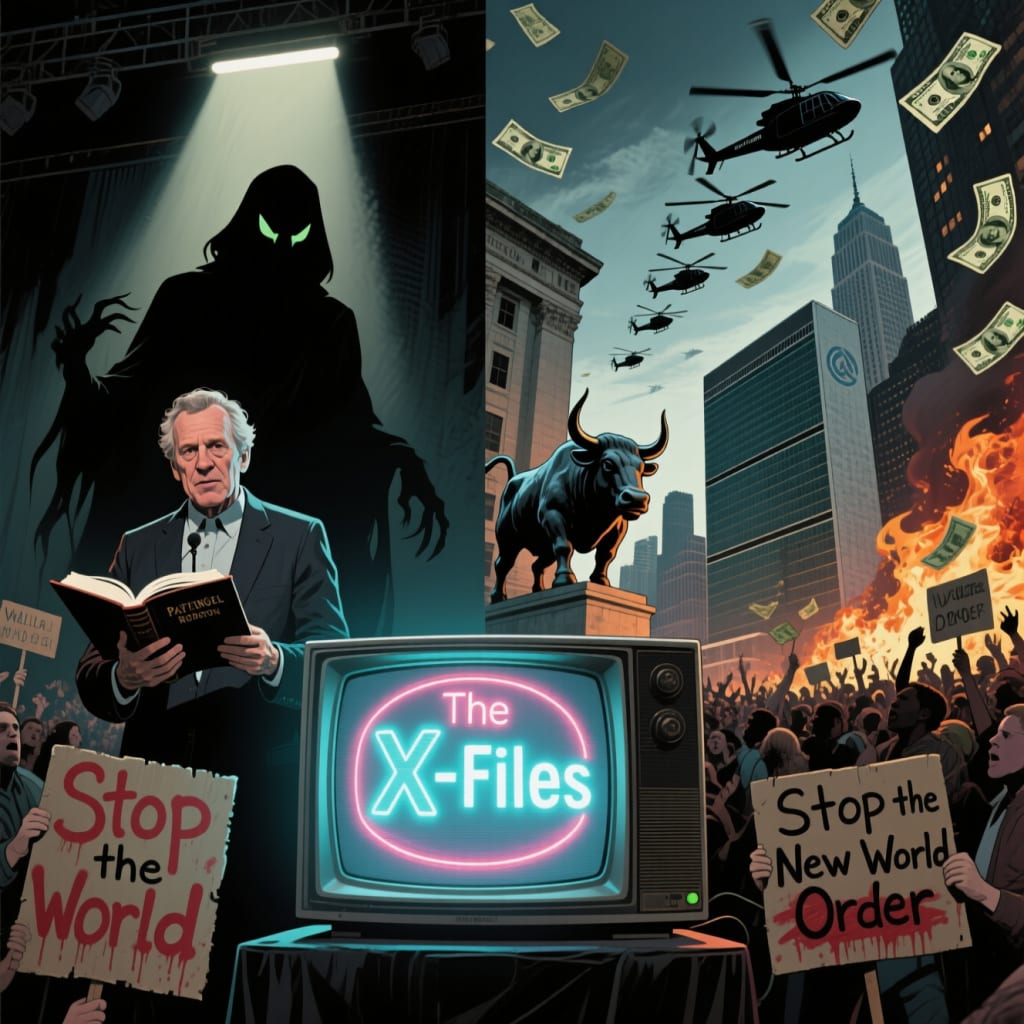
The most famous Christian voice spreading these ideas was televangelist Pat Robertson. In 1991, his book The New World Order became a best-seller, painting a dramatic picture of hidden elites pulling the strings of American politics. According to Robertson, groups like Wall Street, the Federal Reserve, the Council on Foreign Relations, the Bilderberg Group, and the Trilateral Commission were secretly coordinating events to prepare the world for global government under the Antichrist.
Militias, Militancy, and Fear
The 1990s also saw the rise of the American militia movement, fueled by New World Order rhetoric. Conspiracy leaders like Linda Thompson, Mark Koernke, and Robert K. Spear used fiery speeches, books, and videotapes to spread their warnings. Gun shows, shortwave radio, satellite broadcasts, and the earliest internet bulletin boards became the frontlines of anti-government messaging.
This network of voices portrayed the U.S. government as complicit in a globalist conspiracy, and ordinary citizens as its targets. Rumors about black helicopters, FEMA concentration camps, and secret martial law plans spread widely. Such fears energized paramilitary groups and survivalists, many of whom believed they were preparing for an inevitable showdown with global elites.
Late-night radio programs and viral faxes carried the message further. By the mid-1990s, NWO conspiracies had spilled into unexpected communities: Kennedy assassination researchers, UFO enthusiasts, occultists inspired by the “Satanic panic,” and seekers of hidden or stigmatized knowledge. What had once been a right-wing subculture was now a broad, cross-ideological movement fueled by disillusionment with politics.
Pop Culture Goes Conspiratorial
During this same period, Hollywood brought conspiracy theories into the mainstream. Television and films blurred the line between entertainment and paranoia, making the New World Order part of popular imagination.
The most influential example was The X-Files (1993–2002), which mixed science fiction with government secrecy, alien cover-ups, and shadowy cabals. Films like Conspiracy Theory (1997) and The X-Files: Fight the Future (1998) further spread the themes. Millions of viewers were introduced to once-fringe ideas—black helicopters, hidden laboratories, and the belief that powerful elites were orchestrating events behind closed doors.
Financial Crises and Political Rhetoric
The start of the 21st century brought new waves of conspiracy talk. During the 2008 global financial crisis, prominent leaders like Gordon Brown and Henry Kissinger used the phrase “new world order” while calling for reforms in the global financial system. They argued for a “New Bretton Woods,” one that would recognize the growing power of emerging economies like China and India.
But for conspiracy theorists, these statements were proof that the elites were finally admitting their plan. Commentators like Sean Hannity declared on Fox News that “the conspiracy theorists were right.” At the same time, media watchdogs accused shows like Glenn Beck’s program of irresponsibly fueling paranoia and potentially encouraging violent lone-wolf extremists.
Documentaries and New Alliances
In 2009, filmmakers Luke Meyer and Andrew Neel released the documentary New World Order, which explored the lives and struggles of conspiracy theorists such as Alex Jones. The film offered an inside look at the passion, fear, and activism driving those who opposed what they believed was a looming global dictatorship.
Interestingly, the NWO conspiracy also began forming strange alliances across political lines. In hip-hop culture, artists like KRS-One, Professor Griff of Public Enemy, and Immortal Technique incorporated anti-elitist NWO themes into their music. What connected radical right-wing activists and left-wing rappers was a shared distrust of elites, institutions, and government.
The Expanding Web of Conspiracy
By the late 2000s, the New World Order conspiracy had become vast and all-encompassing. It linked financial crises, global institutions, environmental policies, pop culture, and religion. It was no longer confined to one ideology or one group of people—it had become a cultural phenomenon.
From church pulpits to militia camps, from Hollywood blockbusters to rap lyrics, the NWO narrative spread across the globe. For some, it was a sign of coming apocalypse; for others, it was a metaphor for corruption, inequality, and elite power.
Conclusion
In the post–Cold War era, the phrase New World Order shifted from political optimism to global paranoia. What began as a warning in Christian prophecy became a rallying cry for militias, a theme in pop culture, and a lens through which financial crises and global institutions were viewed with suspicion.
The NWO became not just a conspiracy theory but a cultural force—one that connected religious fears, political anger, economic discontent, and entertainment into a single, powerful myth.
And even today, its influence shows no sign of disappearing.
About the Creator
Wings of Time
I'm Wings of Time—a storyteller from Swat, Pakistan. I write immersive, researched tales of war, aviation, and history that bring the past roaring back to life
Keep reading
More stories from Wings of Time and writers in Confessions and other communities.
The Piggy Project
I’ve had so many names in this life I lose track of which ones were ever really mine and which ones I wore because someone needed me to. Some were handed to me before I had words to refuse them, before I knew what they meant, before I knew I could say no. Most weren’t meant to hurt. That doesn’t mean they didn’t leave marks. Marks that told me who I belong to, who I am by way of who claims me, recognizes me in the good and bad, who walks beside me.
By Fatal Serendipity3 days ago in Confessions
The Things We Never Said
There are conversations we have every day—casual greetings, quick messages, polite exchanges that fill the spaces between our busy lives. But beneath all those spoken words lies another world of silence. It’s a world filled with things we never said.
By Aiman Shahidabout 12 hours ago in Confessions



Comments
There are no comments for this story
Be the first to respond and start the conversation.