
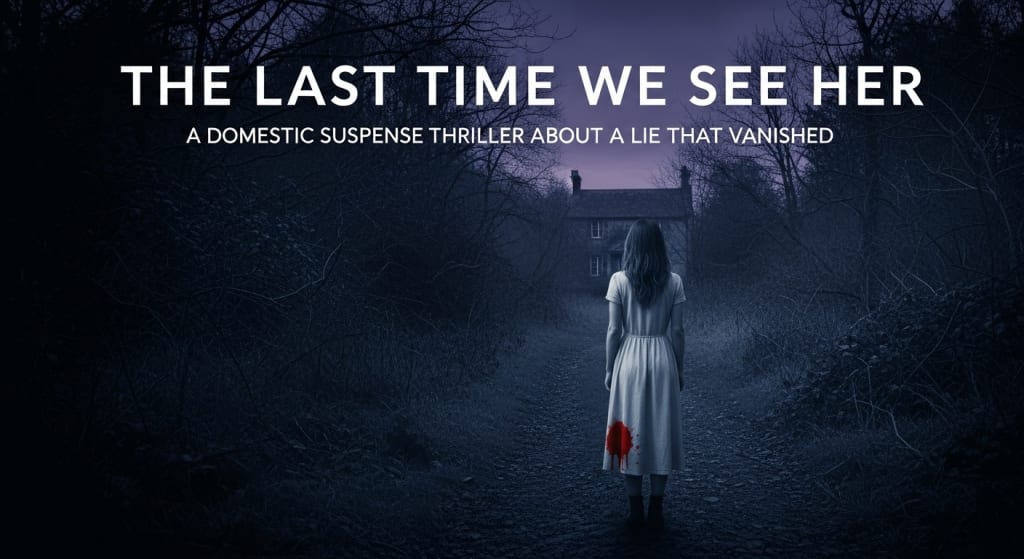
The Last Time We See Her
A Domestic Suspense Thriller About a Lie That Vanished

The static hummed, a low, persistent whisper against the quiet of the empty house. It was the only sound I had heard for three days. A week ago, Clara, my wife, had bought an old-fashioned analogue television from a flea market, claiming its nostalgic fuzz was just what our living room needed. Now, it was a silent vigil, its screen a swirling vortex of gray and black that mimicked the storm clouds outside. I sat on the couch, watching it, waiting.
The police had called it a missing person case. I called it a tragedy. They’d asked the usual questions: When did I last see her? Had we argued? Was she acting strangely? I had answered with the truth. We had a small disagreement about her decision to go out so late, a foolish, harmless fight. She had left in a huff, promising to return. That was the last time I saw her. The last time.
My mind kept replaying the scene. The front door closing with a gentle click. The sound of her car starting. The red glow of her taillights disappearing down our long, winding driveway. She never made it to her destination, a friend’s house just ten minutes away. The car was found abandoned on a quiet country road, its door ajar, the keys still in the ignition. No signs of a struggle. No signs of Clara.
The detective, a man named Miller with tired eyes and a suspicious gaze, had been back to the house twice. He’d gone through our things, his movements methodical and unsettling. He’d paused by the small, ornate music box on Clara’s vanity, the one that played an off-key lullaby. He’d opened it, letting the tinny tune fill the silence, before snapping it shut. A simple gesture, but it had stayed with me. He’d also asked about the gardening shears, the pair with the peculiar, bent blade, noting their absence from the tool shed. I had told him I used them last week to prune the rose bushes, but I must have misplaced them somewhere.
Days bled into one another. I stopped eating, stopped sleeping. I just watched the static, a physical manifestation of the buzzing void in my head. I had told Miller everything, but there were things I couldn't explain. The way Clara's phone was found—it was a new phone, one she'd just activated, and it was in the car. Her old phone, the one she used every day, was still in her purse, sitting on the kitchen counter where she’d left it. A strange detail, but not one that seemed to matter. Not one that the police seemed to care about. They were focused on me, on my grief, on the inconsistencies they couldn’t place.
I remembered the night before she disappeared. Clara had been on her laptop, a look of profound concentration on her face. She was searching for something, I knew it. She had closed the laptop the moment I walked into the room, her smile a little too tight. "Just looking at recipes," she'd said. It was a flimsy excuse, but I loved her, so I didn't press. I was so caught up in my own things—the endless hours at work, the pressure, the need to keep up appearances—that I had been deaf to the silence and blind to the cracks that were forming around us.
The house was cold, a tomb of memories. I walked through the rooms, tracing the outline of her absence. The faint scent of her perfume on her pillow. Her favourite teacup in the sink, waiting to be washed. Her unfinished novel, a paperback with a bent spine, resting on the nightstand. The book’s title, The Vanishing Point, now seemed like a cruel joke.
Suddenly, a flicker on the television. The static shifted. A face appeared, ghostly and pale, superimposed over the white noise. It was her. Clara. Her lips were moving, but the sound was just the incessant hiss of the television. I scrambled to turn the volume up, my heart a frantic drum against my ribs. Her voice broke through, distorted but undeniable. "It's all in the static," she whispered, her eyes wide with fear. "He can't hear me."
The image vanished, replaced by the familiar gray snow. But the words echoed in my mind. "He can't hear me." I looked around the empty room, my heart pounding. Who couldn't hear her? The neighbors? The police? Me?
The truth landed with the force of a physical blow. The static wasn't a metaphor. It was the television's white noise, a constant, high-frequency sound. And Clara’s phone... she had taken a new phone, not her old one. Her old phone was connected to my Wi-Fi, to our home network. To the home security system, which recorded all audio and video. She was trying to leave me a message. She was trying to tell me who had lied. Who had manipulated the evidence. Who had staged the scene.
And in that moment, in the hollow silence of the house, I understood. The lullaby from the music box, the lost gardening shears, the new phone—all of it came together. It wasn't the police who had a suspicious gaze. It was Clara. And she wasn't missing. She was hiding. She had planned this, knowing I would be the first one they would suspect. She had framed me. And I, in my self-absorbed grief, had become her accomplice. The last time I saw her was not the night she left. It was the night before, when she closed her laptop and lied about recipes. She hadn’t vanished; she had simply been waiting for me to catch up.
Analysis of the Narrative: The Anatomy of a Shocking Twist
The narrative titled The Shadow in the Static was crafted to deliver a shocking plot twist by adhering to key principles of suspense writing. A good twist must be carefully foreshadowed, surprise the reader, and, most importantly, be plausible in retrospect. The story’s construction relies on a systematic approach, starting with the final reveal and then strategically planting clues throughout the narrative to create an earned revelation rather than a contrived one.
A central concept in this story's structure is the resolution of what is often called the "plausibility paradox"—the need for a twist to be both unexpected and logically inevitable upon reflection. The story achieves this by using misdirection, a common technique in which the reader is led to suspect one conclusion while the real truth is hidden in plain sight. The narrative presents the narrator's perspective as a reliable source of information, making the reader sympathize with his grief and fear of police suspicion. The subtle clues—the music box, the lost gardening shears, the two phones—are presented as insignificant details or red herrings designed to divert the reader's attention. The true shock comes from the recontextualization of these details not as signs of an external threat, but as evidence of a calculated plan by the missing wife. The narrative essentially makes the reader feel like a co-detective who, after the reveal, can look back and recognize the signs, transforming surprise into a satisfying, self-directed discovery.
The story also leverages a character-driven approach to its twist. Instead of relying on an external, unforeseen event, the climax of the story forces the narrator to confront a devastating truth about his own actions and his relationship with his wife. The protagonist is intentionally portrayed as a fearful, rather than powerful, character, which elevates the tension and makes his predicament more compelling. This narrative choice makes the twist emotionally resonant, as it functions as a moment of self-discovery and anagnorisis for the protagonist. The limited perspective of an unreliable narrator is a highly effective device for delivering such a complex twist within the confines of a short story. This technique allows for the entire narrative world to be built and then completely subverted by a single, late-stage revelation, which is an efficient way to deliver a powerful punch without requiring extensive world-building or multiple subplots. The story concludes with a post-twist cliffhanger—the narrator now understands the truth but must grapple with the consequences of being framed—leaving the reader with a sense of unresolved unease and a final problem for the protagonist to solve.
About the Creator
khalilhoti
Motivational Entrepreneur Digital Marketing and Social Media Expert.
Keep reading
More stories from khalilhoti and writers in Confessions and other communities.
A Forgotten Child. A Haunted Mind. A Lullaby That Never Ends.
In the darkness, I can hear a lullaby. But I have no children. I sit frozen at the top of the stairs, listening to the music box melody drifting from somewhere deep in the house. My heart is pounding in my ears, but there’s no one there. Every instinct screams that something isn’t right.
By khalilhoti7 months ago in Psyche
When Speaking Up Was Dangerous
In today’s world, speaking out is often encouraged. We post opinions online, debate politics, and challenge authority with relative freedom. But history tells a darker story—one where words were weapons, and truth was a crime. There were eras when raising your voice meant risking imprisonment, torture, exile, or execution. When speaking up was dangerous, courage had a different meaning. It wasn’t about being heard—it was about surviving.
By Aiman Shahid6 days ago in Confessions



Comments
There are no comments for this story
Be the first to respond and start the conversation.