
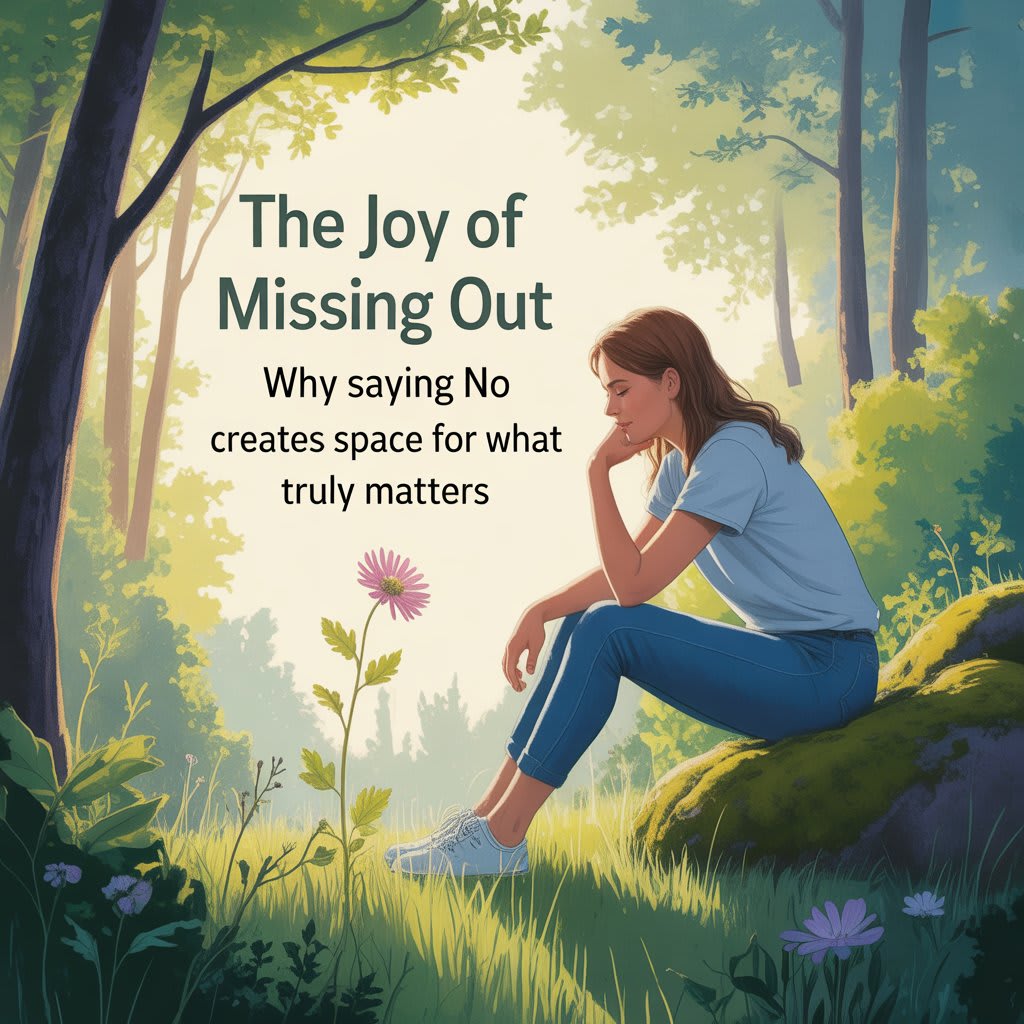
The Joy of Missing Out: Why Saying No Creates Space for What Truly Matters
How embracing JOMO over FOMO leads to balance, clarity, and a more fulfilling life.
Introduction
In today’s hyperconnected world, it feels like there’s always something happening just out of reach. A friend’s weekend trip, a trending event, a new restaurant opening, or even a viral online conversation—all can stir up a sense of unease that we’re somehow falling behind. This is the well-known “Fear of Missing Out” (FOMO), a modern anxiety rooted in comparison, overstimulation, and the pressure to be everywhere at once.
But there’s an antidote to this constant restlessness: the Joy of Missing Out (JOMO). Unlike FOMO, which thrives on scarcity and insecurity, JOMO is about abundance and choice. It’s the conscious decision to step back, say “no” to what doesn’t truly serve us, and reclaim time and energy for what actually matters. Instead of chasing everything, JOMO invites us to savor enough.
In this essay, we’ll explore why JOMO has become such an essential mindset in a culture that glorifies busyness, how learning to say “no” can be transformative, and why intentionally missing out is one of the most empowering forms of self-care.
The Age of Overload
To understand the value of JOMO, we first need to examine the landscape we live in. Modern life is marked by overload—information overload, social overload, and choice overload. Every scroll through social media offers a curated highlight reel of what others are doing: vacations, career milestones, social gatherings, and endless moments that can make us feel inadequate.
The problem isn’t simply that other people are sharing; it’s that we’re wired to compare. When our attention is constantly pulled outward, it becomes nearly impossible to focus inward on what we value most. We say “yes” out of guilt, obligation, or fear of falling behind, until our schedules are bursting and our energy is drained.
This is where FOMO thrives—on the idea that if we don’t attend, participate, or consume, we’ll be excluded, irrelevant, or less successful. But in reality, the cost of always saying “yes” is far greater than the cost of missing out. It’s our well-being, relationships, and sense of purpose that get lost in the noise.
Redefining Missing Out
At its core, JOMO is about redefining what it means to “miss out.” Traditionally, missing out has carried negative connotations—like we’re absent from something important. But what if missing out isn’t actually a loss? What if it’s a choice to prioritize what truly nourishes us?
By choosing to miss out on the unnecessary, we make room for the essential. Saying no to an after-work gathering we don’t feel up for could mean saying yes to rest, reflection, or quality time with loved ones. Skipping the endless scroll through social media might open space for reading, creating, or simply being still.
In this sense, missing out becomes less about deprivation and more about liberation. It’s not about shutting down opportunities, but about curating them with intention.
The Power of Saying No
One of the hardest skills to master in adulthood is learning how to say “no.” Many of us are conditioned to equate saying no with rejection, selfishness, or laziness. But saying no is actually one of the most powerful ways we can honor ourselves and others.
Protecting Boundaries
Saying no allows us to protect our mental, emotional, and physical boundaries. Without boundaries, we risk burnout, resentment, and a loss of authenticity.
Making Space for Priorities
Every “yes” we give takes time and energy from somewhere else. By saying no to things that don’t align with our values, we free up resources for the people, projects, and passions that do.
Empowering Authenticity
When we agree to things out of obligation, we often show up halfheartedly. Saying no creates the possibility of showing up fully when we say yes. It’s a way of aligning actions with intentions.
Far from being selfish, saying no is actually a generous act. It ensures that when we do say yes, it’s with genuine enthusiasm and presence.
From FOMO to JOMO: The Shift
The transition from FOMO to JOMO isn’t about cutting yourself off from the world. It’s about shifting perspective. FOMO whispers: “You’ll regret not being there.” JOMO counters: “You’ll be grateful for the space you created.”
This shift requires practice:
Mindful Awareness: Noticing when a sense of FOMO creeps in. Is it driven by genuine desire, or by comparison and pressure?
Intentional Choices: Asking, “Does this align with my values right now?” before committing.
Celebrating Stillness: Recognizing that quiet, rest, and simplicity are not wasted time, but essential parts of a fulfilling life.
As we practice this shift, something remarkable happens: we stop measuring our worth by how much we do, and start valuing the quality of what we choose.
The Joy in JOMO
What makes JOMO joyful isn’t simply the act of missing out—it’s what emerges in its place.
Presence
By stepping away from the constant “what’s next?” mindset, JOMO anchors us in the here and now. It reminds us to notice the everyday joys that often get overlooked when we’re chasing something else.
Clarity
Missing out helps strip away distractions, allowing us to reconnect with our deepest priorities. It’s in the quiet moments that our values and passions become clearest.
Freedom
JOMO liberates us from the endless treadmill of comparison. When we’re no longer trying to keep up with everyone else, we gain the freedom to move at our own pace and define success on our own terms.
Fulfillment
Ultimately, JOMO creates space for a life that feels less like a checklist and more like a rich, intentional journey. Fulfillment comes not from doing everything, but from doing what matters most.
Practical Ways to Embrace JOMO
Living with JOMO doesn’t require drastic lifestyle changes. It’s about small, intentional practices that reinforce the joy of enough.
Digital Boundaries: Limit time on social media or practice “phone-free” hours each day to reduce comparison triggers.
Selective Yes: Before saying yes, pause and ask: Will this bring value to my life, or am I agreeing out of guilt or fear?
Slow Rituals: Create space for unhurried activities—morning coffee, a walk in nature, or journaling—that remind you of the beauty in simplicity.
Celebrate Saying No: Instead of feeling guilty, view each no as a yes to something better aligned with your needs.
Redefine Success: Shift focus from quantity (how many things you do) to quality (how meaningful those things are).
JOMO in a Collective Context
While JOMO begins as a personal practice, its ripple effects extend outward. When individuals embrace JOMO, workplaces become less pressured by “hustle culture,” friendships become more authentic, and communities gain more mindful participation.
Imagine a culture where people aren’t applauded for burning out but for knowing their limits. A world where declining an invitation isn’t seen as rejection but as honesty. JOMO isn’t just an individual mindset—it’s a collective reimagining of how we measure worth and connection.
Conclusion
The Joy of Missing Out is not about avoiding life; it’s about living it more deeply. In a society that equates busyness with success and visibility with value, choosing to say no can feel radical. Yet it’s precisely in that space of intentional absence that presence, clarity, and fulfillment emerge.
When we let go of the fear of missing out, we open ourselves to the joy of enough. We discover that what truly matters has been within reach all along—not in the endless chase, but in the mindful pause.
So the next time you feel the tug of FOMO, pause and ask yourself: What joy might I find in choosing differently? The answer may surprise you—and it may just change the way you live.
About the Creator
Keep reading
More stories from Aiman Shahid and writers in Confessions and other communities.
The Hidden Cost of Perfectionism: Why Striving for Flawless Often Holds Us Back
Introduction: The Double-Edged Sword of Perfectionism In our achievement-driven world, perfectionism is often praised as a virtue. We celebrate students who aim for straight A’s, employees who double-check every detail, and creators who tirelessly refine their craft. On the surface, perfectionism looks like dedication, high standards, and a recipe for success. After all, what harm could come from wanting to do things right?
By Aiman Shahid5 months ago in Confessions
She Washed Her Hair With Coca-Cola — And Accidentally Changed Her Life
Ayesha never planned to wash her hair with Coca-Cola. It wasn’t part of a dare, a trend she proudly followed, or a scientific experiment. It happened on one of those lonely nights when sleep refuses to come and the mind becomes louder than the room itself. The city outside her apartment was quiet, but her thoughts were not.
By shakir hamid6 days ago in Confessions




Comments
There are no comments for this story
Be the first to respond and start the conversation.