
The Hidden Leadership Role I Found in Office Management
By Lynn Sembor

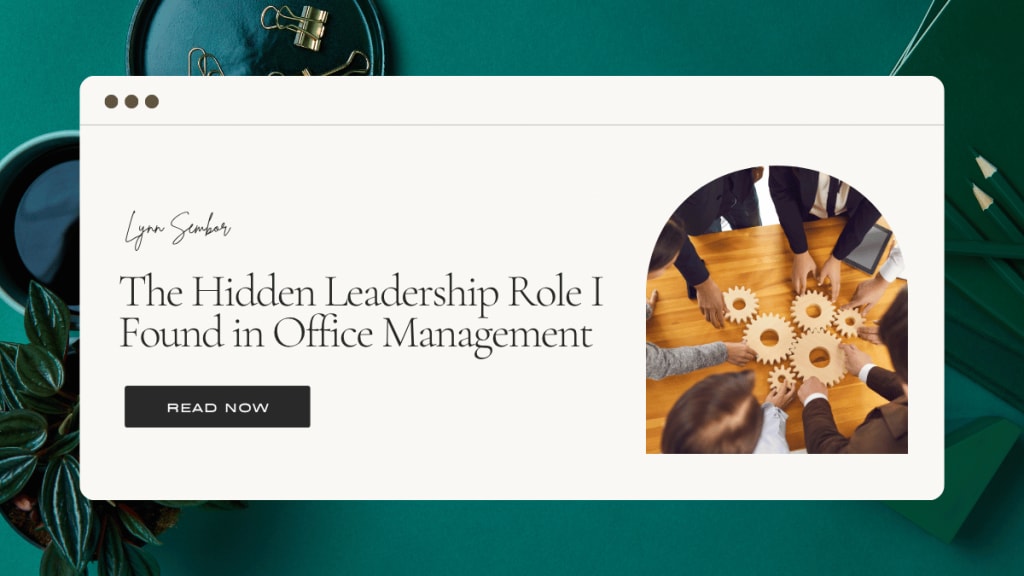
Most people think of an office manager as someone who orders paper, schedules meetings, and keeps things organized. That’s part of the job, yes. But it’s not the full picture.
In truth, the modern office manager plays a bigger role. I’d argue we’re closer to a “Chief Enablement Officer.” What does that mean? It means our job is to make everyone else’s job easier.
Not by doing the work for them. But by clearing the path so they can move forward without friction.
Productivity Doesn’t Just Happen
People want to do good work. That’s rarely the issue. What holds them back are little things. A slow printer. A confusing workflow. Missing login credentials. These might sound small, but they add up fast.
Each delay drains momentum. Each workaround kills time. That’s where we step in—not just to patch things up, but to redesign the process so it doesn’t break in the first place.
Think Like a Problem Remover
I’ve never liked the idea that office managers just “maintain” things. That sounds passive. My approach is the opposite.
If someone is frustrated, I want to know why. If a department is falling behind, I don’t assume it’s the people. I look at the system.
Do they have what they need? Is the process intuitive? Is the technology helping or hurting?
These aren’t complaints. They’re clues. And office managers are in the best position to spot them—because we see it all.
We work across departments. We hear things others miss. That’s a superpower, if you use it right.
No Title Needed to Lead
You don’t need “executive” in your title to drive change. In fact, the best improvements often come from the middle.
I once changed our meeting prep process after seeing how much time teams spent hunting down files. A simple shared folder fixed it.
No big announcement. No long emails. Just quiet enablement.
That’s the kind of leadership people actually notice—because it saves them time.
Start With Flow
Instead of asking, “What should I fix?” I ask, “Where does the flow break?”
That word—flow—is key. When things are flowing, people don’t feel blocked. They don’t need to chase answers. They don’t feel drained by simple tasks.
I look for the areas where energy gets stuck. Then I get curious.
Are people duplicating work? Is approval taking too long? Are tools too complex?
These bottlenecks are invisible until you look for them. Once you do, the fix is often easier than expected.
Resources Matter, But So Does Permission
Of course, having good tools helps. But sometimes, what people need most is permission. Permission to stop doing what doesn’t work. Permission to try something new.
I try to create that space. I’ll say, “If this isn’t helping, let’s change it.” That little sentence can unlock a lot.
Employees need to feel safe raising issues. Otherwise, they suffer in silence—and so does productivity.
That’s why I treat every complaint as a gift. It means someone trusts me enough to speak up.
Efficiency Isn’t Cold—It’s Compassionate
Some people think focusing on efficiency is robotic or rigid. I disagree. It’s actually a form of care.
When processes run smoothly, people aren’t stressed. They don’t waste energy. They go home with more left in the tank.
A well-run office isn’t just good for business. It’s good for morale. For retention. For mental health.
So yes, I care about printer settings and password policies. Because those details create the daily experience of work.
And experience matters.
Celebrate the Invisible Wins
Not all victories are loud. In fact, the best ones are often invisible.
No one sees the meeting that didn’t run late because the agenda was sent in advance. Or the new hire who felt at ease because their desk was already set up.
But those things make a difference. People remember how a workplace feels.
Office managers shape that feeling in a hundred subtle ways. And that’s something to be proud of.
A Quiet Kind of Strategy
I’m not interested in buzzwords. But I do believe in strategy. Mine is simple:
Notice the friction.
Remove it.
Watch people thrive.
That’s enablement. That’s modern office management.
And the best part? You don’t need a new title to do it. You just need to see your role through a different lens.
Not as support staff. But as a support system.
So the next time someone asks what I do, I might just say: “I help people do their best work.” That’s the heart of it.
And honestly, I wouldn’t want it any other way.
About the Creator
Lynn Sembor
Lynn Sembor is an experienced office manager from West Haven, Connecticut. She has worked in both the insurance and education sectors, bringing strong organizational and administrative skills to every role.
Keep reading
More stories from Lynn Sembor and writers in Confessions and other communities.
From Filing Cabinets to the Cloud: How Nonprofits Are (Finally) Digitizing Operations
Lynn Sembor For years, I’ve worked behind the scenes in nonprofit organizations. Quietly. Patiently. Often in rooms filled with metal filing cabinets and paper forms. I’ve watched change come slowly. But it’s here now. And I think it’s a good thing—though maybe not for the reasons most people expect.
By Lynn Sembor8 months ago in 01
Thoughts on Vocal and the way the world is
"Death cannot stop true love, only delay it." – Wesley in The Princess Bride. I decided to come back to Vocal on a very cold and dark night at the end of December. I had been, and still am, convalescing from a horrible staph infection that had gone misdiagnosed for months. This, paired with the increasing challenges of being healthy, making the best choices for my co-parented child, being a wife, and being a director at a new job, was a lot to manage.
By Jazzy 11 days ago in Confessions
The Ghostwriter's Ransom
I have spent the last decade being the voice of people who have nothing to say. I am a professional ghostwriter. If you’ve walked through an airport bookstore in the last five years, you’ve seen my work. You just haven’t seen my name. I’ve written memoirs for starlets who can’t spell "autobiography," and "thought leadership" books for CEOs who haven’t had an original thought since 1998.
By Luna Vani4 days ago in Confessions



Comments
There are no comments for this story
Be the first to respond and start the conversation.