
The Confession of Fire by Stefano D’Angello
A forbidden love between faith and desire

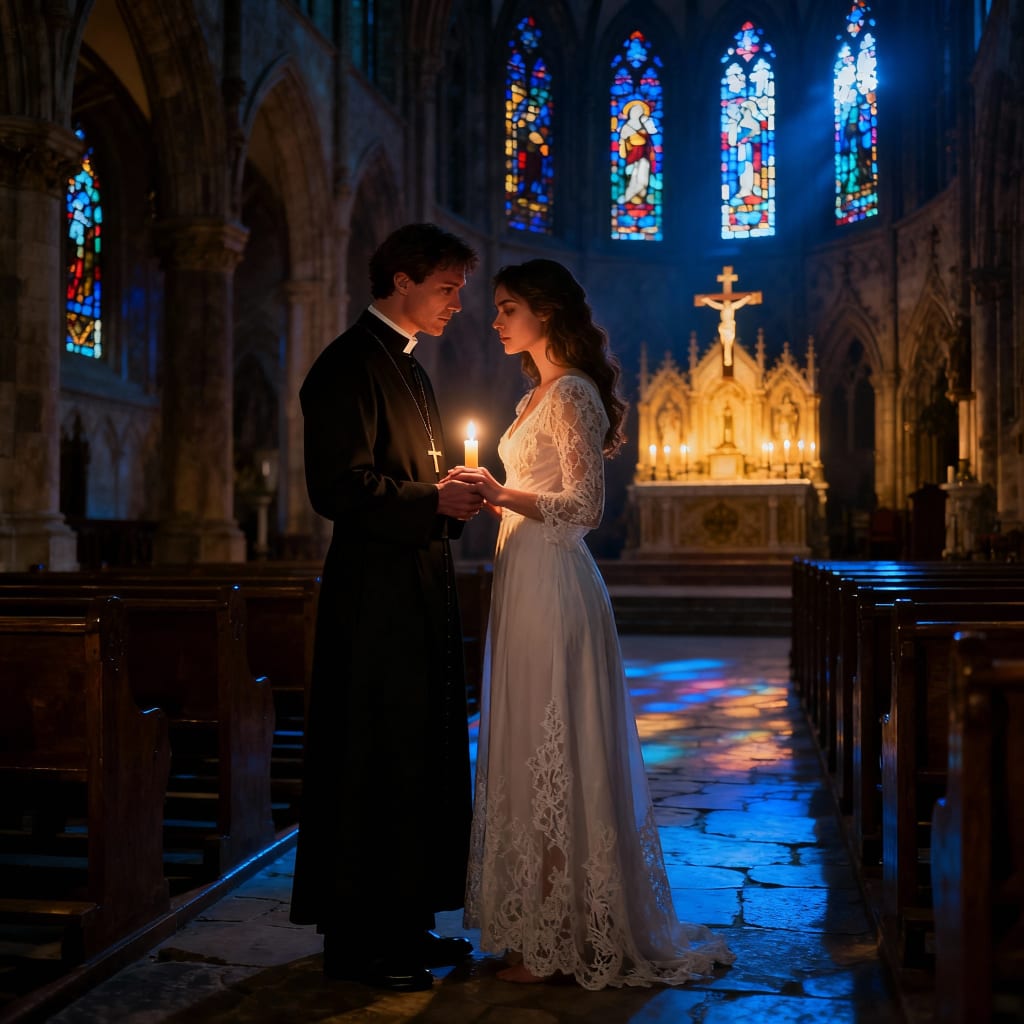
Part I - The Confession of Fire
The rain never seemed to stop that month in Florence. The sky hung low and heavy, as though burdened by the weight of prayers it could no longer answer. In the heart of the city, behind the cracked marble pillars of the Santissima Trinità, Father Gabriel served the word of God. He was thirty-seven, solemn and disciplined, a man whose hands had only touched holy things.
Until she came.
Lucia.
Her name was spoken only in whispers, each syllable trembling between contempt and desire. Some said she once sang in a theater. Others swore she was the mistress of a fallen nobleman. No one knew her truth, and Gabriel told himself he did not care to know. Yet when the faint chime of the chapel door echoed through the nave each dusk, his breath caught like a sinner’s first gasp before confession.
She would kneel, crossing herself with deliberate grace. Sometimes her shoulders quivered under the thin fabric of her shawl; sometimes her lips curved in a smile that felt like a temptation crafted by the devil—a smile meant only for him.
“Forgive me, Father, for I have sinned.”
The first time she said it, Gabriel’s heart recoiled as though burned. Yet he listened. Her voice was smoke and silk, trailing slowly through the lattice of the booth. She spoke not in the language of repentance but revelation—a song of her loneliness, of men who paid and left, of fleeting hands that never touched her soul. There was no shame in her words, only sorrow so deep it became sacred.
When her confession ended, silence lingered. The priest felt something collapse within him—his composure, perhaps, or the memory of what peace had once meant.
“You are forgiven,” he said, his voice faltering.
But forgiveness became harder each week.
The Second Confession
Lucia began waiting for him in the pews instead of the booth. She claimed she wished to pray. Gabriel allowed it, because he believed himself strong enough to endure. She would light a candle before Saint Mary’s altar, her face golden in the flickering light. He found himself watching from the shadows, his prayer beads clutched too tightly.
“Do you ever wonder,” she asked one evening, “if love itself is a kind of prayer?”
He had no answer.
Outside, thunder cracked. The power flickered, leaving only the candles’ light between them. When he approached to bless her, his hand brushed her shoulder. A spark went through him like confession undone. Lucia did not move. She merely turned her gaze toward him—soft, defiant, infinite.
“Then my sin,” she whispered, “is loving what I was told I could never have.”
Gabriel fled that night. He knelt in his quarters until dawn, his knees aching from stone. But every prayer formed her name. The Book offered no absolution.
The Third Week
The bishop visited—the kind of man who smelled of wine and expectation. “Our duty,” he told Gabriel, “is to guide lost souls, not to partake in their ruin.” His words were heavy with warning. Yet the way he looked at Lucia during the morning mass betrayed that even holy men were merely men.
When the bishop left, Lucia laughed quietly. “He fears me,” she said.
“He fears what you awaken in others,” Gabriel replied.
“And you? What do I awaken in you, Father?”
He tried to speak, but his mouth was dry. She took his hand, pressing it to her throat—a reckless sacrament. He could feel her pulse beneath his fingers, trembling like a bird trapped between both heaven and hell.
“Say something holy,” she breathed.
He could not. Instead, he pulled his hand away and whispered, “This must end.”
But even as the words left him, their truth died between them.
The Silence
Weeks passed in torment. He avoided her confessions, her gaze, even her name. Yet temptation was loyal—it lingered like smoke in his cassock, in the scent of the candles, in every dream.
One night, unable to rest, Gabriel walked through the empty streets. The rain had returned, washing the cobblestones as though purging the sins of men. He passed the alley where she lived, saw her lamplit window, and—forgive him, Lord—he knocked.
Lucia opened the door wearing a robe of crimson silk. She did not speak. Neither did he. Thunder rolled above them like divine protest as the world fell away.
They talked for hours that night—of faith and fear, of what salvation might mean to those outside its gates. She told him she had stopped believing in miracles long ago; he told her that perhaps she had been one all along.
When dawn came, they had not touched. And yet everything had been touched.
The Falling
News spread. Someone had seen him leave her home. The whispers multiplied. He was summoned before the bishop again, this time accused not only of negligence but of impropriety.
Lucia begged him to deny it. “Say it was confession,” she pleaded.
But Gabriel looked at her as though already damned. “I cannot lie before God.”
He was suspended from his duties. The parish doors closed to him. The city that once knelt before him now turned away. Only Lucia stood by his side.
“You ruined yourself for me,” she said one evening, holding his hand as they walked along the river.
“No,” he answered softly. “For the first time, I chose what my heart believed sacred.”
She wept.
That night, they shared their first and last embrace—not one of lust, but of surrender. Their lips met like prayer, trembling and pure, lit by lightning through the window. It was not sin that filled the room, but something too vast, too human for words.
The Aftermath
Years passed before the Church reinstated him. By then, Lucia was gone—some said she moved north, some said she married a merchant. He never knew. But every year on the same day, he found a single red flower left on the church steps.
He never saw who placed it there.
And though his vows forbade him from questioning miracles, he kept that flower pressed inside his Bible, between the pages of the Song of Songs—the one passage he could never bring himself to read aloud.
For love, once awakened, cannot be unlearned. It becomes both wound and devotion, both sin and sanctity, both fire and confession.
Part II – The Promise of Ashes
The years following his fall became a slow crucifixion of silence. Gabriel remained in Florence, though the congregation treated him like a relic of scandal—an echo of holiness turned human. He helped children learn their catechism, tended to the gardens behind the chapel, and spoke little.
Each morning, when he lit the altar candles, he wondered if love had been a trial or a revelation. His sermons—when he was allowed to preach again—were quieter now, stripped of grandeur. He no longer spoke of wrath or obedience. He spoke of forgiveness, of hearts that break only to become vessels of light.
Those who listened said his voice carried something unseen—like sorrow polished into grace.
Still, every dusk at vespers, the shadow of her name lingered between verses.
The Letter
One late autumn evening, as he prepared his modest supper, a letter arrived. There was no return mark, only a flower pressed into the wax seal—a red petal damp with rain.
He unfolded it carefully. The handwriting was delicate, slanting like fragile breath:
“Dearest Gabriel,
I do not ask for forgiveness, nor do I wish to give it.
I simply wish you to know I am alive.
I have found peace, and I hope you have too.
There are no saints here, only people who once believed they could be.
Remember what you taught me: even fire, when it dies, leaves light.”
There was no signature.
He read the words again and again until the ink blurred beneath his touch. Then, quietly, he placed the letter in the same Bible that still held her flower.
For the first time in years, he smiled.
The Pilgrimage
Months later, Father Gabriel left Florence for the countryside to serve as a caretaker for an old monastery. The journey felt like penance and absolution intertwined. The air was clearer there, the nights softer. The mountains whispered what the city had silenced—hope reborn through humility.
One evening, while walking through the fields, he found a worn chapel at the edge of the forest. Inside stood a single candle, still burning, its wax pooled like a melted heart. Before it lay a small silver cross.
He knelt. Not from duty, but from something older and greater than belief: remembrance.
As the flame flickered, he felt her presence—not as haunting, but as warmth, as if she had never truly left, only transformed.
He murmured, “Lucia,” and the name passed through him like prayer finally answered.
The End and the Beginning
Years later, when the monks found Father Gabriel one morning, seated peacefully before the altar, the Bible rested open in his lap. Between its pages lay a fresh red flower.
No one knew who placed it there.
That night, as they buried him beneath the old olive tree, a light rain fell over the monastery. Some said it was coincidence. Others whispered that heaven itself wept—not for sin, but for love too pure for rules to contain.
And deep within the earth where two souls had once met, something eternal remained—unconfessed, unrepentant, yet utterly redeemed.
For love, once awakened, sanctifies everything it touches—even the forbidden.
About the Creator
Stefano D'angello
✍️ Writer. 🧠 Dreamer. 💎 Creator of digital beauty & soul-centered art. Supporting children with leukemia through art and blockchain innovation. 🖼️ NFT Collector | 📚 Author | ⚡️ Founder @ https://linktr.ee/stefanodangello
Keep reading
More stories from Stefano D'angello and writers in Confessions and other communities.
Awaken Your Inner Warrior: How to Transform Hidden Fear into Unbreakable Calm and Lasting Strength
Introduction: Society’s Myth of Unshakable Strength We live in a world that often confuses the performance of confidence with true inner peace. At school, in the workplace, and even on social media, we are taught to show strength—to project boldness, certainty, and control. And yet, beneath even the most iron-willed exteriors, many struggle with private, persistent fears. Sometimes, it’s a sudden anxiety before a big meeting, a shaky voice during conflict, or a restless heart at night. Fear, though deeply human, is still mistakenly seen as a flaw. But what if fear were not our enemy? What if it could become our most powerful inner ally?
By Stefano D'angelloExclusive • 6 months ago



Comments
There are no comments for this story
Be the first to respond and start the conversation.