
The Complaint of Old Age Against Me
A humorous yet honest dialogue between a man and his own aging self.

Foreword
Aging is a strange companion.
It does not arrive suddenly, nor does it enter our lives with noise or warning.
Instead, it slips quietly into our mornings — into the stiffness in our knees, the breath that feels slightly heavier, the slow rise from a familiar chair.
At first, we pretend not to notice. We tell ourselves it is nothing: a little fatigue, a bad night’s sleep, a passing weight on our bones.
But aging is patient.
It waits.
And when the moment is right, it begins to speak.
Sometimes it whispers.
Sometimes it complains.
And sometimes — when it has been ignored for too many years — it raises its voice like an old friend who has been forgotten.
It brings with it the memories of youth:
the cigarettes we lit without thinking,
the long nights drowned in alcohol,
the rest we denied ourselves because we believed we were unbreakable.
This story, “The Complaint of Old Age Against Me,” is not merely a tale about growing old.
It is a conversation — sincere, humorous, and at times painful — between a man and the version of himself he never thought he would meet.
A conversation each of us must eventually face.
In this story, old age is not an enemy.
It is not cruel.
It is tired.
It is hurt by years of neglect.
It wants to be acknowledged, respected, treated with even a little kindness.
Behind its complaints lies tenderness.
A reminder that our bodies carried us faithfully for decades, and now they simply ask for gentleness.
A reminder that youth is temporary, but aging is our final and most loyal companion.
A reminder that care delayed is never truly lost — only harder to give.
This story invites us to listen, not just to our aging bodies, but to the promises we made to ourselves long ago.
It invites us to face the truth that the future is shaped by what we do today, and that caring for our aging selves is an act of love toward the person we are becoming.
The Complaint of Old Age Against Me
By Faramarz Parsa
I was lying on the couch when the doorbell rang. With great effort I pushed myself up and muttered,
“Look at me… can’t even stand properly. Only one-ninety pounds and already falling apart.”
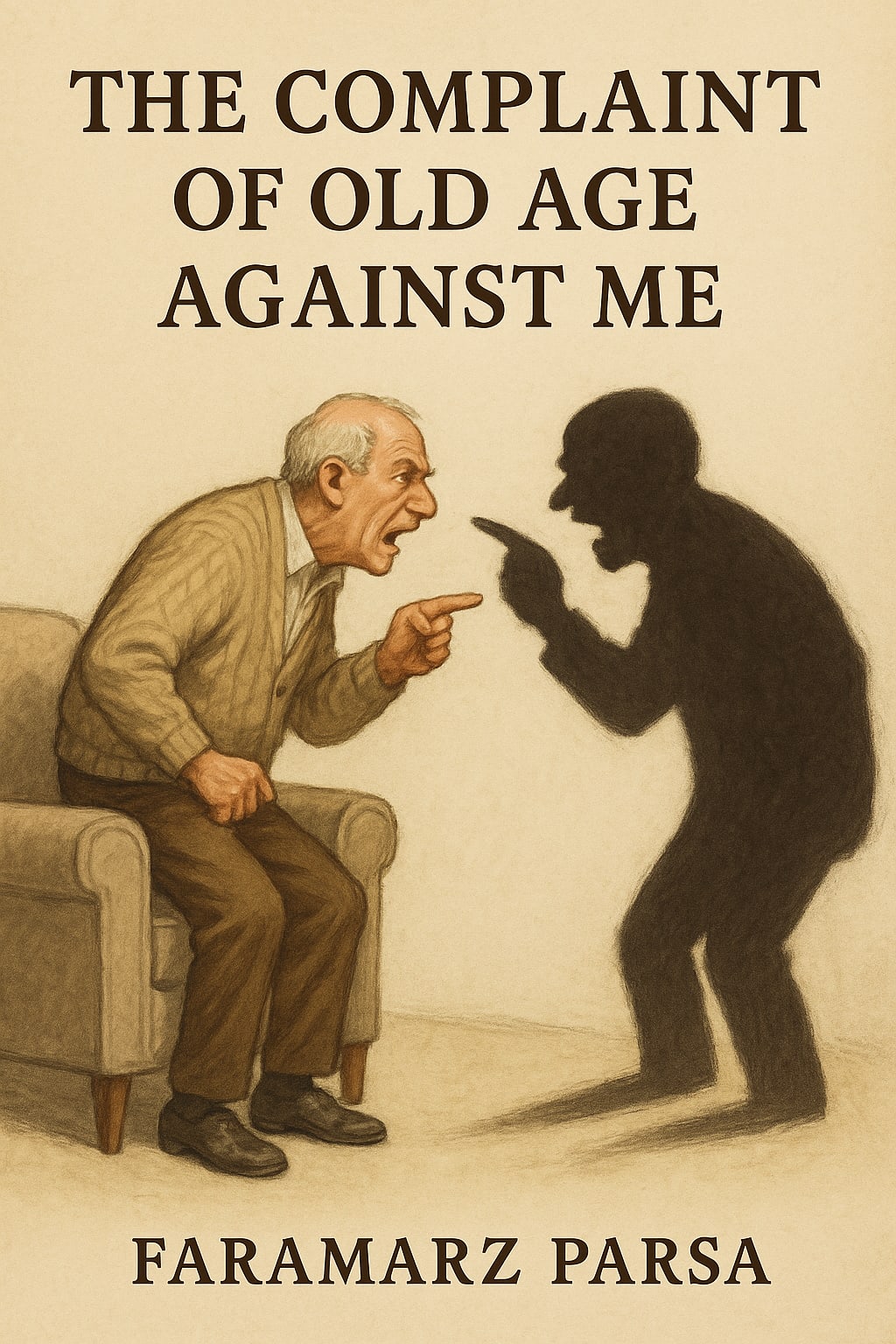
Suddenly, a voice rose from inside me:
— Oh, you’ve seen nothing yet. I’ll make you cry soon.
Startled, I looked around.
“Who are you?”
— The one you’ve become.
“You mean… you’re my old age?”
— Exactly. When you were young, you never thought of me. You ran wild, as if time would never catch up.
The doorbell rang again, pulling me back to the present.
“I’m coming!”
But the voice returned:
— You never took care of me. Don’t expect me to take a single step for you.
“What are you talking about?”
— Oh, come on. Remember the cigarettes? How many packs a day?
The drinking until morning…
And now? Look around you: pills everywhere — three in the morning, four at noon, five or six at night.
You burned through your youth as if tomorrow didn’t exist.
You forgot my turn would come.
A body needs strength to stand, to walk, to breathe…
But you wasted it all. You were selfish.
The doorbell rang for the third time.
“Enough! Let me see who’s at the door.”
But my old age wasn’t done. It sounded furious.
— It should be angry! You think I forgot last night when you begged,
‘Youth, help me… old age is killing me’?
“So that’s why you’re upset?”
Old age shouted:
— Of course! You’re calling for youth now?
Youth is terrified of me — it won’t come near you anymore.
“All right… tell me what I can do.”
— Finally, a real question.
Stop being lazy.
Walk an hour in the morning, an hour in the evening.
Let me breathe some fresh air.
And stop repeating that old foolish line:
‘When you’re young, why think of old age…’
It’s wrong — completely wrong!
You should say:
‘Youth must support old age, so it can hold your hand when the weak days arrive.’
“So if I listen to you, everything will be better?”
— Not as good as it would’ve been if you had cared for me when you were young…
But still better than nothing.
Now go — get yourself ready.
I opened the door,
but whoever had been knocking was already gone.
It was too late.
About the Creator
Ebrahim Parsa
⸻
Faramarz (Ebrahim) Parsa writes stories for children and adults — tales born from silence, memory, and the light of imagination inspired by Persian roots.
Keep reading
More stories from Ebrahim Parsa and writers in Confessions and other communities.
Word of the Day: ホチキス
I don't know the word for Staples. I remember I used to think that Hochikisu was an Onomatopoeia for a stapler rather than a brand name. I am pretty sure I already have this title as a theme, which is making me feel many sort of ways as Vocal is harassing me about payments currently.
By Kayla McIntosh20 days ago in Confessions


Comments (1)
What a gentle reminder that our bodies have been our most loyal companions all along.The dialogue between youth and old age feels like a conversation I’ll one day have with myself.