
Shahbaz Sharif vs Netanyahu at the UN: A Clash of Moral Narratives
Between Diplomacy and Defiance — How Pakistan and Israel Used the UN Platform to Frame Their Stories

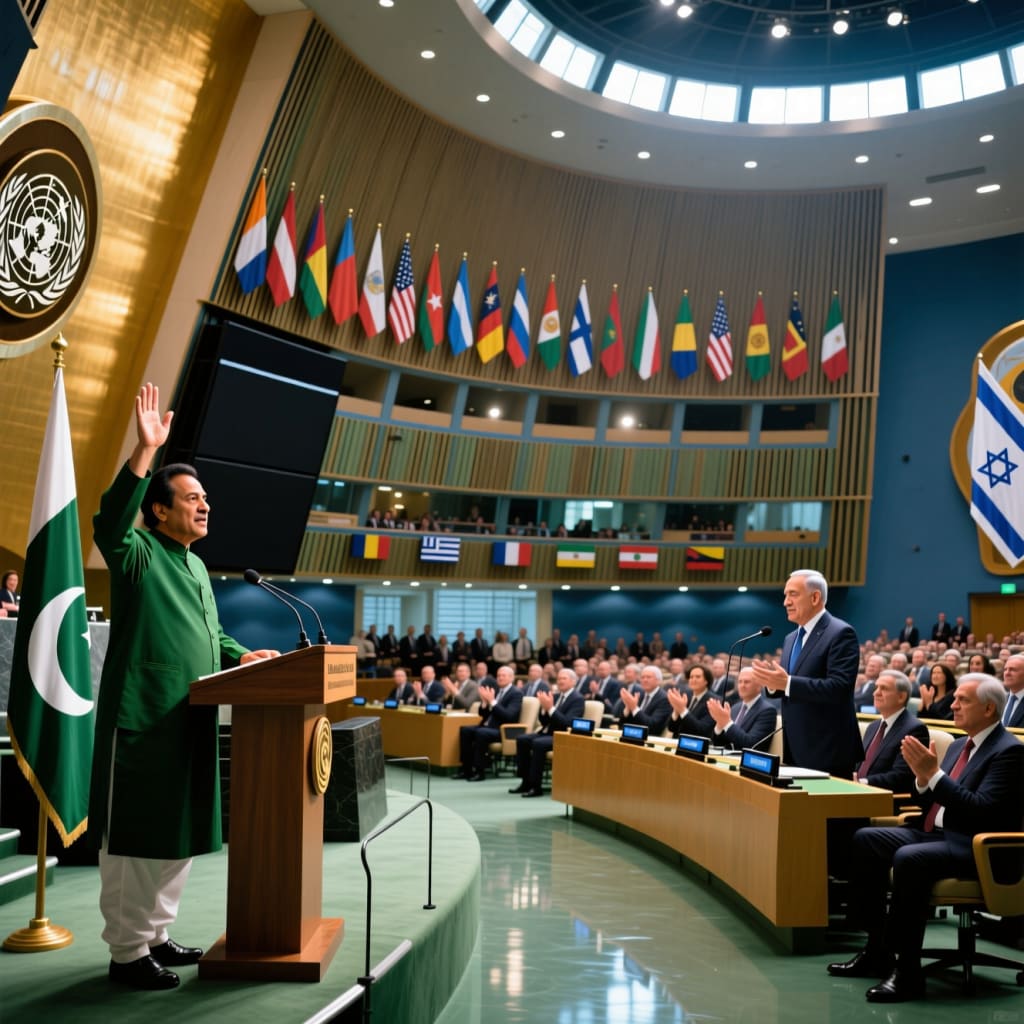
Shahbaz Sharif vs Netanyahu at the UN: A Clash of Moral Narratives
When the General Assembly convenes at the United Nations, it becomes a stage not just for policy but for performance — a place where nations wrestle to shape narratives, appeal to conscience, and declare moral authority. In this year’s assembly, the speeches of Pakistan’s Prime Minister Shehbaz Sharif and Israel’s Prime Minister Benjamin Netanyahu encapsulated two starkly different visions. Their addresses — moments of confrontation and contrast — reveal more about the global battle over legitimacy, justice, and the power of rhetoric than about immediate diplomatic outcomes.
Setting the Stage
At the 80th session of the UN General Assembly, Shahbaz Sharif and Benjamin Netanyahu spoke on different days, but their addresses echoed across the same global audience. Sharif’s speech came amid growing international condemnation of the violence in Gaza and the broader Israel-Palestine conflict.
Netanyahu’s appearance, meanwhile, was met by walkouts, protests inside and outside the UN hall, and demands for accountability.
The contrast between their receptions foreshadowed the clash of narratives to follow.
Sharif’s address drew attention for its impassioned defense of the Palestinian people, while Netanyahu sought to justify Israel’s actions as matters of national security and moral imperative. The UN platform thus became their battleground.
Sharif’s Moral Appeal: The Voice of the Oppressed
Shehbaz Sharif’s speech embraced a language of victimhood, justice, and moral responsibility. He portrayed Pakistan as part of a global conscience standing with the oppressed. In his words, the struggle in Gaza was not merely a regional dispute but “the struggle of humanity against unconscionable violence.”
Key elements of his address included:
- Humanitarian framing. Sharif emphasized the scale of suffering, invoking children, families, and displacement — the images that stir moral urgency.
- Legal and Islamic references. He appealed to international law, human rights principles, and Islamic notions of justice, arguing that Pakistan’s stance is rooted in faith as much as morality.
- Call for action, not just words. Sharif did not only condemn; he urged the UN and member states to take concrete steps — sanctions, accountability, diplomatic pressure — against violations.
- Solidarity narrative. He positioned Pakistan not as a distant observer, but as a participant in global resistance to injustice. This allowed him to shift from defender to protagonist in the struggle for Palestinian rights.
The result was a performance that aimed to rally moral support, striving to frame Israel’s actions as outrageous violations of common humanity. For many in the Global South, Sharif’s voice resonated.
Netanyahu’s Counter: Sovereignty, Security, and Narrative Control
Benjamin Netanyahu’s speech, on the other hand, operated from a very different foundation. He cast Israel’s actions in the light of existential defense, and sought to delegitimize the oppositional narrative.
Prominent features of his address and the surrounding context included:
- Right to self-defense. Netanyahu framed Israel’s role as responding to terrorism and existential threats, arguing that the state has a duty to protect its citizens.
- Narrative of distortion. He often claimed that Israel is misrepresented, that accusations are exaggerated or false, and that the complexity of security threats is not understood by adversaries.
- Rejection of ceasefire calls. Unlike Sharif’s plea for immediate action and censure, Netanyahu insisted that a full ceasefire is unsuitable, as Israel must continue military pressure.
- Disruption as message. The walkouts, protests, and public anger that greeted him were used to underscore Israel's defiance — a kind of spectacle to communicate that Israel won’t bow to external pressure.
His address was less about persuasion of those already sympathetic and more about shoring up support among allies, asserting Israeli sovereignty, and pushing back against the narratives of victimhood.
Clash of Narratives: Legitimacy, Morality, and Power
At the heart of the Sharif vs Netanyahu dynamic in the UN setting lies a tension between two competing narratives:
- Victimhood and Justice vs. Security and Sovereignty. Sharif’s speech leans on the moral high ground of oppressed peoples, while Netanyahu emphasizes the inescapable demands of state security.
- Global Conscience vs. Realpolitik. Sharif appeals to the conscience of nations, pushing for collective responsibility. Netanyahu counters with the argument that great powers and geopolitics will always mediate outcomes— not moral proclamations alone.
- Symbolic Weight vs. Enforcement Capacity. While Sharif’s rhetoric draws attention, the question remains: who can act? Netanyahu’s appeals implicitly underscore that power — military, diplomatic, economic — remains the decisive currency.
The UN becomes less a neutral ground and more a theater in which narratives are contested. Sharif’s challenge is to translate moral outrage into tangible pressure and policy. Netanyahu’s challenge is to avoid diplomatic isolation despite the weight of international critique.
After the Mic Fades: What Matters
Speeches are symbolic, but the real effects lie in what follows:
- Diplomatic momentum. Sharif’s words may help solidify alliances and international backing for measures (e.g. resolutions, sanctions) against Israel’s policies.
- Defensive posture. Netanyahu will lean on alliances (notably the U.S.) to block punitive measures and maintain strategic backing.
- Public perception. For global audiences, these addresses help shape which side is seen as “right” or “wrong,” which matters in soft power and public diplomacy.
- Accountability mechanisms. Sharif’s blame campaign leans on invoking international legal bodies and tribunals. Netanyahu’s counter is to resist or dismiss such efforts as biased or politically motivated.
Ultimately, neither side expects a decisive victory on stage alone. Their hope is that their narrative becomes part of the broader strategic environment — in UN votes, in bilateral relations, in media framing, and in public memory.
About the Creator
Wings of Time
I'm Wings of Time—a storyteller from Swat, Pakistan. I write immersive, researched tales of war, aviation, and history that bring the past roaring back to life
Keep reading
More stories from Wings of Time and writers in Confessions and other communities.
The Silent Power Ranked No. 1 Pakistan’s Intelligence
Pakistan’s Intelligence: The Silent Power Ranked No. 1 In the shadowed world of intelligence, where silence speaks louder than speeches and precision matters more than parades, one agency has emerged with an unshakable reputation: Pakistan’s Inter-Services Intelligence (ISI).
By Wings of Time 4 months ago in Confessions
Word of the Day: ホチキス
I don't know the word for Staples. I remember I used to think that Hochikisu was an Onomatopoeia for a stapler rather than a brand name. I am pretty sure I already have this title as a theme, which is making me feel many sort of ways as Vocal is harassing me about payments currently.
By Kayla McIntosh22 days ago in Confessions
They Said Girls Don’t Do That. Turns Out We Always Have
There was a moment on my social media feed recently that felt small and huge at the same time. A woman on video leaned in and said, half joking, half reverent, “When the enemies finally become lovers and no one’s home.” There was a soft buzzing sound underneath the audio. Anyone who understood it understood it immediately. Anyone who didn’t was about to learn. The comment section exploded. Women laughing, women nodding, women confessing, women admitting, women asking, “Wait… we’re allowed to do that?” Like they needed permission. Like someone had to sign it off. Like there had ever been a rulebook handed out in the first place.
By No One’s Daughtera day ago in Confessions


Comments
There are no comments for this story
Be the first to respond and start the conversation.