
"Raised Between Languages"
A personal reflection on growing up bilingual and how language shaped identity, connection, and confusion.

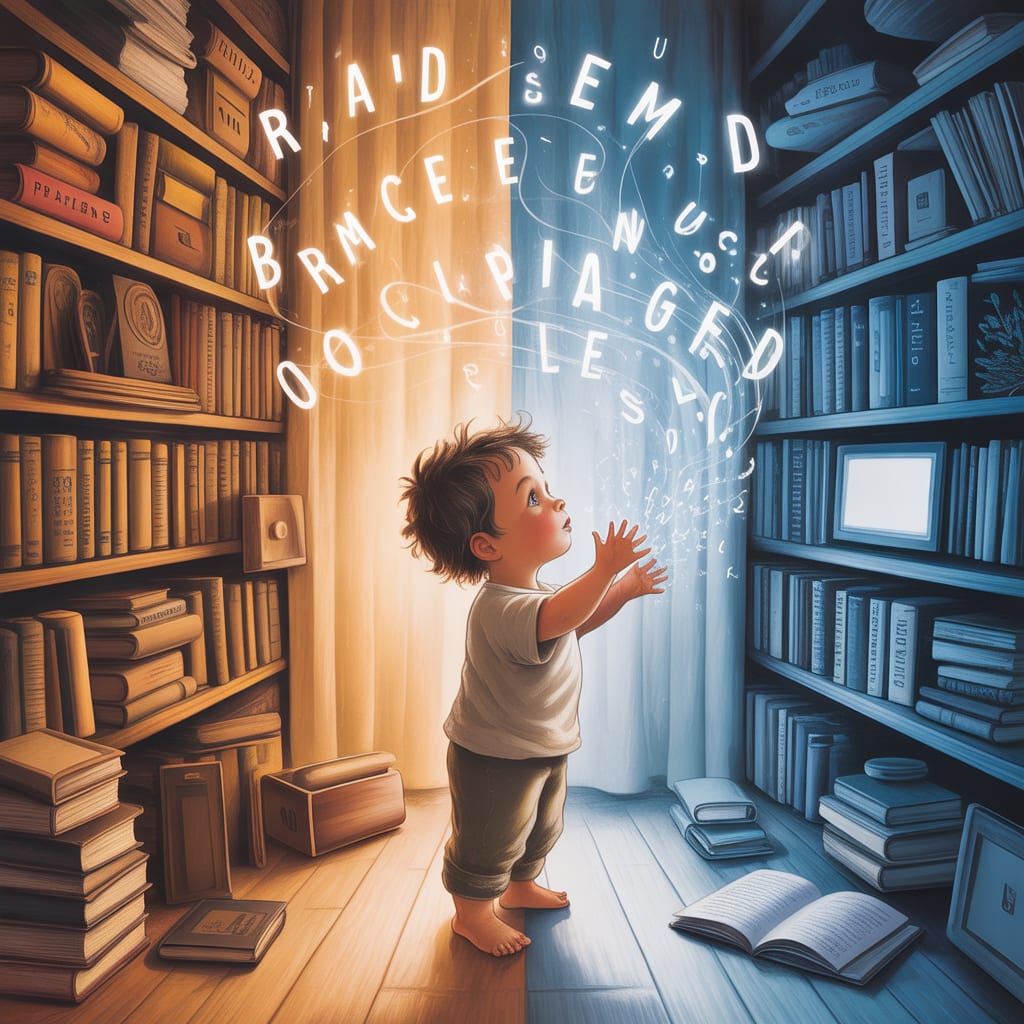
I was born between words.
Not in the sense that I came out speaking, of course—but the moment I learned to say hello, I also had to learn how to say salaam. One word felt round and warm, the other flowing like a whispered river. I didn’t realize at the time that I wasn’t just learning vocabulary—I was learning how to be different people in different languages.
At home, my parents spoke Urdu—soft, poetic, and full of metaphor. The kind of language that makes you feel like you’re living inside a poem, even when you’re arguing over who left the light on. It was the language of family, of late-night chai and Friday prayers, of my mother’s lullabies and my father’s favorite Faiz Ahmad Faiz couplets.
At school, though, it was all English—sharp, efficient, direct. Teachers corrected my pronunciation, classmates laughed when I said “chappal” instead of sandals, and I learned quickly to split myself in two. One version of me thrived in grammar tests and spelling bees; the other quietly translated jokes from Urdu into English in my head, trying to make them land the same way in two different worlds.
By the time I was nine, I’d become a master of code-switching. Urdu at home, English outside. I switched accents without thinking, even tone and posture. I adjusted. I adapted. And slowly, I began to ask myself the question so many bilingual kids do but never say out loud:
Which language is the real me?
The confusion didn’t hit me all at once. It crept in subtly, like background noise. At family gatherings, older relatives would scold me for forgetting words in Urdu:
"Beta, don’t you know what ‘dastarkhwan’ means? Are you forgetting your roots?"
But then at school, when my mom called out in Urdu at pickup—"Idhar aao!"—I’d flush with embarrassment as classmates turned to stare.
I wasn’t ashamed of either language. I loved them both. But I hated how they seemed to compete inside me, like two parents fighting for custody.
I remember once, in seventh grade, being asked to write a short story for English class. I wrote about a boy whose grandmother spoke no English and whose teacher couldn’t pronounce his name. I filled it with untranslated Urdu phrases, wanting my teacher to feel the disconnect I lived daily. When I handed it in, she gave it a B+.
“Nice story,” she wrote. “But I didn’t understand a lot of the dialogue.”
I wanted to scream, That was the point.
It was in high school that things started to shift. I read Jhumpa Lahiri, Ocean Vuong, Sandra Cisneros—writers who moved between languages like dancers, who didn’t apologize for the worlds their words came from. I realized that what I had considered confusion was actually something rare and powerful.
Bilingualism wasn’t a crack in my identity. It was the bridge.
Slowly, I began to use both languages more intentionally—not to divide my life but to enrich it. I texted my cousins in romanized Urdu. I wrote poems in English with Urdu metaphors. I listened to Coke Studio while annotating Shakespeare, and for the first time, both versions of myself sat in the same room.
I still slip up. I still forget a word in one language and try to fish it out in the other. And there are moments—especially in arguments—when I wish I could fully explain myself in Urdu but the words catch in my throat, or when I want to comfort someone in English, but nothing feels quite right.
But now, instead of seeing that as failure, I see it as evidence of my richness. My thoughts stretch across two worlds. My love speaks with two tongues. My identity doesn’t split—it spans.
A few months ago, my grandmother passed away. She’d always spoken to me in Urdu, even when I’d answer in English. In the days after her funeral, I found myself longing for the cadence of her voice, the way she’d say “meri jaan” like a prayer and a nickname all at once. I went looking through old letters she wrote—beautiful, flowing script, half-poetry, half-blessing.
And for the first time, I sat down and wrote back to her in Urdu.
I cried over every word I struggled to spell, but I finished the letter. It won’t be sent anywhere, of course. But in writing it, I realized I hadn’t lost the language. It had just been waiting, like a childhood home whose door is always open.
Now, when I think about language, I don’t ask myself which one is more “real.” I know that both are me. Both are my home.
Urdu taught me how to feel.
English taught me how to express.
Together, they taught me how to be.
About the Creator
Nadeem Shah
Storyteller of real emotions. I write about love, heartbreak, healing, and everything in between. My words come from lived moments and quiet reflections. Welcome to the world behind my smile — where every line holds a truth.
— Nadeem Shah
Keep reading
More stories from Nadeem Shah and writers in Confessions and other communities.
The Loneliest Role: Being the Strong One
There’s an invisible weight that comes with being “the strong one.” It’s the role no one assigns you, but somehow, it becomes yours. Maybe it’s because you don’t easily cry in front of others, or because you’ve mastered the art of saying “I’m fine” when you’re breaking inside. Perhaps it’s because you’ve always been the one who steps up—holding families together, carrying friendships on your shoulders, and being the steady voice when everyone else is falling apart.
By Nadeem Shah 5 months ago in Confessions
The Last Day of the Year
My New Year Countdown Clock indicates that I have just over five hours left before this year is over. I am stuck in the suburbs with my mother and stepfather, contemplating what I am going to eat and drink to celebrate this great change in our lives. The weather is cold, but I do not feel as though it has really affected my attitude about what the new year will bring...but I am not as happy with this moment as I usually feel.
By Kendall Defoe 18 days ago in Confessions
Am i Demon-possesed?
On my journey to trying to understand the development of schizophrenia I've endured over the last five years, has given me the ultimate question. Am I demon-possessed? Let me begin by expressing the psychosis I was in five years ago It started when I was living away from family. Now, it's important to not that the brain and mind are interchangeable and schizophrenia is a brain disease. From what I've been told and the major consumption of research it is a chemical imbalance in the brain that has been brought on by stress, trauma, genetics, environmental factors such as an emotionally distressing event, drugs, and psychological factors.
By Cerina Galvan5 days ago in Confessions



Comments
There are no comments for this story
Be the first to respond and start the conversation.