

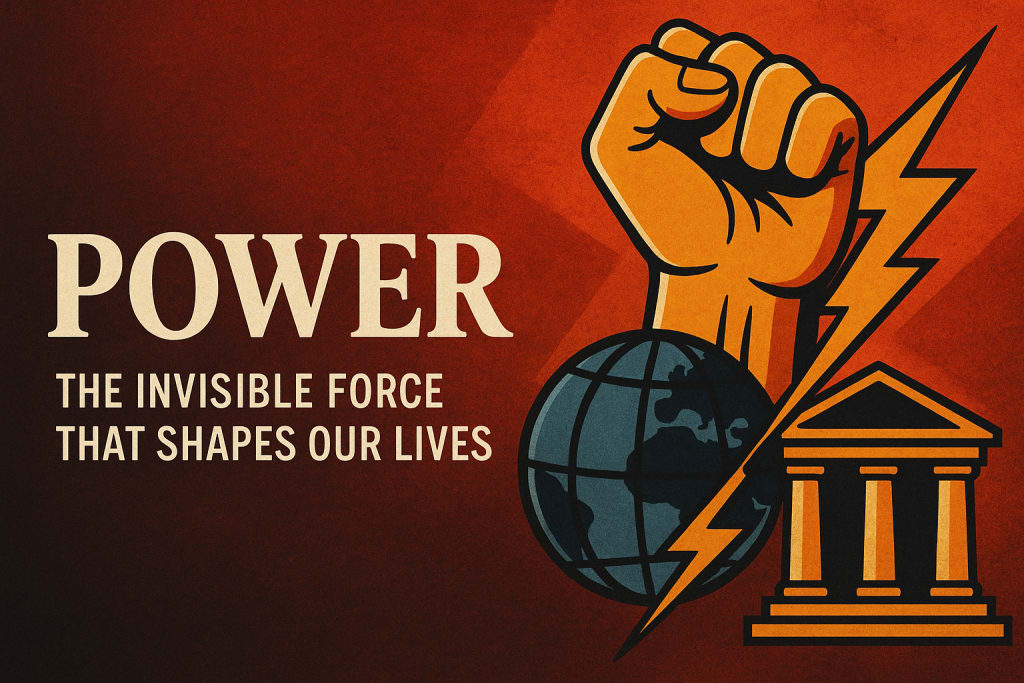
Power. It’s a word that stirs strong emotions—ambition, fear, respect, even awe. It’s the invisible current running beneath every interaction, every decision, every societal structure. But what is power, really? Is it dominance? Influence? Control? Or is it something more nuanced, even paradoxical?
At its core, power is the ability to affect outcomes. It is the capacity to influence others, to shape events, and to bring about change—whether on a personal, communal, or global scale. But while power can be a tool for justice, growth, and inspiration, it can also be wielded for oppression, manipulation, and destruction. Understanding power—how it works, who holds it, and how it is gained or lost—is key to understanding the world around us.
The Many Faces of Power
Power wears many masks. It can be overt, like a president signing a bill into law, or subtle, like a social media influencer shifting public opinion. There’s political power, which governs laws and nations. Economic power, which drives markets and opportunity. Social power, which defines cultural norms and values. Personal power, which resides within each individual and determines our ability to make choices and assert boundaries.
These types of power often overlap. A CEO, for instance, might possess economic power through control of a company, political power through lobbying, and social power through their public persona. Meanwhile, someone with no official authority can still shape the thoughts and behaviors of thousands through charisma or compelling storytelling.
Where Does Power Come From?
Power isn’t always inherited or assigned; often, it's earned—or taken. Traditional sources of power include:
Position: Power that comes from a role or title, like a manager, judge, or teacher.
Knowledge: Power rooted in expertise, like a scientist influencing policy.
Charisma: The magnetic force of personality that attracts loyalty and persuasion.
Network: The ability to influence through connections and relationships.
Access to Resources: Controlling money, information, or tools gives one leverage.
But power can also arise from collective action. Movements like civil rights protests or climate advocacy show how ordinary people, when united by a cause, can challenge and even overturn powerful institutions.
The Psychology of Power
Power doesn’t just change how we interact with the world—it changes how we think and behave. Psychological studies have shown that people in positions of power are more likely to take action, speak first, and take risks. Power can boost confidence and assertiveness—but it also has a dark side.
The classic saying "power tends to corrupt, and absolute power corrupts absolutely" isn't just a political commentary—it’s rooted in human behavior. When people gain unchecked power, they may become less empathetic, more self-serving, and more disconnected from the consequences of their actions. This is why power, without accountability, can be dangerous.
Yet power doesn’t inherently corrupt—it reveals. It brings out the underlying values and intentions of the person who holds it. A leader with compassion may use power to protect and uplift, while one driven by ego may use it to dominate and divide.
Power and Resistance
Where there is power, there is also resistance. Throughout history, those without power have found ways to challenge the status quo. From Mahatma Gandhi’s nonviolent resistance to colonial rule, to the #MeToo movement exposing abuses of power in the workplace, these acts of defiance remind us that power is never static.
Resistance takes many forms: protest, art, whistleblowing, education, innovation. It is the means by which marginalized voices can be heard, oppressive systems can be questioned, and new paradigms can emerge.
In some cases, resisting power leads to revolution. In others, it sparks dialogue and reform. But always, it serves as a crucial counterbalance to unchecked authority.
The Illusion of Power
One of the most fascinating aspects of power is how fragile it can be. Dictators have fallen overnight. Empires have crumbled in a generation. Celebrities with millions of followers can lose influence with a single scandal.
Power is often perceived rather than possessed. A person is powerful only as long as others recognize their authority. This recognition can be based on respect, fear, admiration, or tradition. But once that recognition fades, so does the power.
Consider the workplace: a boss may have formal power, but if employees no longer respect or trust them, their influence quickly erodes. On the flip side, a junior employee with integrity and vision may quietly gain influence, becoming a true leader in practice, if not in title.
Empowerment: The Other Side of Power
Not all power is about control over others. True empowerment is about enabling others to realize their potential. It’s the teacher who inspires students to think critically. The parent who encourages independence. The leader who listens as much as they speak.
Empowerment shifts the focus from domination to collaboration. It recognizes that power is not a finite resource—when shared, it multiplies. A society where people feel empowered is more innovative, more just, and more resilient.
Today, movements for equity and inclusion are fundamentally about redistributing power—ensuring that those historically excluded from decision-making tables have a seat and a voice. It’s about challenging the idea that power belongs to a select few, and affirming that everyone has the right to shape their future.
Power in the Digital Age
In our hyperconnected world, the nature of power is changing rapidly. Social media platforms, algorithms, and data collection are reshaping how influence is gained and wielded. A viral tweet can topple a reputation. A tech company’s algorithm can sway elections. Data has become a new currency—and those who control it have enormous power.
This new frontier presents both opportunities and threats. On one hand, digital tools allow marginalized communities to organize and speak out. On the other, they create new avenues for surveillance, manipulation, and misinformation.
Navigating power in the digital age requires new forms of literacy—not just technical skills, but ethical awareness, critical thinking, and a commitment to transparency and accountability.
Conclusion: Rethinking Power
Power is not inherently good or bad. It is a force—a tool—that can build or destroy, liberate or confine, depending on how it’s used. The real question is not whether power exists, but how we choose to wield it.
Are we using power to dominate or to elevate? Are we challenging abuses of power when we see them? Are we empowering ourselves and others to speak, act, and lead?
In a world shaped by power, the greatest strength may lie not in seizing control—but in sharing it.
About the Creator
Keep reading
More stories from D A R K and writers in Confessions and other communities.
"10 Common Mistakes to Avoid When Starting Your Career"
Starting your career is an exciting yet challenging journey. The transition from education to the workplace can be overwhelming, and it’s natural to make a few missteps along the way. However, by being aware of common mistakes that many early-career professionals make, you can position yourself for long-term success. Below are ten frequent errors to avoid when embarking on your professional path.
By D A R K10 months ago in Confessions
This Is What I Do When People Throw Rocks At Me
Rocks have been thrown at me for a greater part of my life. Some have been small and missed hitting me. When people don't get a reaction from me, they throw bigger rocks with a better aim. Many have been hurled at me with precision over the years. For a long time, I thought my only options were to dodge them or be crushed by them.
By Margaret Minnicks3 days ago in Confessions
Cold Coffee and Red Ink
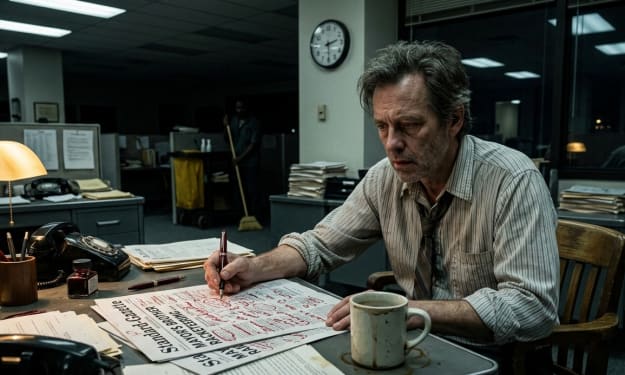
The clock on the wall of the Standard-Gazette newsroom didn’t tick; it thudded, a heavy, rhythmic reminder that Arthur Penhaligon was officially out of time.It was 3:14 AM. The fluorescent lights overhead hummed with a sick, flickering yellow energy that made the bags under Arthur’s eyes feel like lead weights. On his desk sat a ceramic mug—once white, now stained with a permanent ring of tannin. He took a sip. The coffee was stone cold, a bitter oily film coating his tongue. It tasted like failure and long division.Beside the mug lay the galley proofs for the morning edition. They were hemorrhaging.Arthur held a fountain pen gripped so tightly his knuckles were white. The ink was a shade of crimson called "Oxblood," and he had used it to eviscerate the lead story. Great sweeping strikes crossed out adjectives; jagged circles trapped grammatical errors like flies in amber. But the red ink wasn't just for style tonight. It was for survival."You’re bleeding it dry, Artie," a voice rasped from the shadows of the cubicle row.Arthur didn’t look up. He knew the scent of cheap cigars and peppermint anywhere. It was Elias, the night janitor, a man who had seen more scandals swept into dustpans than Arthur had ever printed."The truth is messy, Elias," Arthur muttered, his pen hovering over a paragraph that implicated the Mayor’s brother in a construction racketeering scheme. "It needs to be precise. If I miss one comma, the lawyers will have us for breakfast. If I miss one fact, I’ll be looking for a job at a greeting card company by noon.""You’ve been 'precise' for twelve hours," Elias said, leaning on his broom. "At some point, you're just stabbing the paper."Arthur finally looked up. His reflection in the dark window across the room looked like a ghost—gaunt, grey-skinned, and haunted. "I found a discrepancy."He pointed his red pen at the ledger notes he’d been cross-referencing. The ink there was different. It wasn't his. Someone had been in his office while he was at dinner, and they had made their own "corrections." Someone had tried to sanitize the blood out of the story, and they had used a red pen that matched his exactly."Look at this," Arthur whispered, his voice cracking. "The numbers in the second paragraph. They’ve been shifted by a single decimal point. It looks like a typo. It should be a typo. But $1.2$ million becoming $12$ million changes this from a local bribe to a federal conspiracy."Elias stopped leaning and stepped closer, his eyes narrowing. "And you didn't change it back?""I can't," Arthur said, gesturing to the cold coffee. "The editor-in-chief signed off on this version five minutes before he bolted out the door. If I change it back to the truth, I’m 'sabotaging' the paper. If I leave it, I’m publishing a lie that will ignite a firestorm the city can't put out."The silence of the newsroom felt heavy, like the air before a lightning strike. Arthur looked at the red ink on his fingers. It looked remarkably like the real thing. He realized then that the "Red Ink" of the title wasn't just about editing—it was about debt. The debt of the truth.He looked at the cold coffee, then at the clock. $3:22$ AM. The press started rolling at $4:00$."You know," Elias said softly, "sometimes the only way to fix a mess is to knock the whole bottle over. "Arthur looked at the bottle of Oxblood ink sitting precariously near the edge of the desk. He looked at the galley proofs. He thought about the years he’d spent chasing the perfect sentence, only to realize that the most powerful thing he could do wasn't to write—it was to erase.He didn't pick up the pen. Instead, he picked up the mug. He swirled the cold, dreg-filled liquid one last time."I'm not an editor anymore, Elias," Arthur said, a grim smile finally touching his lips. "I'm a witness."He stood up, grabbed the red ink, and headed toward the elevator that led down to the printing press. The coffee stayed behind, a cold monument to a career that was about to end in a very loud, very public explosion of ink and paper.
By aadam khana day ago in Confessions
Magic
Note from the Author: I want to let you know that this is an unusual story, and it has been written purely from whatever is in my unconscious mind, because before I start writing, I get into a flow state that reaches my unconsciousness. I also write in my subconscious mind, which is like a mid-flow state between the conscious and unconscious mind.
By Denise Larkin7 days ago in Fiction



Comments
There are no comments for this story
Be the first to respond and start the conversation.