
Loyalty in the Court of Caliph Muʿāwiya
A Bedouin’s plea for justice, a governor’s betrayal, and a wife’s unwavering love put to the ultimate test.

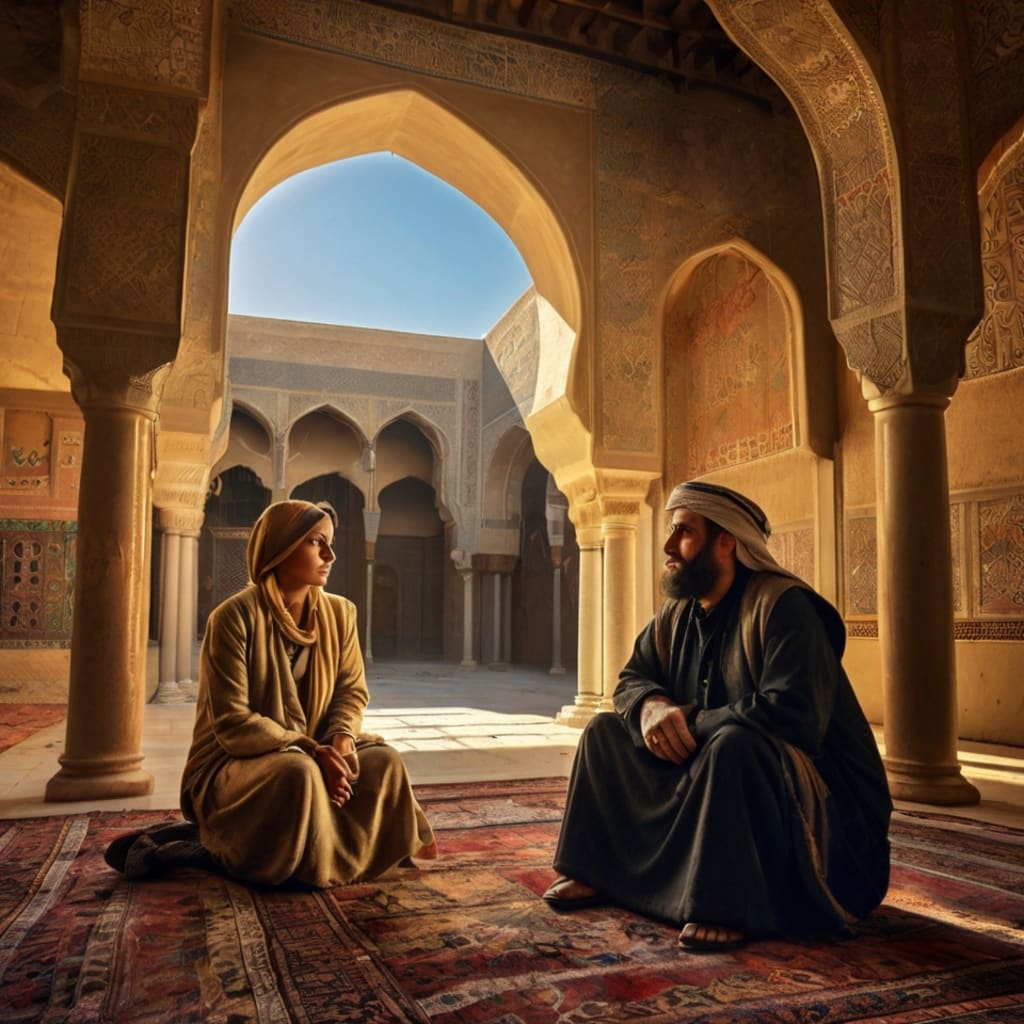
Loyalty Tested in the Court of Caliph Muʿāwiya- BY:Khan
The sun blazed mercilessly over Damascus. It was noon, and the heat pressed down on the earth like a heavy blanket. Inside his grand palace, Caliph Muʿāwiya ibn Abī Sufyān sat by a window, gazing out across the vast open fields that stretched as far as the eye could see.
Suddenly, his attention fixed on a lone figure staggering across the burning ground. The man was barefoot, struggling forward under the punishing sun. The Caliph pointed him out to those gathered around him and said, “Who could be more unfortunate than the one forced to travel in such unbearable heat?”
One courtier replied softly, “Commander of the Faithful, perhaps he carries a need that has driven him to you.”
The Caliph nodded. “By Allah, if he has come with a plea, I shall grant it.” He ordered a servant to wait at the palace gates and allow the weary traveler entry if he sought an audience.
A few moments later, the man stood before the Caliph. His face was lined with hardship, his clothes worn, and his body weak from the journey. Yet his eyes burned with determination.
“What brings you here?” asked the Caliph.
The man bowed. “O Leader of the Believers, I come to seek justice. I have been wronged.”
“Who has wronged you?”
“Your governor, Mervān ibn al-Ḥakam,” the man said bitterly. “He has oppressed me and stolen from me what was dearest to my heart.”
The Caliph leaned forward. “Tell me your story.”
The man took a deep breath and began.
“I had a wife, Sāʿd, whom I loved dearly. We owned a caravan of camels and lived in comfort. But famine struck our land, and I lost everything. My father-in-law, disgusted by my poverty, forcibly took my wife away from me.
I turned to Governor Mervān for justice. He summoned my father-in-law, who lied, claiming that his daughter no longer wished to live with me. I begged Mervān to ask Sāʿd herself, and she was brought before him. But when Mervān saw her beauty, he was captivated.
Instead of delivering justice, he turned against me. He insulted me, ordered me imprisoned, and struck a bargain with her father: in exchange for one thousand gold dinars, I was to be forced into divorcing her so that Mervān could marry her himself.
I refused, but he had me tortured until I could endure no more. In pain and despair, I divorced her. After her waiting period, Mervān married her.”
The man’s voice broke. Tears rolled down his cheeks, and he collapsed to the floor unconscious.
A hush fell over the court. The Caliph’s expression darkened with anger.
“Mervān has dared to transgress the limits of Allah and has dishonored a Muslim’s household!”
He called for pen and paper and wrote a stern command:
“It has reached me that you have exceeded the bounds of Islam and committed injustice against your subject. Immediately divorce this woman and send her to Damascus with Naṣr ibn Dhubyān.”
Mervān, faced with the Caliph’s authority, had no choice but to comply. He divorced Sāʿd and sent her, along with a letter laced with poetry. In it, he pleaded for forgiveness and admitted his weakness: ‘When you see her beauty, O Caliph, you will understand. She is like the rising sun, a sight that no man or jinn has ever beheld before.’
When Sāʿd arrived in Damascus, the Caliph saw that Mervān’s words had not been exaggerated. She was strikingly beautiful, but more than that, her speech was eloquent, her mind sharp, and her presence commanding.
The Caliph decided to test her loyalty. He turned to the Bedouin and said, “Why do you cling to her so desperately? I will grant you three slave-girls, each as fair as the moon, with a thousand dinars each. From the treasury I will provide enough wealth for you to live in comfort. Forget her, and take this instead.”
The man cried out, his voice echoing in the hall: “I came here seeking justice against Mervān’s tyranny. Now tell me, O Caliph—if you too deny me justice, where shall I turn?”
The Caliph smiled. “You admitted you divorced her, and Mervān too divorced her. Now she is free to choose. Sāʿd, the decision is yours. Choose between three men: the Caliph with his palace and power, Mervān with his cruelty and wealth, or this Bedouin with his poverty.”
Without hesitation, Sāʿd spoke in verse:
“Though he is poor and destitute, in my eyes he is more honorable than my entire tribe. He is dearer to me than all else.”
She continued, her voice steady: “O Commander of the Faithful, I will not abandon him because of hardship or poverty. My bond with him is old and cannot be erased. I shared in his joys during days of prosperity; how can I forsake him now in struggle?”
The Caliph’s stern expression softened into a smile. He was moved by her loyalty and love. “Sāʿd, I only wished to test you. Truly, this is how a Muslim wife should be—faithful, steadfast, and unshaken by fortune.”
He ordered that both she and her husband be granted two thousand gold dinars each from the treasury.
Thus, justice was restored, and a timeless lesson was left behind: true loyalty does not waver in hardship, and real love cannot be bought with wealth or power.
About the Creator
Keep reading
More stories from Khan and writers in Confessions and other communities.
The Prize Hunter and the Junkyard Trick
The Prize Hunter and the Junkyard Lesson BY:Khan Bashir Ahmed Bhatti, my old friend, has an unusual obsession. He is always chasing after prize schemes. Over the years, he has won several items through lucky draws—small and big prizes alike. A washing machine, a motorcycle, household appliances—he has collected them all, free of cost.
By Khan 4 months ago in Confessions
Two girls, one library, and a hunger for worlds beyond your own—Part 3
The maths teacher, he tried to speak with my father then back. Nothing came good of that! Quite the contrary. So latter, when he, my father, moved in a small city, where i went further to another high school, and he put me out, i had the occasion or the luck, to ''land '' at the door of my cousin and her brother, after 1 am in the night! I had a small luggage. And trembling from fear and cold! Her brother was married with 2 children there and his sister in 2 rooms. Somehow, there was found a place for me! I will not tell you the reason my father throw me out. Or maybe I should?
By C.M.about 22 hours ago in Confessions



Comments (1)
"Great article! I really enjoyed your insights and perspective. You’ve done a fantastic job presenting the topic. If you have a moment, I’d love for you to check out my article as well. Looking forward to hearing your thoughts!"