
The Prize Hunter and the Junkyard Trick
How a clever friend turned embarrassment into wisdom and walked away with a prize.
The Prize Hunter and the Junkyard Lesson
BY:Khan
Bashir Ahmed Bhatti, my old friend, has an unusual obsession. He is always chasing after prize schemes. Over the years, he has won several items through lucky draws—small and big prizes alike. A washing machine, a motorcycle, household appliances—he has collected them all, free of cost.
The secret of his winnings lies not in luck alone but in his peculiar habit. He never throws away wrappers. Soap wrappers, tea packets, biscuit covers—even empty cigarette packs—he hoards them all in his house like a treasure trove. Whenever a company announces prizes through a lucky draw, he is the first one to pull out a stack of wrappers, scribble his name, ID card number, and mobile phone on them, and drop them into the entry boxes.
Most people buy the products just to participate in the scheme, but my friend never spends a dime. He scavenges wrappers from wherever he can find them—at shops, in trash heaps, or even in the junkyard. For him, every wrapper is a lottery ticket, and the more entries he sends, the better his chances of winning. And indeed, his tactic often pays off.
The companies, of course, are not blind to this trickery. They know many participants send in wrappers without purchasing the products. But since a wrapper carries no proof of whether it was bought or found, they are forced to honor the winner. A currency note works the same way: whether earned through hard work or picked up from the street, it holds its value everywhere. Similarly, a wrapper is valid as long as it isn’t torn or soiled.
Still, some companies have become smarter. They now mark new products with a golden star, insisting that only star-marked wrappers qualify for the draw. Others insert coupons inside the packaging, forcing customers to purchase the item to participate. These innovations have reduced the tricks of people like my friend, but his passion remains undimmed.
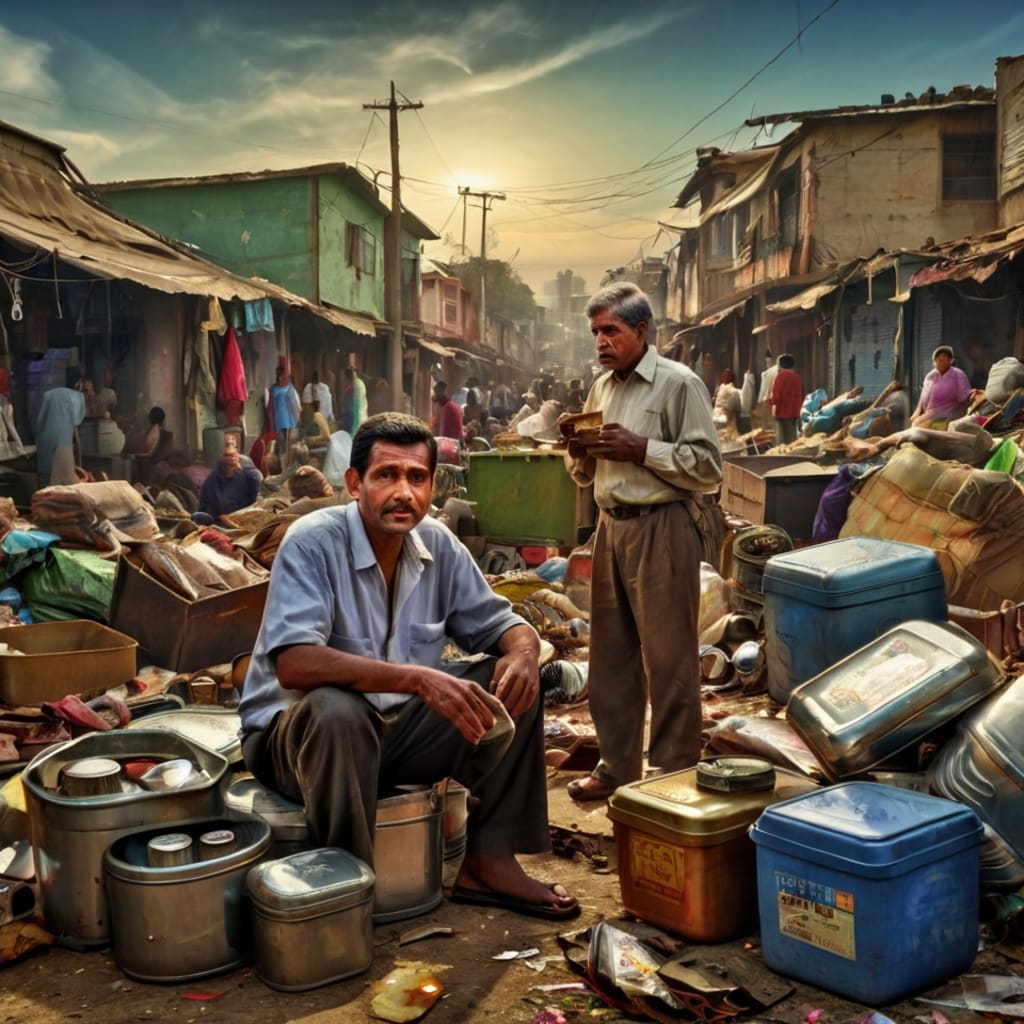
One pleasant afternoon, with cool breezes sweeping the city, my friend and I were strolling down a busy street. As we neared the bazaar, rows of junk shops came into view. On one side of the road stood two warehouses, and on the other, three more yards buzzing with business. Pushcart vendors were weighing scrap paper, bottles, and broken goods while the junk dealers, dressed in shabby clothes, sat lazily on their chairs, paying cash and recording tallies.
Among the piles of junk, my friend’s sharp eyes caught sight of something—a shiny, almost brand-new tea tin lying on top of a mound of scrap. Its retail price would have been around 190 rupees. To him, it wasn’t just an empty container—it was a golden ticket. Without hesitation, he stepped forward, picked it up, and examined it with delight.
But his small act didn’t go unnoticed. The junk dealer, sitting nearby, shouted in a harsh tone, “Uncle, please put that back. It’s not yours.”
The words struck like a whip. My friend froze. All eyes turned toward him. The other junk dealers, sensing a moment of drama, began staring, eager to watch him squirm. The tin itself was worthless, but his mistake was in picking it up without permission. The dealer’s voice had exposed him, and embarrassment is heavier than any burden.
For a moment, my friend looked shaken, but being clever and quick-witted, he recovered instantly. Saving face was now more important than saving the tin. He beckoned the junk dealer over with a mysterious smile. Curious, the man walked up. I, too, drew closer, wondering what trick my friend would pull this time.
Holding the tea tin, my friend pointed at the printed word “Supreme.”
“What does this say?” he asked.
The dealer, who was literate enough, replied, “It says Supreme.”
“Good,” said my friend. “Now tell me, if you remove the letters ‘Sup,’ what remains?”
“Then it becomes ‘reme’—or rather ‘reme,’” the dealer answered hesitantly.
“And if we add the letter K before it, what word do we get?”
The dealer thought for a second. “That would make it ‘Kreme’—or ‘Cream.’”
My friend leaned in dramatically. “Exactly. And cream sounds like ‘Kareem.’ Tell me, Kareem and Raheem—what are these names?”
The dealer chuckled. “Kareem was my father’s name. Raheem was my uncle’s.”
“Wrong!” my friend declared firmly. “No ordinary human is named Kareem or Raheem on their own. These are sacred names—attributes of Allah Himself. That is why our parents always prefix them with ‘Abdul,’ making them Abdul Kareem, Abdul Raheem. Without ‘Abdul,’ they belong only to God.”
The dealer scratched his back nervously. “Yes… yes, you are right. My father’s real name was Abdul Kareem, and my uncle was Abdul Raheem.”
My friend pounced on the moment. “So you see, this word on the tin—‘Supreme’—contains the sacred letters that form the word Kareem. And here you are, letting it lie in the dirt among scrap and filth. Do you realize what a grave sin that is? Words connected to the divine should be kept in a clean, elevated place, not tossed onto a junk heap.”
The dealer’s eyes widened. He folded his hands apologetically. “You are absolutely right. I have made a big mistake. Please, take this tin and place it somewhere respectful. I don’t want to be guilty of disrespect again.”
My friend nodded gravely. “Good. Learn from this. Never let sacred words fall into dishonor again.” He shook the dealer’s hand, tucked the tin under his arm, and walked away with me.
Once we were at a distance, I turned to him and asked, half amused, half amazed, “What was that all about? You turned a scolding into a sermon and walked away with the prize.”
He grinned slyly. “If I had simply put the tin back, I would have lost face. The dealer wanted to embarrass me, but I outsmarted him. And besides,” he winked, “I didn’t lie. Respect for sacred words is indeed our duty.”
I couldn’t help but laugh. That was my friend—always cunning, always ready with a trick, and forever chasing prizes, even if it meant turning a junkyard lesson into a theological debate.
About the Creator
Keep reading
More stories from Khan and writers in Confessions and other communities.
A House Divided: When a Father’s Betrayal Shattered a Family
A House Divided BY:Khan Khalid Mahmood Ashraf’s life took a turn the day his wife, Bushra, fell seriously ill. For years, she had been the heart of their home — the mother of five daughters and two sons, the anchor of a bustling household. But this time, when she was admitted to the hospital after her third heart attack, the doctors shook their heads grimly. “Pray for her recovery,” they told the family, “the rest is in God’s hands.”
By Khan 6 months ago in Confessions
Open Relationships Require Clear Rules Communication And Emotional Honesty Consistently
An example of consensual relationship is open relationships where the partners are willing to have romantic or physical relationship with other people. In contrast to the conventional monogamous relationships, open relationships are based on a high level of understanding and clear expectations. The partners also need to conform on how the relationship is to be organized and observe the boundaries of the other partner. Open relationships when done well can enable one to experiment with new relationships without abandoning the main one.
By Robert Smithabout 10 hours ago in Confessions


Comments
There are no comments for this story
Be the first to respond and start the conversation.