
How Problems Get “Solved” in Naples
In Naples, people don’t really solve problems. They marinate them.

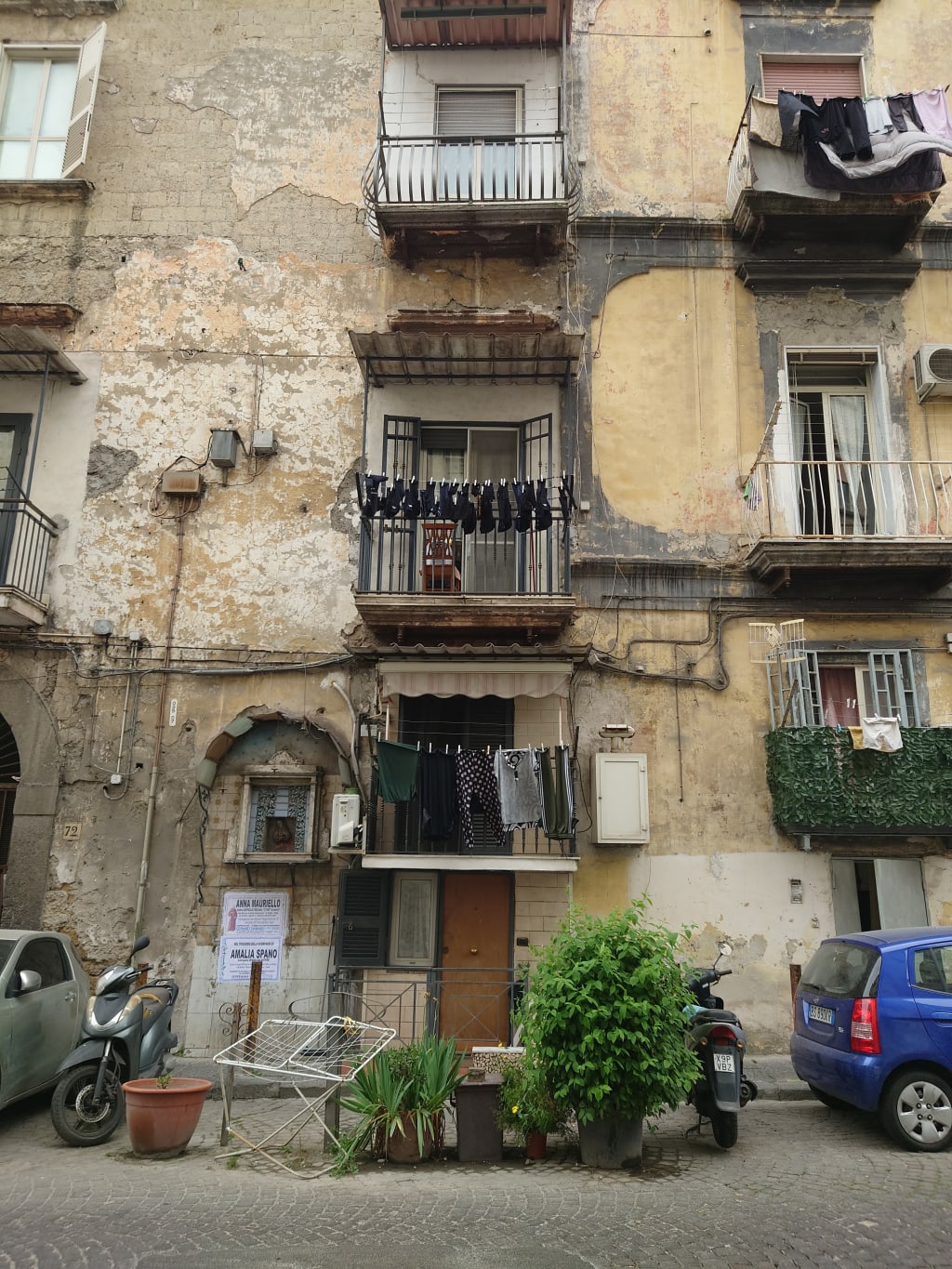
Two years ago, our roof started leaking. Well, leaking is a strong word for it; it was dropping tears on rare occasions — sometimes it seemed to me — to check in with us, as a kid does, to make sure their parents hadn't forgotten about the existence of the smallest.
Everyone in the family already knew that simple truth that the roof was not “at its best.” Yet, people in Naples know a lot of things in advance: the building is old, the wiring dates back to the ancient Greeks, or the rains in winter are like guests who you wish had not come.
Despite such profound knowledge, there is no bother as long as it's not bucketing down in the cradle of Ancient Greece. They must be right, one can point out: if it ain't broke, don't fix it. So, nessun' did.
Why would anyone deal with a potential problem? For the reason of its prevention, isn't that enough as a motive? Maybe, maybe... but that doesn't really sound Napolitan. This does: potential problems live in the same parallel universe as savings, retirement plans, and workers of any craft who actually show up on time.
Back to the story, winter after winter, water paved its path through microscopic gaps between the roof, the concrete, and the ceiling, layer by layer.
Beyond-our-knowledge doubts evaporated when the drywall quietly — and more importantly, visibly — got soaked. Its metamorphosis had become extremely obvious, thanks to the arrival of mold that made its presence known, seen, and felt.
Within a couple of days, the plaster began to crumble like tiny pieces of the puzzle. Indeed, that was a natural run of things. However brutal, the apartment started smelling less like “home” and more like a basement. Surprise me — half of Naples lives like that! We are not the first, nor will we be the last. "Tranquillo, caro," they lullabied me.
If you’ve ever walked around the tiny streets of Naples, you must've seen scooters wrapped in duct tape, wire, rope, and, by the look of it, the prayers of three generations. It does not take long to spot them in town: they rattle, they cough, but — much to foreigners' surprise — they move.
The first year, I laughed at these Franken-scooters too.
The second year, I looked up at our ceiling and didn’t laugh quite as loudly.
By the third, I started thinking. Deeply.
Last summer, I finally proposed a solution. The solution was quickly dismissed due to a lack of urgency and necessity. Instead, on the table, there was an idea. Not a proper repair, not a solution. An idea — that type of experiment that should not necessarily come to any fruition. Alright then.
On a sunny June day, a few well-tanned (apparently sun-lovers) guys went up to the roof with brushes and a waterproof sealant. They took their tops off and got their hands dirty. But no matter how steadily and sturdily their moves were performed, in some places the roof, already soaked through from the last winter, didn’t repel water — it repelled the sealant itself. As if it said: "Boys, are you serious?" I made sure to vocalize that thought, too.
— Tranquillo, caro. Nun te preoccupa'.
In summer, Naples is heaven.
Warm air, long light days, sea, wine, an abundance of cibo, linen shirts, half-naked ladies and Americans, and Campari Spritz at sunset above all.
Who cares what happens in winter? Who can say what winter may bring?
Naples always lives in the here and now. Everything is tutt’ appost, that magic Neapolitan “all good, all fixed, don’t worry.”
You can find it hard to imagine, but after fall came winter.
Temperatures dropped, and with them, tropical rains arrived. Not that romantic drizzle when you take an umbrella, walk out of the comforts of the room, and stroll around the city's majesty. But the kind of downpour that turns the city into an aquarium.
On the third or fourth day of this monsoon, our personal connection between heaven and the bedroom ceiling grew closer. Drops began to fall.
While I wasn’t in town (I was in Prague attending the sacred graduation ceremony after the 4-year academic ritual), my Neapolitan girlfriend was about to leave the apartment and, instead of putting a proper bucket under the new source of leakage, she left an installation. Please, switch your imagination on, as the following scene is so hard, almost impossible, to believe: on the mattress, directly under the leak, she laid out a pattern made of leather clothes and plastic trash bags. The leather, I suppose, was meant to get wet instead of the mattress. The bags — who knows, maybe for conceptual depth.
Naturally, the mattress got soaked anyway. No matter how vintage your pattern, gravity in Naples works just fine.
The next day, I came back and took the night shift.
From bad to worse, the old “spring” in the ceiling was still dripping, and it was joined by a second one.
All good things come in three. A day later — a third.
I stood under that ceiling, staring at the swelling drywall, getting darker and heavier, and thought only one thing, “The chandelier can’t possibly hold on. It just can’t hang on that mush forever.”
But every time in my life I voiced anything resembling concern, I got:
— Ilia, you’re being dramatic again.
So I detached myself with a mantra of "none of my business," even when the ceiling was literally darkening and warping above me.
The worst hadn't come, and I left for a couple of days. Some fresh air out in nature. Far from the dripping. Those days, ironically, were dry. As if the sky decided to give me a little hope.
I came back. Started pacing back and forth, peeking into the bedroom, looking at the ceiling that now resembled an old belly sagging under the fragile spine of the chandelier. I’d stare and think: “Will it hold? Won’t it? Maybe I really am exaggerating?”
Spoiler: I wasn’t.
One evening, right before bed, I was in the kitchen making the sofa. Suddenly, there was a sound you just can’t confuse with anything else — as if the house took a deep breath and… gave up. It could be a burglar or...
... the lower part of the ceiling simply crumbled down. The chandelier dragged the soaked drywall down with it, all of it crashing to the floor with such a sense of finality that you can ask for any other sense of closure.
The smell hit instantly: earth, damp, rot, old building, curtain call. A perfect parmigiano of neglect, a cheese aged in years of “we’ll deal with it later.”
Then came the calls. The conversations. The misunderstandings.
“But we did put sealant!”
“Well, it was completely fine in the summer!”
“I mean, it’s winter, what do you expect?”
And in my chest — that sticky shock, when you walk and talk and do things, but inside you’re just sitting in one spot, staring at nothing... well, at the hole in the ceiling, if I'm honest with you. The grand hole.
This is Naples. Here, everything is solved through third hands.
My girlfriend’s dad found a friend. The friend knew a guy.
And that guy is supposed to show up tomorrow morning.
He doesn’t know when he’ll come — his father just died.
He doesn’t know when he’ll be free, what condition he’ll be in, what mood, what ideas he’ll bring with him.
Actually, we don’t know anything. Not the time, not the plan, not the price, not what exactly he intends to do with the hole. The plan seems "We’ll see."
And here I am now, sitting in the kitchen with the sofa wrapped in cottone calde like a wounded soldier in blankets. In the bedroom, there’s a hole in the ceiling, which finally put into words the inevitable “I’m not okay.”
A lamp burns on the table. The little stufetta hums quietly.
I can smell the damp even through the wall. I see what happened in that room, even though right now, in front of me, there’s just the lamp and the stufetta.
I realise my eyes are full of tears. Why? Because I brought myself to this point, too.
Not just them, not just “the Neapolitan way,” not just duct tape instead of repairs, not just tutt’ appost instead of a proper solution.
I played this game as well: it’ll work out somehow; if it’s not dripping, there's no problem; we’ll figure it out later; I’m probably overreacting.
Now I’m waiting for a man I’ve never met, in a city that doesn’t fix problems but lets them grow all the way up to the ceiling...
... and then quietly watches as they come crashing down on your head.
Buonanotte.
About the Creator
Ilia Teary
if a ceiling has never fallen on your head — literally or metaphorically — you’re probably not paying enough attention.
Keep reading
More stories from writers in Confessions and other communities.
The Time I Never Had
There are things you understand late, sometimes too late. Like the fact that I grew up long before I was old enough. Not by choice. Not to prove anything. Just because life pushed me there. In a few weeks, I will be 32. And yet, deep inside, something resists, something asks for the time I never had.
By Baptiste Monnetabout 3 hours ago in Confessions
Wild Card Weekend Recap: What Happens Now?
I think I figured out why I love Wild Card Weekend so much. It's because it's the first playoff anything of the calendar year. The NFL season starts in the fall, and once upon a time, the champion was crowned either on or slightly before New Year's. The evolution of the NFL schedule has resulted in the playoffs starting just into the New Year, and currently, the final week of the season falls on the first weekend of the New Year, with Wild Card Weekend coming a week after that. So yes, chronologically, the NFL's Wild Card Weekend serves as the first playoff anything of the calendar year.
By Clyde E. Dawkins3 days ago in Unbalanced




Comments
There are no comments for this story
Be the first to respond and start the conversation.