
Escape
A poetic journey through silence, memory, and the fragile beauty of existence.

About the Book
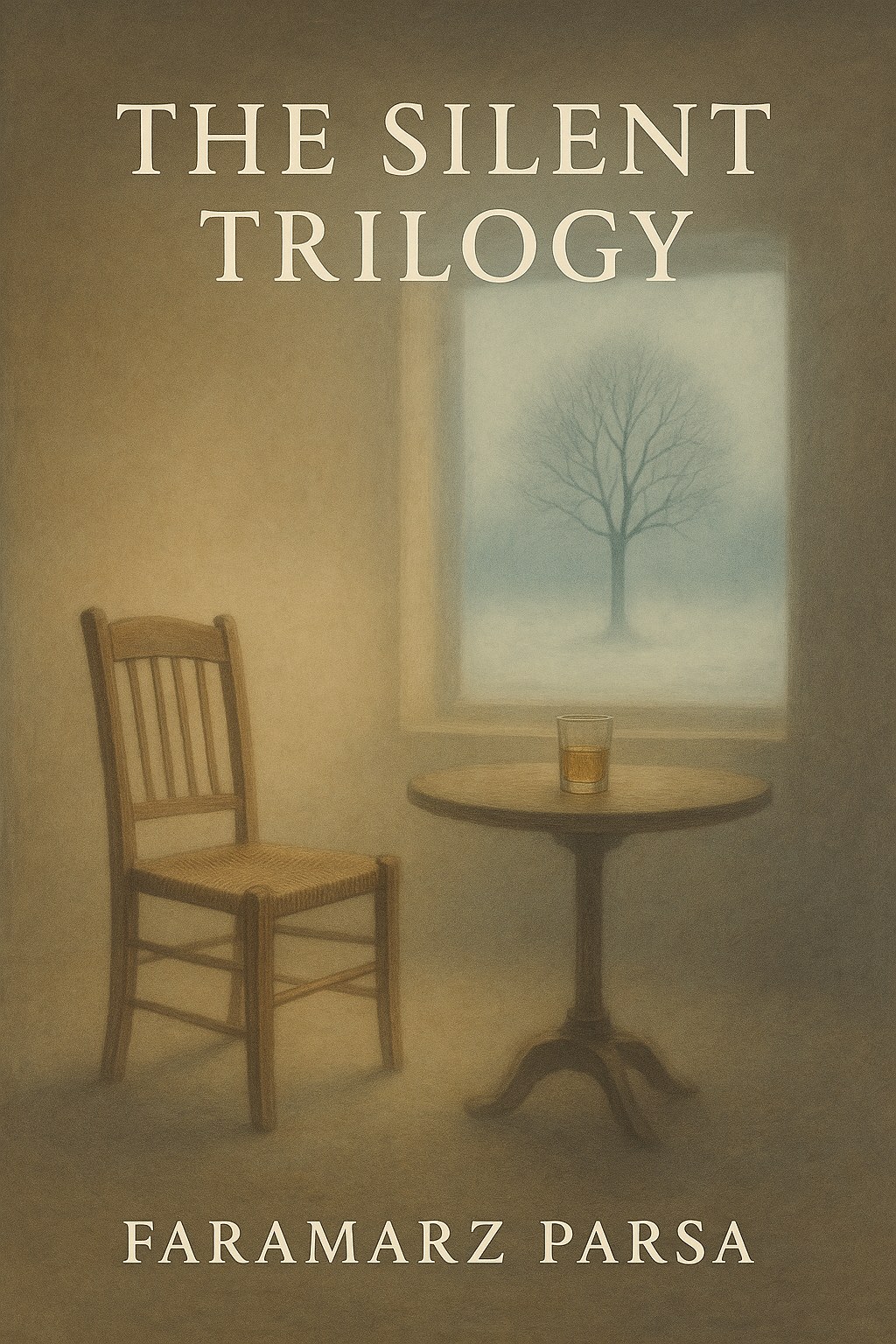
In a quiet room where time seems to stand still, two presences — one silent, one searching — blur the boundary between life and death, dream and awakening.
“Escape” is not merely a story, but a reflection on the hidden corners of the human mind: on pain that cannot be spoken, love that refuses to fade, and the endless struggle between staying and leaving.
Through a delicate and haunting narration, Faramarz Parsa guides the reader into a space where thought becomes breath, where light and shadow exchange places — and where the soul searches for release not from the world, but from itself.
⸻
Part I – The Silence Beneath the Skin
When the ice began to break, the air trembled with a sound too faint to name.
A hand reached out, touching the surface of a cold face —
yet beneath that chill, warmth was rising,
a fever that carried no name, no origin.
The lips held their color of fading dusk,
the eyes heavy from sleepless storms.
A pulse trembled beneath the skin — not steady, not strong —
like the echo of a cry that never found its way out.
The sob was silent, trapped within the throat,
a wound so familiar it had forgotten how to bleed.
It was not sorrow alone; it was the fatigue of staying,
the ache of not leaving, the numbness of existing without desire.
The breath came and went —
a rhythm that was neither life nor death.
Inside, a quiet fire burned; outside, the stillness of the room refused to move.
Every thought folded upon itself,
like paper consumed by invisible flames.
The eyes remained open,
staring into a point beyond reflection —
empty, patient, timeless.
The hands were warm, almost burning,
as though holding an ember that refused to die.
The face, untouched by that heat,
stayed cold — calm — as if carved from snow.
And beneath it all, a question lingered:
What kind of fire burns unseen, leaving the skin cold but the soul aflame?
⸻
Part II – The Courtyard of Silent Rivers
The being moved toward the window,
drawn by a whisper that was not sound but memory.
Outside, the courtyard waited —
ice fractured into floating mirrors,
and on the lone tree, the first fragile buds trembled like forgotten words.
The air was hollow.
No bird crossed it, no song disturbed it.
Stillness was heavy, yet it seemed alive —
as though the world itself held its breath.
Why remain beside the silent form?
Perhaps if one word were spoken,
the stillness would crack, the eyes would move.
But silence had already become a wall —
a wall that both protected and imprisoned.
The gaze fell upon the closed window again.
It felt like a cage — not of iron, but of reflection.
The self inside was both prisoner and guard.
And somewhere in the folds of that air,
a presence waited —
not a person, not a spirit,
but something between thought and remembering.
It watched.
It listened.
And when the being turned away,
the courtyard seemed to breathe —
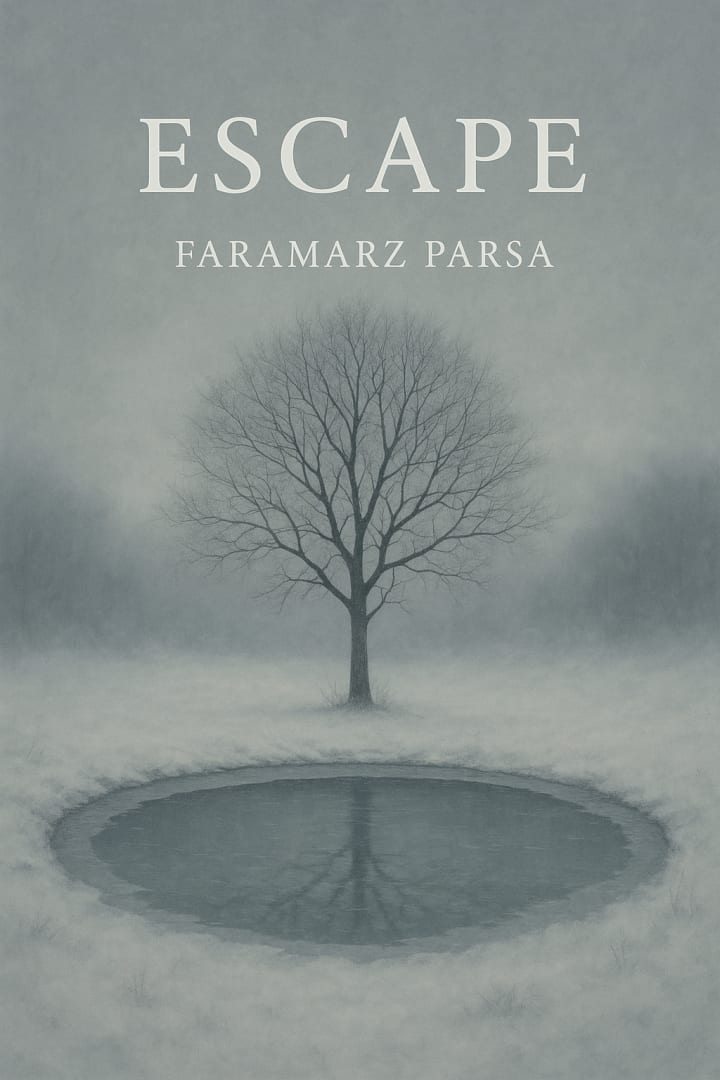
a faint mist rose from the pond,
as though the ice itself exhaled.
⸻
Part III – The Elder Within the Mirror
From the silence rose a shadow —
not walking, not standing, simply appearing,
as if drawn out of the room’s own breath.
The elder figure sat beside the unseen pond of thought.
Lines crossed the face like the branches of a dry tree,
each wrinkle a road carved by years of remembering.
No words came.
Only the faint sound of something ancient —
a sigh older than speech.
The elder was not a visitor;
it was the echo of the being itself,
a reflection wearing time as a disguise.
“You have come far,” said the voice that had no mouth.
“Yet the distance between you and yourself remains.”
The being tried to answer,
but the lips — though no longer pale —
could not decide between silence and sound.
The elder watched, not in pity, not in judgment,
but with the quiet knowing of someone
who had already forgotten what it meant to be awake.
Outside, the courtyard had changed.
The tree now bore faint buds of light.
The ice no longer held its form;
it had turned into thin mist,
rising gently toward a sky that was neither day nor night.
“Do not seek the warmth,” the elder whispered.
“You were born of the frost.”
⸻
Part IV – The Reflection That Breathed
The light inside the room dimmed,
yet it was not the setting of a sun,
but the closing of an unseen eye.
The being turned toward the mirror —
a mirror clouded by breath,
its surface trembling like water remembering rain.
Within it stood the elder again,
not older, not younger,
but made of the same pulse and the same exhaustion.
“Who are you?” the being asked,
though no voice escaped the mouth.
The reflection smiled faintly,
as if hearing an old question return home.
“I am what remains when you stop remembering yourself.”
The air thickened.
Shadows on the walls began to breathe.
The window’s frost melted into trails of silver tears.
The being reached out,
touching the glass between two worlds —
cold against the warmth of skin.
And for a heartbeat, the mirror breathed back.
It was no longer possible to tell who looked at whom.
The reflection and the watcher shared the same silence,
the same heartbeat, the same trembling hands.
Outside, the pond whispered,
and pieces of broken ice drifted like forgotten thoughts.
The tree shivered under a sky of unspoken words.
Then the elder’s voice — or perhaps its echo — said,
“You came to see if you are still alive.
Now you must learn how to die without leaving.”
The being did not understand —
or perhaps understanding was the very thing being burned away.
⸻
Part V – The House That Remembered
The door was half open,
breathing out the scent of dust and years.
The being stepped through,
feet soundless against the floor that sighed beneath their weight.
A narrow corridor stretched ahead,
its walls damp with forgotten time.
The air was thick with the scent of iron,
as though memories had rusted here.
To the right, a curtain of faded red hung over a frame —
its fabric heavy with shadows,
its patterns trembling in the faint light.
To the left, a door of gray wood
peeled and scarred from years of silence.
The being drew the curtain aside.
A small room appeared,
where a mat of yellow threads lay torn upon the ground.
On the wall hung a portrait drawn in black —
the face of someone stern and weary,
eyes carved deep into paper,
a mouth closed against the world.
Two small sculptures sat upon the dusty shelf:
one of a figure standing half-clothed,
its hand raised to hide what could not be unseen;
the other, a man bent beside a broken cart,
his pipe cold, his hat tilted toward the years.
Both coated in the same soft dust,
both trapped in the same quiet decay.
Cobwebs filled the corners like whispers unspoken.
The being touched the frame of the drawing —
the lines felt alive,
the eyes seemed to follow.
The air shifted.
The elder figure appeared once more,
not from a door, not from the air — simply there.
“This is where you left your beginnings,” the voice said.
“Every forgotten face is another shape of your own.”
The being looked around.
The objects, the walls, even the dust
seemed to breathe with recognition.
The house was not remembering —
it was being remembered.
⸻
Part VI – The Voice Made of Dust
“Why do you keep searching?”
The voice came not from the elder’s mouth,
but from the walls, the dust, the air itself.
The being stood still,
listening to the sound of time
echoing through its own bones.
“Everything you have lost,” said the voice,
“still walks within you.
The faces, the voices, the unfinished words —
they never left;
they simply changed their rooms.”
The being wanted to argue,
but words, once born, refused to serve.
They floated inside the head,
turning soft and round like ash in wind.
The elder stepped closer —
or perhaps it was memory taking shape again.
Its eyes held no light, no reflection,
only the weight of long knowing.
“In this place,” the elder whispered,
“no one carries a shadow.
They are the shadow.
They come here to find themselves,
and some never leave,
because what they seek
was never missing.”
Silence followed.
The air itself seemed to exhale.
The being lowered its gaze to the cracked tiles,
where shapes of forgotten footsteps
appeared and vanished like breaths in cold air.
“Am I one of them?”
the being asked, though no lips moved.
The elder’s head tilted —
a gesture somewhere between sorrow and peace.
“Some questions are not meant for answers,” it said.
“Only for remembering.”
And with that, the walls began to fade,
the portrait melted into light,
and the room folded upon itself
like a page closing on its final word.
⸻
Part VII – The Distance That Followed
The room was gone.
Only the pale scent of air remained,
and the faint rhythm of something breathing —
perhaps memory itself.
The being stood in an open field
where nothing had shape or edge.
It was light, yet not light —
a gray silence spread like mist across thought.
In that emptiness, footsteps began to echo —
slow, uncertain, as if learning how to exist.
Each step left no trace,
and yet the sound lingered,
a memory of movement without direction.
A shadow appeared ahead,
neither near nor far,
its outline bending with every blink.
The being called out,
though the sound made no noise.
The shadow turned —
and the being saw its own face.
Not young, not old,
not man, not woman —
only the tired reflection of someone
who had been both seeker and fugitive.
The echo of the elder’s voice returned,
woven into the wind:
“You are the one you have been chasing.
Every step away was a step toward.”
The being reached forward,
but the shadow did not move.
Instead, it smiled —
not as comfort, not as farewell —
but as understanding.
Then the horizon folded inward,
bringing the world closer,
until sky and earth became one continuous breath.
“There is no escape.
There never was.”
And for the first time,
that truth felt like freedom.
⸻
Part VIII – The Return That Never Was
There was no sound.
Even memory had grown tired of speaking.
The being sat beside what once was the window —
now only a frame of air,
through which the faint shimmer of light
moved like a last breath through a dream.
The world beyond was neither alive nor gone.
It waited, unexpecting, unchanging,
as though it had never been anything else.
The hands no longer burned.
The face no longer felt cold.
There was nothing left to balance —
heat and frost had become one.
The elder figure appeared once more,
not outside, not within,
but in the quiet rhythm between thoughts.
“You see?” the voice said without sound.
“Even silence ends when you listen long enough.”
The being smiled faintly —
not in triumph, not in defeat —
but in the calm knowing
that every escape leads home.
Outside — if “outside” still meant anything —
the tree by the pond had bloomed again,
its branches trembling under invisible wind.
The ice had melted long ago,
leaving only circles of water
that reflected no face, no sky.
The being closed its eyes —
not to sleep, not to die,
but to see what could only be seen
from the dark within.
And for a moment —
brief as breath,
endless as forgiveness —
the air was filled
with the quiet sound of nothing returning.
(Belgium – 1989)
About the Creator
Ebrahim Parsa
⸻
Faramarz (Ebrahim) Parsa writes stories for children and adults — tales born from silence, memory, and the light of imagination inspired by Persian roots.
Keep reading
More stories from Ebrahim Parsa and writers in Confessions and other communities.
The Complaint of Old Age Against Me
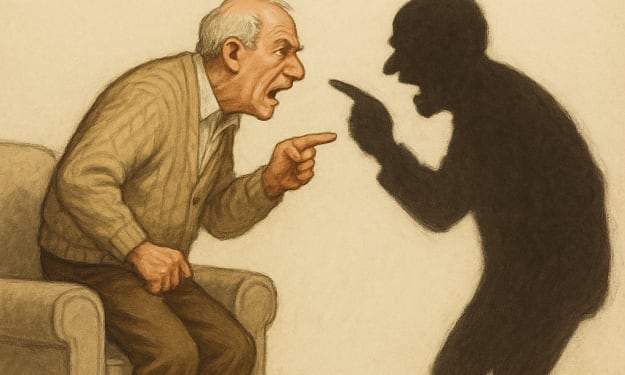
Foreword Aging is a strange companion. It does not arrive suddenly, nor does it enter our lives with noise or warning. Instead, it slips quietly into our mornings — into the stiffness in our knees, the breath that feels slightly heavier, the slow rise from a familiar chair.
By Ebrahim Parsa2 months ago in Confessions
Word of the Day: ホチキス
I don't know the word for Staples. I remember I used to think that Hochikisu was an Onomatopoeia for a stapler rather than a brand name. I am pretty sure I already have this title as a theme, which is making me feel many sort of ways as Vocal is harassing me about payments currently.
By Kayla McIntosh20 days ago in Confessions
The Fear of Being Seen
Introduction The fear of being seen is something many of us carry quietly. It hides behind our smiles, our silence, and the carefully curated versions of ourselves we present to the world. We want connection, yet we dread exposure. We long to be understood, but we fear judgment. This inner conflict shapes our choices, our relationships, and even our dreams.
By Aiman Shahid3 days ago in Confessions


Comments
There are no comments for this story
Be the first to respond and start the conversation.