
Dark Woke: The Rise of Frontal Progressivism
When Political Messaging Trades Politeness for Visibility.

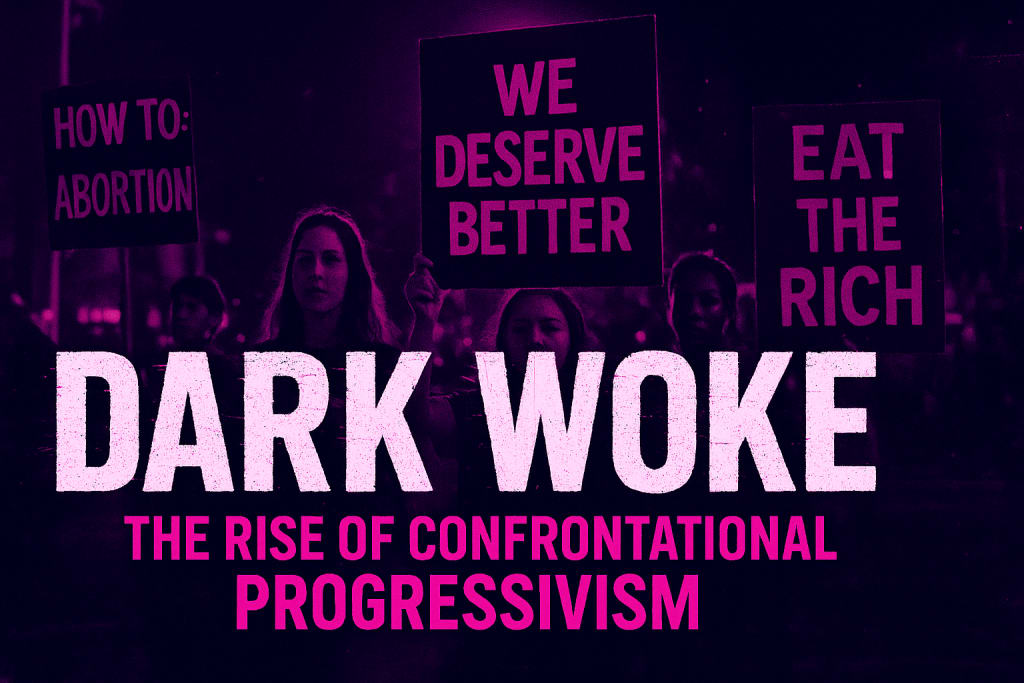
Introduction: A New Language of Resistance
For years, political progressivism in the United States was often built around slogans of hope, inclusion, and optimism—“Yes we can,” “Stronger together,” “The future is women.” But as cultural divides widen and conservative voices dominate some media landscapes, a new tone is emerging. Called “Dark Woke,” this wave of progressivism is unapologetic, blunt, and sometimes even aggressive.
Instead of carefully polished soundbites, activists are embracing raw, confrontational messages designed to cut through the noise. It’s not about civility; it’s about visibility. In an age of short attention spans and furiously driven algorithms, “Dark Woke” has become a progressive counterpunch.
What is “Dark Woke”?
The phrase captures a shift in progressive rhetoric:
- It’s less about gentle persuasion, more about direct confrontation.
- It embraces emotion, humor, and shock value to drive home social justice messages.
- It resists respectable politics, choosing authenticity over indulgence.
In practice, Dark Woke might look like this:
- A viral TikTok mocking discriminatory laws with a biting satire.
- Protest signs that use profanity or irony instead of safe slogans.
- Politicians and influencers use memes to push back against conservative narratives.
This is progressiveness with a sharp edge — deliberately designed to provoke, upset, and demand attention.
Why now?
Several factors explain why Dark Woke is growing in 2025:
1. Media Noise and Saturation - With the endless flood of content in social feeds, polite calls for change are often drowned out. They are broken by sharper, more emotional messages.
2. Frustration with Gridlock - Many young activists feel that traditional political strategies have failed to deliver on climate change, healthcare, student debt relief, and voting rights. Dark Woke reflects their impatience.
3. Cultural Polarization - As conservative messaging becomes louder and more combative, progressives have adapted to match the tone.
4. Meme Era - In a world where jokes and viral content spread faster than policy papers, the language of resistance has morphed into memes, dark humor, and an aesthetic of confrontation.
Faces of the Dark woke
Unlike traditional movements with centralized leaders, dark woke thrives in decentralized spaces. Its influence can be seen in:
- TikTok and Instagram creators who mix humor with political commentary.
- Local activists who organize protests with bold imagery and unapologetic slogans.
- Musicians and artists who incorporate raw political criticism into their work.
Even mainstream politicians are adopting dark woke tones online, experimenting with sharp language and meme-driven communication to capture a younger audience.
Critics vs. Supporters
Not surprisingly, Dark Walk has its critics — even in progressive circles.
Critics argue:
- It alienates moderates and undecided voters.
- It risks turning serious issues into viral gimmicks.
- It deepens polarization rather than building consensus.
Supporters counter:
- The old strategy wasn’t working. New tools are urgently needed.
- The progressivism of confrontation mobilizes younger generations.
- Memes and satire democratize activism, making it more accessible.
For supporters, the goal isn’t to make everyone comfortable — it’s to make it impossible to ignore injustice.
Examples of Dark Woke in Action
- During the debate over restrictive abortion laws, activists exposed the hypocrisy with satirical “how to” skits on TikTok.
- At climate protests, young people carried signs that read, “You die of old age, I die of climate change”—a blunt call to action for racial inequality.
- Viral memes mocked corporate greenwashing campaigns, making the contradictions more obvious through humor than any press release.
These examples illustrate the dual power of Dark Week: It’s disruptive and it spreads quickly.
A culture shift, not just a hashtag
Dark Week is not just a communications strategy—it’s a cultural shift. It reflects a generation that is unwilling to change reality or wait patiently for change. It values urgency over manners, memes over manifestos, imperfection over refinement.
Whether this becomes a long-term pillar of progressive politics or merely a transitional phase, one thing is clear: the tone of activism has changed permanently.
Conclusion: The Future of Resistance
The rise of the Dark Walk shows that progressivism in America is adapting to its times. As inequality, climate concerns, and culture wars intensify, activists are finding new ways to be heard.
That doesn’t mean hope is gone. Instead, it means hope is now dressed in sarcasm, bluntness, and fire. In 2025, progressives are no longer asking politely. They are demanding — loudly, visibly, and sometimes uncomfortably.
Because in the words of a viral Dark Walk meme:
“If you don’t hear us whisper, you’ll hear us when we scream.”
About the Creator
Echoes of Life
I’m a storyteller and lifelong learner who writes about history, human experiences, animals, and motivational lessons that spark change. Through true stories, thoughtful advice, and reflections on life.
Keep reading
More stories from Echoes of Life and writers in Confessions and other communities.
Lipstick, low-rise jeans, and layoffs?
On wall Street, economists watch the charts and fret over the latest market signals. On TikTok, people watch lipstick sales, low-rise jeans, and viral “budget brunch” videos — and somehow, these amateur indicators are unsettlingly predicting the same thing: the economy isn’t doing too well.
By Echoes of Life5 months ago in Confessions
Silenced No More
Throughout history, the ability to speak freely has never been guaranteed. For centuries, voices have been suppressed by kings, governments, religions, and social systems determined to control what people think, believe, and say. Yet, despite censorship, punishment, and even death, individuals have continued to raise their voices. Their courage shaped societies, challenged injustice, and transformed the world. The story of free speech is not just about laws and rights—it is about human bravery, resistance, and the unbreakable desire to be heard.
By Aiman Shahida day ago in Confessions


Comments
There are no comments for this story
Be the first to respond and start the conversation.