
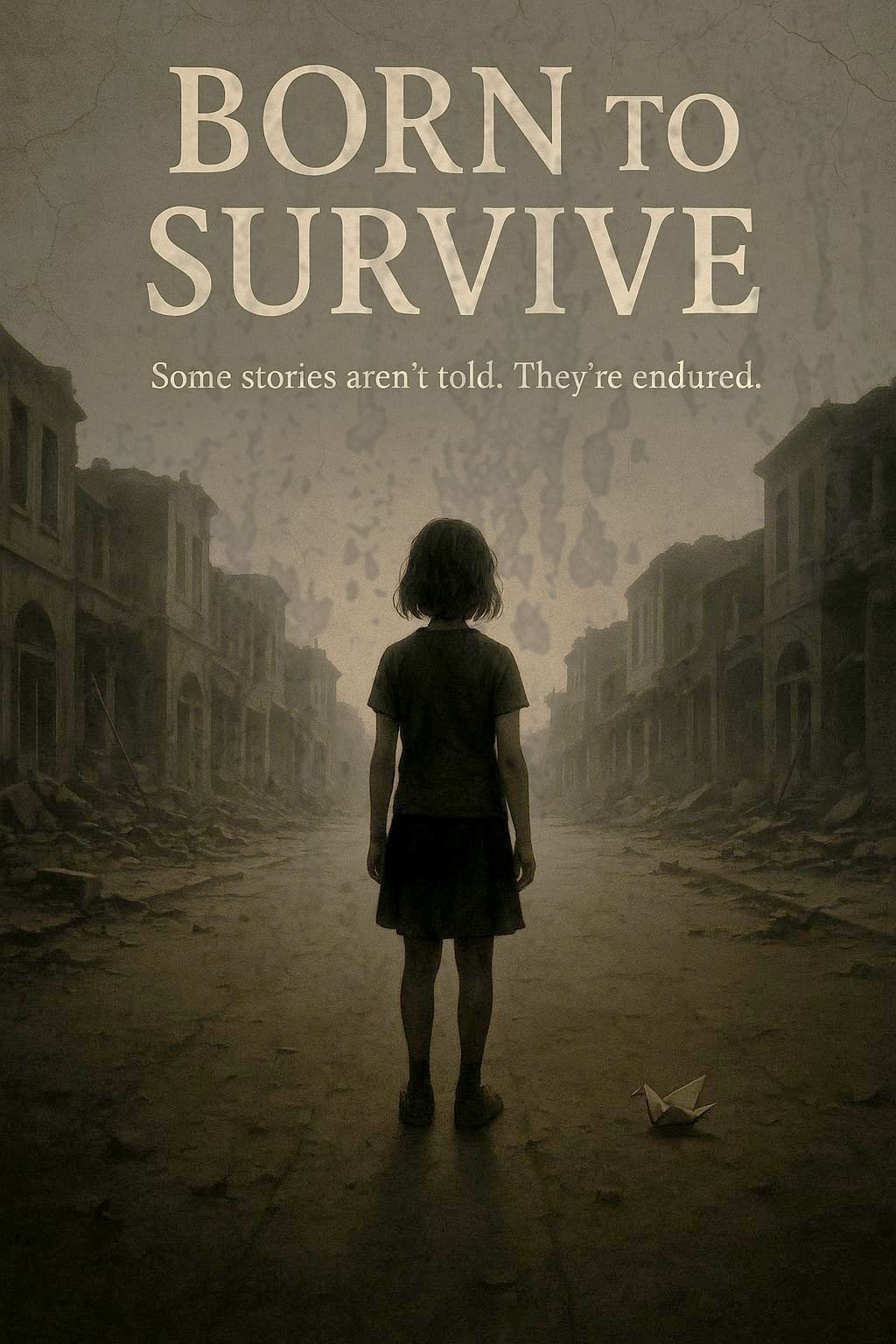
BORN TO SURVIVE
She lost everything - except her will to live.
They used to call me "child" back when the world still had room for softness - before something as simple as a name could put a target on your back. Now, when someone asks who I am, I stay quiet. Not because I’ve forgotten, but because I remember too much. In a place that stopped seeing people as people, names lose meaning.
I was fourteen when I came home. If you can even call it home. I’d spent six months in the hospital. When I returned, everything had changed. They had opened up my leg twice, once to save it and again to fix what went wrong in the first instance. The doctors promised I’d walk again. What they didn’t say was where I’d be walking. Or how you’re supposed to take steps when your house smells like smoke and your street feels haunted.
I expected things to be familiar. I wanted the old smell of pencil shavings at school. The creak of my locker. Mom’s chamomile tea fogging up the kitchen. Dad shouting, “There’s my tough girl!” when I walked in. Instead, I got silence. And gasoline. And a kind of tension in the air that made it hard to breathe.
I was born into a mixed marriage - Catholic and Orthodox. That used to mean more holidays and twice the cake. I grew up watching my parents tease each other about who crossed themselves the right way and whose saints had the better stories. But when I came back? It meant we were on the wrong side. I was suddenly a girl split down the middle. Praying the wrong prayers. Carrying the wrong name. Belonging nowhere. And everything around me whispered the same thing: You shouldn’t exist. The street outside our building felt like a trap. Not quiet in a peaceful way - quiet like something was about to strike.
In the hospital, the noise never stopped. Machines beeping, patients crying, the hum of a radio playing old songs. Pain had rhythm there.
But here? Silence was the warning sign. When we pulled up, my dad carried me like I was breakable. I had crutches. I could walk, more or less. But I needed to try. I needed something to remind myself I wasn’t helpless. Mom hugged me so tight it felt like she was trying to hold the world together with her own arms.
“You made it back to me,” she whispered.
But I could see it in her face - something had cracked. Something no prayer, no bedtime story, no mug of tea could repair. I didn’t leave the apartment for a week. “Things are tense,” they said. I already knew tension. I’d felt it in every pulled stitch, every delayed breath. But “tension” didn’t explain why the music had stopped. Why a new flag hung over our building. Or why there was a dead man under my window.
I didn’t scream. I closed the curtain. Washed my face. Pretended it was the morphine playing tricks on me. But it wasn’t. This was war. And war has its rhythm. Explosions at sunrise. More after lunch. Then stillness. That stillness? Worse than the noise.
I gave up the crutches. Started sitting by the window on the third floor. Just high enough to see without being seen. Safe enough - if anything was still safe.
One afternoon, I saw the neighbor’s little boy. Wobbling on a bike, wearing a silly hat. I almost smiled. Then came the gunshot. He just fell. The bike skidded as if it had a will of its own. And just like that, laughter didn’t belong here anymore. By the third month, I missed the hospital. At least there, someone cared whether you made it to morning.
At home, people moved like shadows. My dad lost his job. My mom stopped seasoning food. We rationed beans and hoped for bread. And when we didn’t pray, we just waited. Listening. Neighbors disappeared. Some said “relocated.” Others didn’t say anything at all.
One night, my dad said, “I don’t know what side I’m on anymore.”
I told him, “You’re on my side.”
He looked away. “That’s not enough here.”
A year later, our apartment was gone. A grenade hit our building. Left a hole where the kitchen used to be. Mom got a scar. Dad went silent. Again. We moved in with my aunt. Fifteen people. One room. Blacked-out windows. No lights. No sound. We memorized silence. We lived like ghosts. I lost everything - my country, my school, and my future. No flag. No safety. No place to belong and no one left to save me.
When I found out my friend from school had been killed, I didn’t cry. They said he was “on the wrong side.” But I remembered when he gave me candy after I fell down the stairs. He never hurt anyone. He folded origami birds and doodled monsters in his notebooks. No bullet can erase that.
Four years passed like that. Four years of hunger, of frostbite, of learning to speak in code. To whisper your last name. To forget what normal ever felt like. Then came exile. We left with one bag each. We boarded a bus to a place that didn't exist. A border crossing. A passport that told me I didn’t belong anywhere. Dad cried. First and last time. Mom didn’t. But something in her eyes went quiet and never came back.
I didn’t look behind me. I looked ahead. And I kept breathing. Now I have daughters. Two fierce, loud girls who slam doors and argue about mascara and roll their eyes over Wi-Fi speed. They don’t understand fear the way I did. And that makes me so proud I could burst.
I don’t tell them everything. Not yet. But one day, they’ll know. They’ll know their mother was made of bone and willpower. That she carried herself through fire and silence and came out stronger. They’ll know what survival looks like.
Because I was born to survive.
And I did.
About the Creator
Keep reading
More stories from Jelly and writers in Confessions and other communities.
The Piggy Project
I’ve had so many names in this life I lose track of which ones were ever really mine and which ones I wore because someone needed me to. Some were handed to me before I had words to refuse them, before I knew what they meant, before I knew I could say no. Most weren’t meant to hurt. That doesn’t mean they didn’t leave marks. Marks that told me who I belong to, who I am by way of who claims me, recognizes me in the good and bad, who walks beside me.
By Fatal Serendipity6 days ago in Confessions
When Shields Fall Faster Than We Expect
I always thought I was someone who trusted slowly—pain had taught me that lesson well. I wrapped my heart in layers of caution, convinced that careful steps were protection. But life has a way of surprising you, quietly, in moments you least expect.
By Alex Sterling 3 days ago in Confessions
📢 Raise Your Voice Thread: 03/05/2026
Our “Raise Your Voice Threads” are hosted most alternating Thursdays at 12PM ET to offer creators more avenues to uncover exceptional stories on Vocal. As we are continuously searching for fresh creators and inspiring stories, this thread provides an opportunity to exchange and discuss the stories that have moved and motivated us on Vocal.
By Raise Your Voice by Vocal5 days ago in Resources


Comments (1)
Your story's powerful. The change from hospital noise to that street silence must've been jarring.