
Alone Together: The Quiet Loneliness of the Connected Age
How endless connection taught us to sit with emptiness—and what it means to feel unseen while being watched

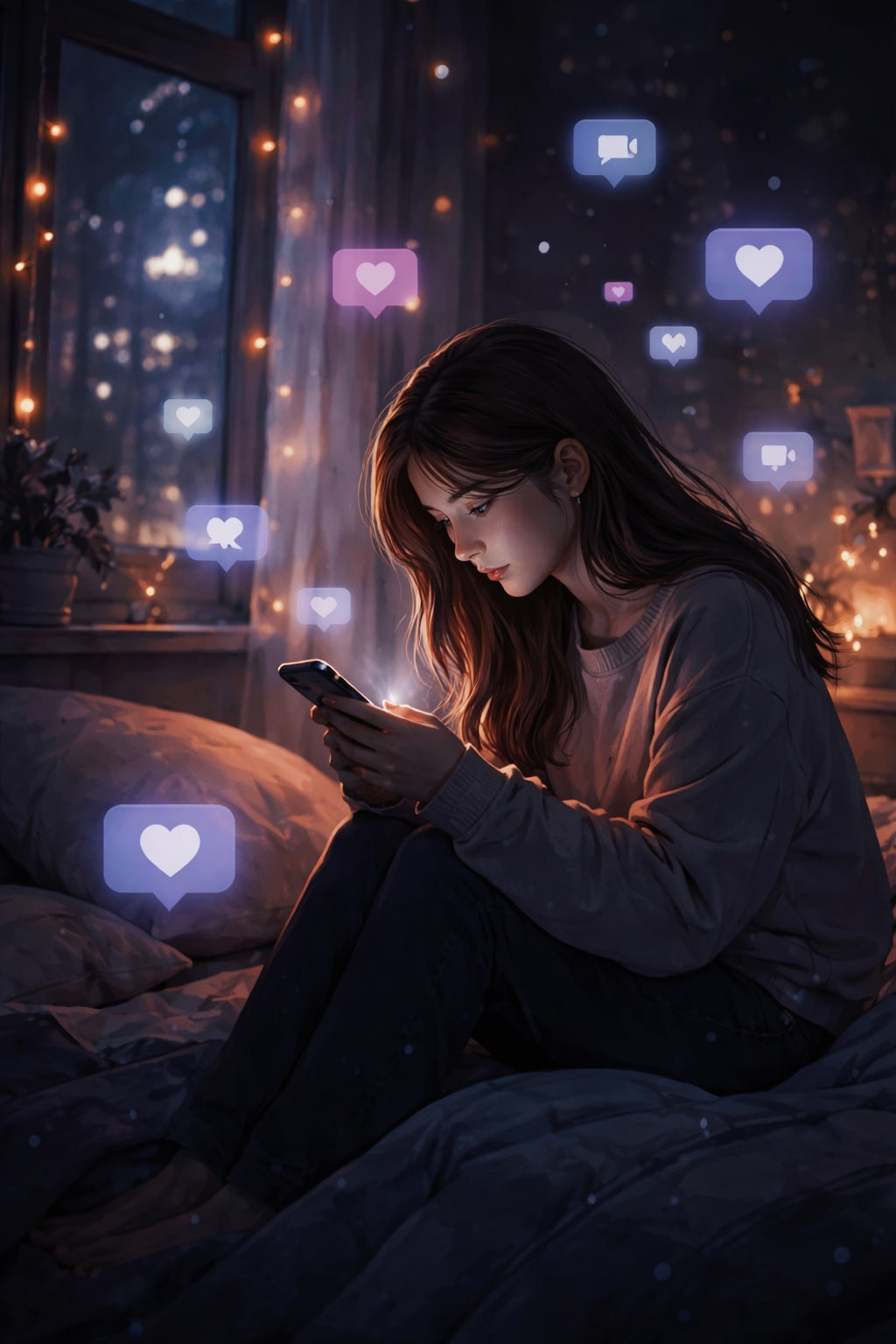
We have never been so connected, and yet loneliness has never felt so loud.
It hums beneath notifications, pulses through glowing screens, and settles quietly in the spaces between posts. It is not the dramatic loneliness of exile or abandonment; it is subtler, more insidious—a loneliness that exists even when the room is full, even when the phone vibrates in our hand.
Social media promised us proximity. It promised that distance would collapse, that silence would dissolve, that no one would ever truly be alone again. And in many ways, it delivered. We can reach anyone, anywhere, instantly. We can witness lives unfolding in real time—births, weddings, heartbreaks, triumphs—compressed into stories that vanish in twenty-four hours. Yet somehow, amid all this closeness, many of us feel increasingly invisible.
Loneliness today does not always look like isolation. Often, it looks like scrolling. 📱
It looks like refreshing a feed at midnight, hoping for a sign that someone else is awake and thinking too. It looks like typing a message, deleting it, and convincing yourself it wasn’t important anyway. It looks like posting something vulnerable and then pretending you didn’t care how many people reacted. We curate our lives carefully, sanding down rough edges, presenting versions of ourselves that are likable, digestible, algorithm-friendly. But the more polished the image, the harder it becomes to feel truly known.
There is a peculiar ache in being seen but not understood.
On social media, we are encouraged to speak constantly, but rarely to be heard deeply. Conversations fragment into comments, likes, emojis—tiny gestures that simulate connection without demanding much of us. ❤️🔥👏 They are not meaningless, but they are often insufficient. A heart icon cannot sit beside you when grief settles in your chest. A view count cannot reassure you when doubt whispers that you are replaceable.
And so, loneliness adapts. It no longer waits for silence; it thrives in noise.
We compare ourselves endlessly, not to neighbors or colleagues, but to carefully edited highlights of strangers’ lives. Everyone else seems to be living more fully, loving more deeply, laughing more freely. Even when we know, intellectually, that these images are incomplete, the emotional impact remains. The mind may understand illusion, but the heart still measures itself against it. 📸
What makes this era particularly cruel is that loneliness now feels like a personal failure. If connection is always one click away, what does it say about us when we still feel alone? We blame ourselves for not being interesting enough, social enough, visible enough. We forget that abundance does not equal intimacy, and access does not equal belonging.
Yet beneath all of this, something profoundly human persists.
The desire behind every post, every story, every carefully chosen caption is the same ancient longing: Do you see me? Do I matter? Am I alone in feeling this way? Social media did not create loneliness; it simply changed the language through which we express it. Where we once knocked on doors, we now tap screens. Where we once sat together in silence, we now share it digitally.
And still, the hunger remains.
Perhaps the answer is not to reject technology outright, nor to romanticize a past that had its own forms of isolation. Perhaps the invitation is gentler—and braver. To slow down. To risk sincerity in a space that rewards performance. To send the longer message. To make the call instead of the comment. To admit, quietly or aloud, that we are lonely without dressing it up as irony or self-deprecation. 🌱
Loneliness, after all, is not a flaw. It is evidence of our capacity for connection.
In moments when the feed feels endless and hollow, we can choose depth over breadth. One honest conversation over a hundred passive interactions. One person who knows our contradictions over a thousand who know our highlights. This does not cure loneliness entirely—nothing does—but it transforms it from a private shame into a shared human condition.
We are alone together, yes. But together is not nothing.
And sometimes, in a world saturated with voices, the most radical act is to listen—to others, and to ourselves. To sit with the quiet without immediately filling it. To remember that behind every screen is another person, scrolling for the same reasons we are: connection, meaning, reassurance that this strange, beautiful life is not meant to be lived entirely alone. ✨
Loneliness may be the soundtrack of our era, but it does not have to be the final word.
About the Creator
Rachid Zidine
High School Teacher
Keep reading
More stories from Rachid Zidine and writers in Confessions and other communities.
Beyond Bars: Rethinking Prisons, Punishment, and What Justice Is Really For.
Do we need prisons? It is a deceptively simple question—one that exposes deep assumptions about justice, responsibility, fear, and hope. My answer is yes, but only provisionally. Prisons should exist, but only as a last resort, tightly limited in scope, radically reformed, and oriented toward a clear moral purpose: restoration and public protection, not suffering for its own sake.
By Rachid Zidinea day ago in Critique
Thoughts on Vocal and the way the world is
"Death cannot stop true love, only delay it." – Wesley in The Princess Bride. I decided to come back to Vocal on a very cold and dark night at the end of December. I had been, and still am, convalescing from a horrible staph infection that had gone misdiagnosed for months. This, paired with the increasing challenges of being healthy, making the best choices for my co-parented child, being a wife, and being a director at a new job, was a lot to manage.
By Jazzy 16 days ago in Confessions
Benefits of Looking Forward To Something
Everyone looks forward to something because it is part of life. When we were younger, we looked for most things that were different from what we look forward to now that we are older. Even so, we might still look forward to some of the same things: birthdays, holidays (some more than others), graduation, first job, dating, marriage, anniversaries, raising a family, and more.
By Margaret Minnicks4 days ago in Confessions




Comments
There are no comments for this story
Be the first to respond and start the conversation.