
A Nation Under Pressure: America’s Converging Crises in 2025
Political violence, shaky economic data, and climate disasters are testing the resilience of the United States.

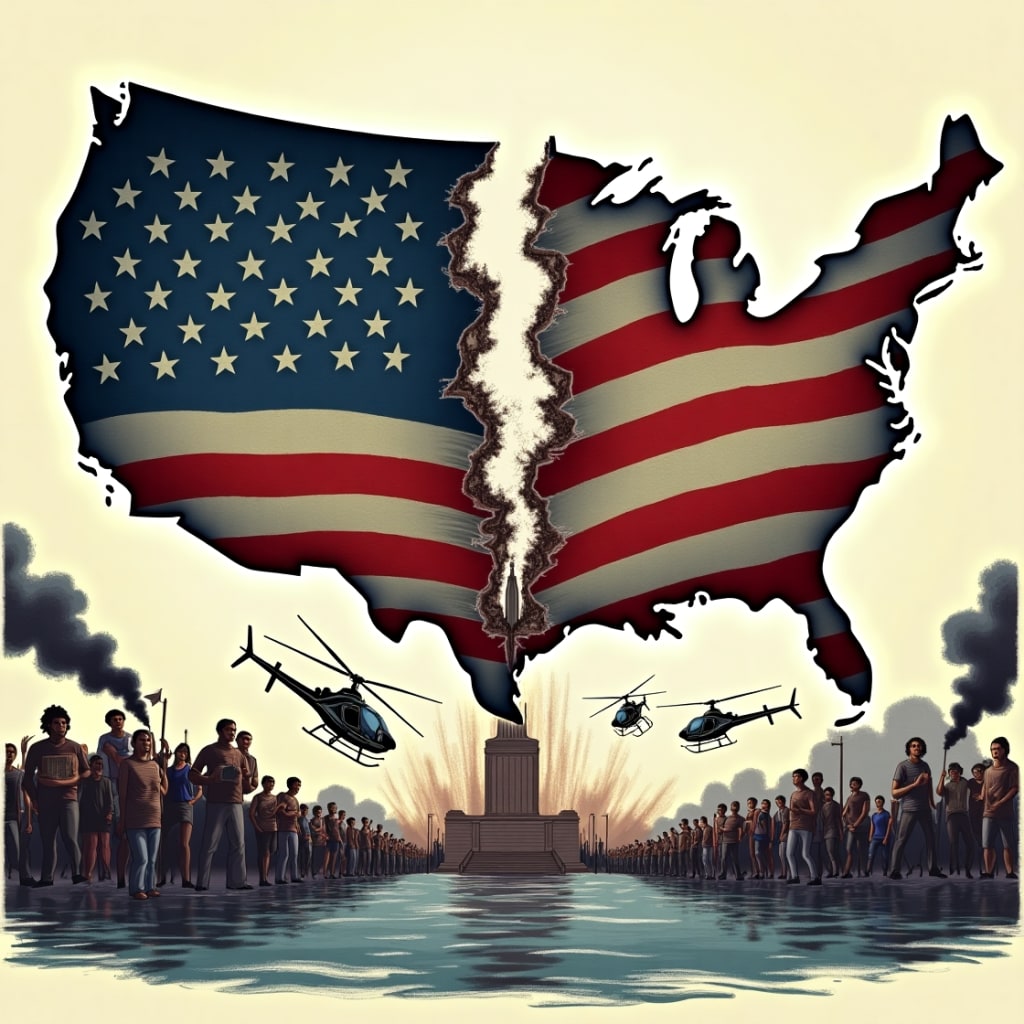
A Nation Under Pressure: America’s Converging Crises in 2025
The United States in 2025 finds itself grappling with not one, but several crises unfolding simultaneously. Each challenge alone would be significant. Taken together, they reveal the immense strain on America’s political stability, economic credibility, and environmental resilience. From rising political violence to doubts about the reliability of official statistics and the escalating toll of climate disasters, the country faces a crossroads that will shape its future path.
Political Violence: A Dangerous Spiral
The assassination of conservative activist Charlie Kirk has shocked the nation and brought renewed focus on the rise of politically motivated violence. For years, observers have warned that heated rhetoric and polarization could spill over into bloodshed. Now, those warnings have become reality.
Experts fear that this tragedy may trigger a vicious cycle of retaliation, deepening ideological divides across the political spectrum. The United States has long prided itself on democratic debate, but when bullets replace words, the health of the republic itself comes into question.
Law enforcement agencies are bracing for potential unrest, while political leaders struggle to strike the right balance between condemning violence and calming their increasingly agitated bases. What is at stake is not just security on the ground but the survival of trust in peaceful democratic processes.
Economic Data Under Fire
As if political turmoil were not enough, America is now questioning the reliability of the very statistics used to measure its economic health. Recently, the Bureau of Labor Statistics (BLS) issued a shocking revision: nearly one million fewer jobs were created than originally reported.
The Labor Department’s inspector general has opened a review into how employment data, inflation rates, and producer price indexes are being collected and reported. Critics point to underfunding, staff shortages, and leadership shifts as reasons for the inconsistencies.
This uncertainty undermines not only public trust but also policymaking. The Federal Reserve, businesses, and consumers all rely on accurate data to make decisions. If the numbers themselves cannot be trusted, the ability to plan for growth, control inflation, or set wages is compromised. The crisis of confidence in data is, in many ways, a crisis of confidence in governance.
Climate Setbacks and Natural Disasters
Overlaying these challenges is a worsening climate crisis. After policy reversals earlier this year, U.S. greenhouse gas emissions have risen once again, making global climate goals harder to reach. For a country that plays such a large role in global emissions, this trend carries consequences not just domestically but internationally.
Meanwhile, the cost of extreme weather is mounting at record pace. Floods in Texas and New Mexico, wildfires in California, and severe storms across the Midwest have collectively caused over 131 billion dollars in damages so far in 2025. Roads have been destroyed, power grids knocked out, and communities forced into emergency evacuations.
For affected families, these disasters are not abstract policy debates—they are daily realities. Lives have been upended, savings lost, and futures thrown into uncertainty. Climate scientists warn that unless stronger mitigation and adaptation strategies are implemented, such crises will only grow more frequent and severe.
A Crisis of Trust
What unites these three separate challenges is their impact on trust. Political violence erodes faith in democracy. Questionable data weakens confidence in government institutions. Climate disasters fuel doubts about leadership’s ability to protect citizens from worsening threats.
Trust is the glue that holds societies together, and America’s glue appears to be weakening. Without renewed efforts to rebuild confidence—in institutions, in leadership, and in collective action—the nation risks sliding further into division and instability.
Lessons and the Way Forward
The convergence of these crises offers several important lessons.
Political leaders must lower the temperature. Violence is not an isolated act but a reflection of a political culture that has become increasingly toxic. Calls for unity must be backed by genuine efforts to promote dialogue rather than deepen divides.
Economic transparency is vital. The credibility of national statistics is essential for a functioning economy. Investment in staffing, modern data systems, and independent oversight is required to restore faith in the numbers that guide national policy.
Climate resilience cannot wait. With billions in damages already recorded this year, the costs of inaction are clear. From stronger infrastructure to renewable energy investments, the U.S. must take both immediate and long-term steps to protect its citizens.
Conclusion
America in 2025 is being tested on multiple fronts. The assassination of a political figure, doubts about economic data integrity, and record-breaking climate disasters may seem like separate issues, but together they paint a picture of a nation under extraordinary pressure.
Yet, crises also carry opportunities. Political violence can spark a renewed commitment to civility. Economic challenges can push for greater transparency and reform. Climate disasters can accelerate investments in resilience and sustainability.
The question is whether America can seize this moment not only to respond to emergencies but to emerge stronger. The world is watching, and the stakes could not be higher.
About the Creator
Wings of Time
I'm Wings of Time—a storyteller from Swat, Pakistan. I write immersive, researched tales of war, aviation, and history that bring the past roaring back to life
Keep reading
More stories from Wings of Time and writers in Confessions and other communities.
World War 3: Life in the Aftermath
World War 3: Life in the Aftermath The idea of a third world war is often spoken of in terms of nuclear strikes, battlefield strategies, and clashing superpowers. Yet the most haunting question is not how such a conflict might begin, but how people would live once the first waves of destruction had passed. What happens to the survivors when the smoke clears? The true story of World War 3 would not end with armies, but with ordinary people struggling to rebuild a broken world.
By Wings of Time 6 months ago in Confessions
Memory Snapshot: An Inconvenient Time For Sausage and Sex
Memory Snapshot: Inconvenient time for sausage and sex The energy on January 18, 2025 felt strange. No one in the department knew it, but it was the anniversary of my company’s start date. I celebrate it every year because I’ll always be proud that I went a different path than traditional. I was scheduled for one demo in meat department from 11-3 during the store’s tasting event. As I rolled my stand over to the product area, Elias stood there leveling lunch meat and cheese. I really didn’t want to say hi but because friendliness is basically my default setting, I did without thought. Plus, he was already looking at me as if he was waiting for me to break the ice.
By Chelsea DeVriesa day ago in Confessions


Comments
There are no comments for this story
Be the first to respond and start the conversation.