
The search for 'proper footie'
A trip to Oakwell blends past and present


When it comes to history, whose side are you on? A trip to Oakwell might help provide some answers.
You could watch Barnsley FC from the imposing East Stand. When it was opened in 1993, it made Oakwell the first football ground in Yorkshire to have purpose-built executive boxes in the stadium. The jury’s still out on whether this is a smart commercial move, or a sell-out to the prawn sandwich brigade.
Alternatively, you could opt for the West Stand. Dating from the early 1900s, at a time when Barnsley was reaching FA Cup finals and winning its only major trophy in 1912, this is a rare surviving example of an Archibald Leitch stand. It lacks the traditional lattice-work facing that was Leitch’s trademark, but the covered seating above a once-terraced paddock follows the architect’s favoured template. Today, it’s showing its age. The paddock went all-seater in the 1990s, following the Taylor Report’s recommendation to stop standing at top-level football in the wake of the Hillsborough disaster. Like many repurposed terraces, it’s something of a fudge, the rake a little too gentle to make for a satisfying view and the whole thing uncovered and at the mercy of a Yorkshire winter.
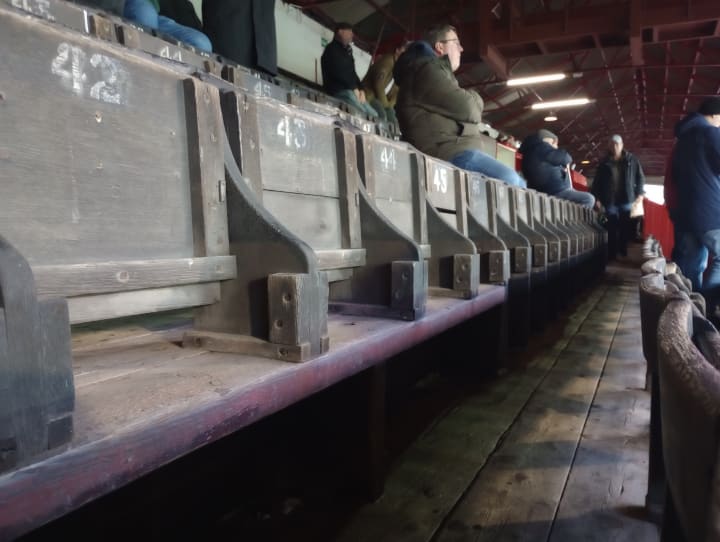
However, the covered seating area is a gem of a throwback. Wooden bench-style seating (and, along the back, an actual bench running the length of the stand) evokes memories of how football was when I started watching the game as a child. It might like the legroom and amenities of more modern venues, and the gents’ verge on the primitive. But there’s a whiff of nostalgia as potent as the heady mix of Bovril and Deep Heat.
There’s also a fine view of the future, not just in the East Stand opposite, but also on the horizon. Wind turbines tumbled on the hills beyond the edge of town, a profound change in the former heart of the South Yorks coalfield. Once, Barnsley’s nickname was the Colliers; now they are generic Reds with the pits reduced to folk memory and a mural inside the market hall.
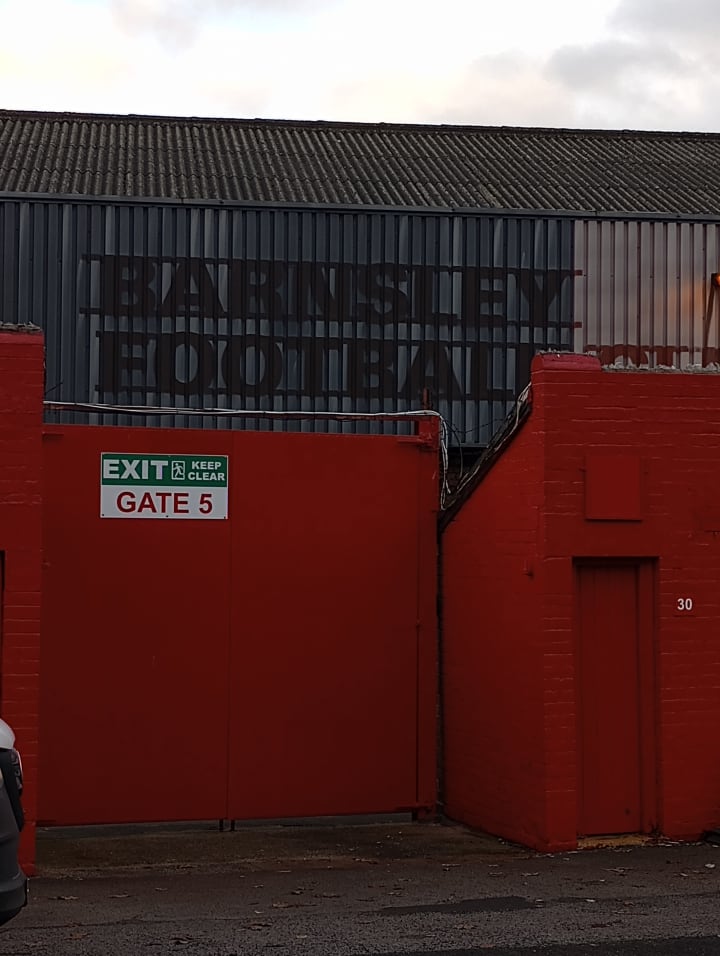
Today was FA Cup second round day. Back in Barnsley’s glory days, when it reached the 1910 final then won the trophy in 1912, the FA Cup was a huge deal. Even as recently as my childhood (yes, kids, that is recent, honest!) it took top billing in the football calendar. For teams in the lower divisions, a second-round game was a chance for a shot at playing the big boys; win, and you go into the hat alongside the Premier League giants. A cup run could bring a cash injection, plus back-page headlines. It was worth something, and cup ties tended to draw bigger than average crowds.
Not any more. Saturday’s game – admittedly not against the most appealing opposition as League One rivals Bristol Rovers headed north for the third time in 2024 – attracted a crowd of 4,801. The average attendance in the league is over 10,000, despite higher ticket prices for League One action. The die-hards who turned out for this one witnessed a goalless draw that dragged on for 120 minutes thanks to a rule change this season meaning that after the qualifying rounds, all FA Cup ties are settled on the day. Barnsley dominated – 30 attempts on goal, nine on target, two more hitting the woodwork – and, almost inevitably, lost in a penalty shoot-out. If I’d had the courage of my convictions and bet on Bristol to progress as the second half of normal time ran down, I’d have won back my ticket money and earned a free pie and Bovril. Coulda, woulda, shoulda; much like the home team’s strikers.
But was it better back in the day? Did the grim toil of underground labour build a better town? Was the football more exciting, the players more skilful? It’s hard to imagine. Despite a deeply frustrating game, it was noticeable that the playing surface was in fine condition a week after snow and hard frosts hit the north of England. The squelchy, muddy goalmouths immortalized in Kes – a legendary Barnsley-based ‘grim oop North’ tale of the 1960s – were nowhere to be seen. That enabled the players to move the ball around freely, rather than hacking it out of ankle-deep mud on a ploughed field, with obvious implications for the quality of play. Sure, there was a lack of the kind of rumbustious tackling that would always raise a ragged cheer from the crowd. And, given that this is the third tier, not every attempt to compile slick passing play leapt from the coaches’ imaginations into fluent and immaculate football at every turn. But the intelligent probing of young Nigerian midfielder Kelechi Nwakali was encouraging to see, while forward Stephen Humphrys displayed a bag of tricks that made him engagingly unpredictable to watch, even if he had a habit of bamboozling his team-mates as often as his opponents.
In short, it’s a different joy from the ones we grew up with. And age makes it too easy to feel that different is automatically worse. But on my way into the ground, I met a group of primary school kids visiting as part of the ‘my home debut’ scheme, designed to get families into the stadium rather than sitting in front of a screen with distant megastars from Manchester, Munich or Madrid. The thrill of getting on the pitch at half time will doubtless live longer than memories of the game itself, but Humphrys, Nwakali & Co will end up forming their footballing memories when they are grumpy enough to tell their kids how this modern game is nothing like the “proper football” we used to have.
Game details
Nov. 30, 2024. Oakwell, Barnsley
FA Cup Round 2
Barnsley 0 Bristol Rovers 0 (aet, Rovers win 4-3 in a shoot-out)
Att: 4,801

About the Creator
Andy Potts
Community focused sports fan from Northeast England. Tends to root for the little guy. Look out for Talking Northeast, my new project coming soon.
Keep reading
More stories from Andy Potts and writers in Cleats and other communities.


Comments (2)
Loved this Andy. Made me nostalgic and long for the days when I stood shivering on the sidelines cheering on mates! Great stuff.
I'm quite partial to a prawn sandwich. I get the joy of the muddy field every Sunday with my youngest. And today, it was muddy and lumpy and a bit of a mosh pit as a result.