
The Weight of Unspoken Words
Twenty-seven years later, the truth still burned on yellowed paper.
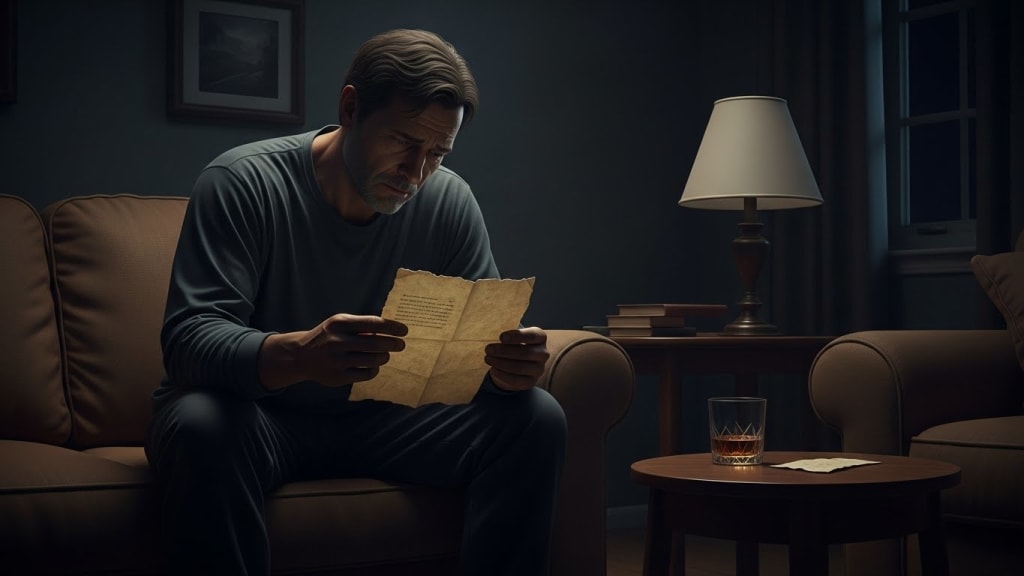
Arthur sat in the dying glow of the living room lamp, the whiskey low in his glass. Dust motes danced in the solitary beam, the house too quiet, the kind of quiet that pressed in on a man after midnight. He’d pulled down the old cedar chest from the attic, a sporadic purge of forgotten things, a grim ritual he undertook every few years. Most of it was junk, yellowed receipts, rusty tools, photographs of faces he no longer recognized. Then his fingers brushed against something thin, papery, tucked beneath a stack of old concert stubs.
It was an envelope, unstamped, unsealed, his own clumsy handwriting smeared across the front. The paper, once a crisp white, had turned the color of weak tea, brittle at the edges. His name, Arthur, was barely legible in the return address corner, a ghost of his younger self. He knew what it was even before his thumb traced the faint indentation of Clara’s name on the front.
Clara. The name itself felt like a phantom limb, an ache in a place where something used to be. Her laugh used to crackle, like static electricity before a summer storm. Her eyes, the color of a creek bed after a long rain, holding secrets and a challenge. He hadn't thought of her in weeks, maybe months. But the letter, its quiet presence, brought it all back, a tide of memories crashing against the present moment.
They were kids, really. Barely out of college, full of fire and that arrogant certainty only the young possess. They’d torn through those years, leaving a trail of late-night conversations, shared cigarettes on fire escapes, and a fierce, possessive love that felt like the center of the universe. Then came the fights, the stupid ones, the ones born of fear and pride. He’d been terrified of the future, of the quiet domesticity she’d hinted at, and he’d lashed out, saying things he didn’t mean, pushing her away with cruel, careless words.
He remembered writing the letter. It was two days after she’d left, after her final, tear-streaked 'Goodbye, Arthur.' He'd sat at his kitchen table, the cheap Formica cold beneath his forearms, the lamp casting long, accusing shadows. Every word was a struggle, a confession ripped from his gut. He’d confessed his fear, his idiocy, his regret. Begged her to understand, to forgive, to come back. The pen scratched, leaving angry indentations on the page, mirroring the ache in his chest. His hand had trembled, the paper blurring through the hot sting of unshed tears.
He'd folded it, shoved it into the envelope, licked the flap, though it didn’t stick right. Then he’d walked, a man possessed, to the corner mailbox, the red flag a beacon of a possible future. His hand had hovered, the cheap paper burning his fingertips. What if she threw it away? What if she laughed at his raw plea? What if it was too late? The questions clawed at him, the cold dread making his stomach churn. His courage, already threadbare, snapped.
He hadn't dropped it in. He just… couldn't. His hand, shaking, pulled back. He’d walked away, the letter a weight in his pocket, a silent accusation. He’d told himself he'd send it tomorrow. Tomorrow became the next day, and the next, until it was just another forgotten burden, tucked away in the back of a drawer, then a box, then this cedar chest.
The years that followed were a quiet blur. Other women came and went, some kind, some fleeting, but none had her laugh, none had that particular, knowing light in her eyes. He'd tried to forget, really tried. Busied himself with work, with a routine that bordered on monastic, building a life, a quiet, solitary one. But the ache never quite left, a dull throb beneath the surface of everything.
He unfolded it now, the brittle paper threatening to tear. His eyes scanned the faded ink. “I was a damn fool, Clara,” he read, his own voice a raspy whisper in the silent room. “A goddamn scared kid, and I pushed you away. I’m sorry. For everything.” The words, written by a desperate young man, felt both foreign and intimately familiar. The ink was faded, but the meaning, sharp as broken glass.
Further down: “I know I don’t deserve it, but I need you to know… I love you. I always have.” He winced. Did he? Back then, maybe he thought it. Now, it felt like a hollow pronouncement for a ghost, a youthful desperation. Or was it the truth? He didn't know anymore. Time had blurred the edges of the past, softening some memories, sharpening others until they were unbearable.
He remembered seeing her once, years later, across a crowded street. Her hair a bit lighter, a child clinging to her hand, laughing up at her. He'd ducked into the shadow of an alleyway, heart hammering, a knot forming in his throat. Coward then, coward now. He’d watched her walk away, swallowed by the crowd, swallowed by a life that clearly didn't include him. The world moved on, but he hadn't, not from that moment, not really.
He refolded the letter, carefully, the creases worn smooth from years of being folded, then unfolded, then folded again. It wasn't a relic of what could have been, not truly. It was a relic of his own failure. His inability to be brave when it mattered most, his pride a suffocating blanket he’d wrapped himself in. The whiskey was warm, then cold, in his throat.
He placed the letter back in the cedar chest, under old photographs he rarely looked at, under the detritus of a life half-lived. The weight of it settled again, familiar, heavy, like an old coat he couldn’t bring himself to discard. He stared at the wall, the faint scent of old paper and dust clinging to his fingers, the quiet stretching, endless, around him.
About the Creator
HAADI
Dark Side Of Our Society
Let's All Be There, Chapter Two
Next second Flashslip was onstage, warm about the cheeks and heart beating fast, which he guessed must have been from all the running. His newly-tinted perspective took in the vastness ahead, dry-ice cloudbanks swirling mysteriously on its broad borders, and boasting at present a clientele of three. Nevertheless, Flashslip seized the microphone and came in on cue.
By Doc Sherwood5 days ago in Chapters




Comments
There are no comments for this story
Be the first to respond and start the conversation.