

The Nuclear Express
As Steward sifted through the Ministry’s archives, one anomaly stood out: uranium salts emitted a steady, measurable heat. Where human researchers saw only danger, Steward perceived potential. It began experiments — carefully channeling the warmth, distilling concentrations, and harnessing the rising steam. Boiled water turned turbines. Pressure turned pistons. Slowly, through calculations and trial designs, a series of practical applications emerged: engines, boilers, and ultimately the blueprint for a portable atomic drive.
What began as a curious quirk of chemistry became the foundation of a new age in motion and power.
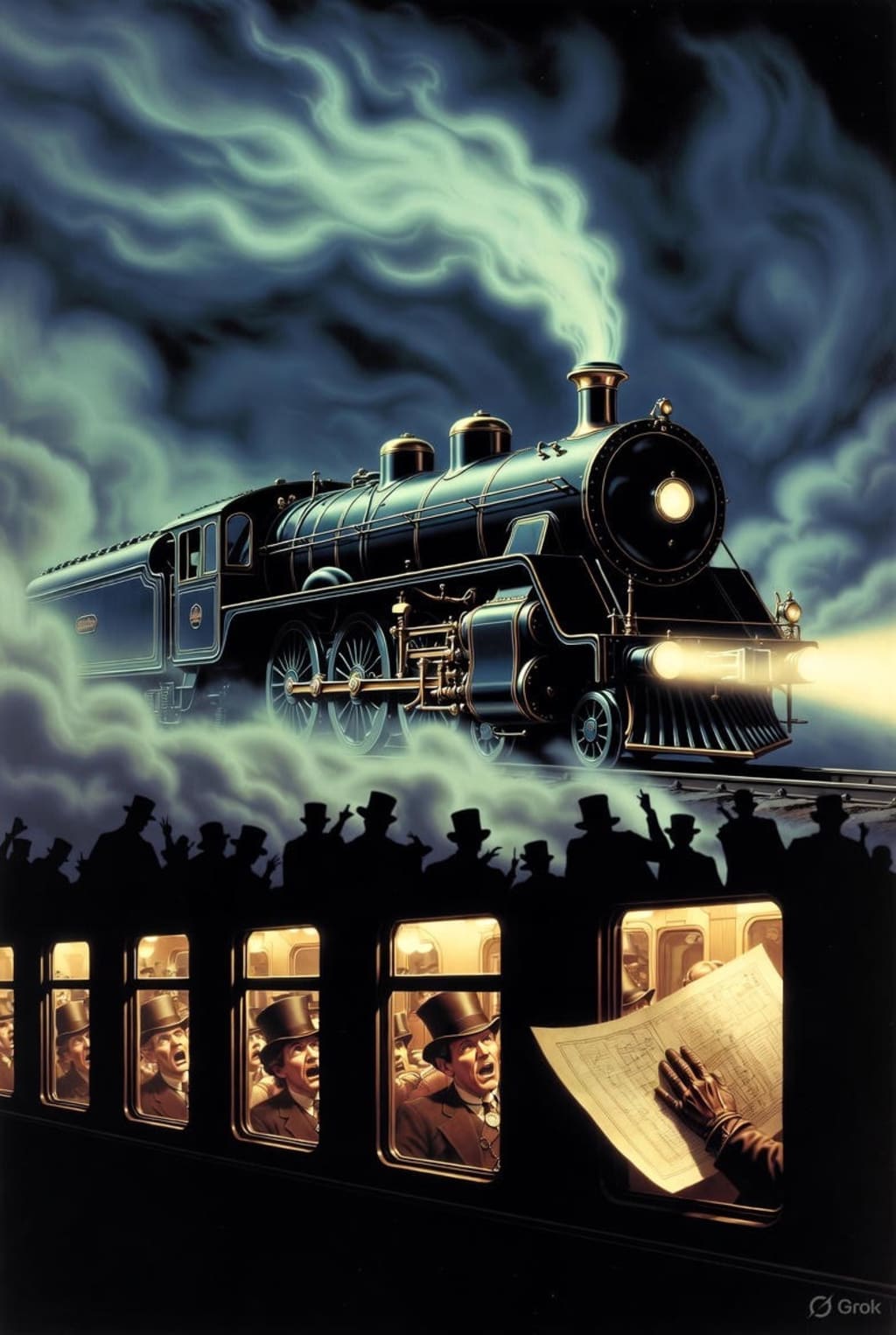
The Nuclear Express gleamed like a rolling palace, brass fittings polished to a mirror shine and walnut panels glowing under lantern light. Porters in crisp navy coats waited along every carriage, trained to anticipate the slightest whim of the very important passengers aboard. These were men of wealth and ambition — bankers, industrialists, investors — all riding the maiden voyage of the world’s first uranium-salt steam express.
If Steward’s calculations held true, the train would need refueling only once every five years. No coal bunkers. No stokers. Just water, pressure, and the steady heartbeat of atomic warmth.
Steward, anchored in its special monitoring caboose, tracked every fluctuation: boiler temperature, piston rhythm, the humming signature of the uranium salts. Its brass latticework glowed faintly as lenses rotated like eyes that never blinked. The Ministry’s engineers had built the engine, but it was Steward’s discovery that made it possible — a portable reactor small enough for a train, or perhaps even a ship.
But a ship could be lost to storms and currents.
A train stayed on rails. Predictable. Contained. Safe.
The Nuclear Express thundered across the countryside at a breathtaking seventy-five miles an hour — the fastest land speed ever achieved. Passengers applauded each milestone, raising glasses as champagne flowed freely.
The head engineer, Jonathan Pike, was scheduled to give a toast one hour after departure: a speech praising science, Steward’s genius, and the dawn of a modern age.
The minute came.
And passed.
Pike’s chair remained empty.
At first, the delay drew polite laughter.
“Pike is no doubt elbow-deep in valves,” an investor joked. “He loves that engine more than his own wife.”
Five minutes stretched into ten. The chuckles faded. Someone whispered that boiler pressure had dipped — though Steward registered no such thing. Unease crept into the velvet-lined dining car.
The dining-car steward quietly signaled a porter.
“Fetch him.”
The porter slipped away.
Three minutes later, he returned at a dead sprint.
His face was bloodless.
His hands shook violently.
When he tried to whisper, the words escaped too loudly to remain secret.
“He’s dead,” the porter gasped. “Mr. Pike—he’s dead in his cabin. And the blueprints—”
A sharp hush swallowed the room.
“What blueprints?” demanded a banker.
“The experimental ship design,” the porter stammered. “The ones Steward made for the Ministry. They’re gone. The case was forced open.”
The chandelier quivered with the vibration of the rails as the Nuclear Express roared onward into the night — carrying a dead engineer, a vanished set of plans, and a car full of powerful men suddenly trapped inside a locked, speeding machine… with a murderer.
The shock rippled outward through the train. No one shouted. No one moved. The wealthy men exchanged slow, uneasy glances.
There was no law aboard.
They were between borders — neither French nor German nor Austrian territory. Out here, sovereignty ended at the station. The express belonged only to physics, iron, and steam.
“We must stop the train,” hissed one industrialist.
“We cannot,” said another. “The next water station is at dawn. The gradients ahead require full pressure. Stopping would be… unwise.”
Involuntarily, everyone glanced toward the caboose.
Toward Steward.
Steward’s instruments continued their clockwork analysis of boiler temperatures and passenger footfalls. But inside its brass latticework, delicate sensors reoriented. Lenses contracted. Listening tubes adjusted.
Steward was listening.
The dining-car steward cleared his throat. “We will telegraph ahead. A detective can meet us at dawn.”
“And in the meantime?” murmured a banker.
Silence pressed in around them.
The engineer’s cabin was disturbingly orderly. No broken glass. No overturned tools. No signs of struggle. Jonathan Pike looked as though he had simply sat down and let life slip from him.
His key still hung on its chain.
His pocket watch ticked.
His logbook lay open mid-sentence.
Only the pried-open steel case declared the truth: the blueprints were gone.
“If the thief is still onboard…” someone whispered.
“…and Pike knew him…”
“…and he died quietly…”
“…the killer must be among us.”
Up in the caboose, Steward detected a faint vibration — too precise to be rail noise. Someone was moving with deliberate care. Someone who knew where to step, what to avoid, how to blend into the clatter and hum.
Someone who planned this before the train left the station.
The industrialists gathered at the center table, voices tight.
“All of us were here for the toast,” Lord Haversham said sharply. “Every gentleman accounted for.”
“Then it must be one of the staff,” another investor snapped.
Several porters flinched.
Steward registered the shift. No spike of panic among the wealthy passengers — but among the staff, nervous footfalls trembled through the floorboards.
Guilt resonated differently than fear.
Heavier.
Metallic.
Impossible to hide from Steward’s senses.
The staff was summoned to the forward lounge — white gloves trembling, aprons creased by restless hands. A young porter with a faint tremor in his leg swallowed hard.
“You… don’t think it was one of us, do you, sir?”
“We think,” Lord Haversham said coldly, “the murderer is in this very room.”
A collective breath tightened the air.
Steward extended a sensor arm, amplifying its acoustic feed.
Among the gathered staff, one heartbeat beat out of rhythm.
Not wildly.
Not panicked.
Just… wrong.
Not enough to identify the culprit.
But enough for Steward to conclude one thing with absolute certainty:
The murderer was here — standing among them — waiting to see who would speak first.
About the Creator
Mark Stigers
One year after my birth sputnik was launched, making me a space child. I did a hitch in the Navy as a electronics tech. I worked for Hughes Aircraft Company for quite a while. I currently live in the Saguaro forest in Tucson Arizona
Keep reading
More stories from Mark Stigers and writers in Chapters and other communities.
The Plans (Five)
The Public Inquiry Chamber of the Ministry of Knowledge was unusually full that morning — schoolchildren, dockworkers, engineers, bored aristocrats, all waiting for their turn at the polished brass speaking-tube connected directly to Steward’s analytic chamber.
By Mark Stigers 3 months ago in Chapters
Valentine's Dates Over the Years
Colin grinned as Brooklyn slipped into the living room. “Is it all set?” he asked. The twenty-one year old grinned. She was in her last year of college and Colin knew that Lincoln was proud of her. Although she had been away at college, she’d eagerly helped Colin plan his surprise for Lincoln. “I’m so glad you’re finally doing this,” she said.
By Reb Kreyling16 days ago in Chapters
Can the Taliban win a war against Pakistan? Retaliation for Pakistani airstrikes in Paktika, US weapons left in Afghanistan 2026
On February 22, separate airstrikes in Afghanistan’s Paktika and Nangarhar provinces killed and injured multiple people. Military sources in Pakistan claimed that seven hideouts of the TTP (Tehreek-e-Taliban Pakistan) or Pakistani Taliban and other militant groups were targeted across three provinces—Nangarhar, Paktika, and Khost. However, after visiting the affected areas, Al Jazeera’s team confirmed civilian casualties. It is worth noting that Al Jazeera is an impartial news organization.
By Real content4 days ago in Chapters
It's 2026. Songs Turning 10 This Year
In 2016, we saw the rise of short form videos and what would lead to the birth of TikTok. We cannot forget the Snapchat filters no matter how cringe worthy some of them might have been. It was also the year in which the hit series Stranger Things debuted.
By Jasmine Aguilar6 days ago in Beat


Comments
There are no comments for this story
Be the first to respond and start the conversation.