
The Smog We Breathe
A Story of Humanity’s Battle with Its Own Creation
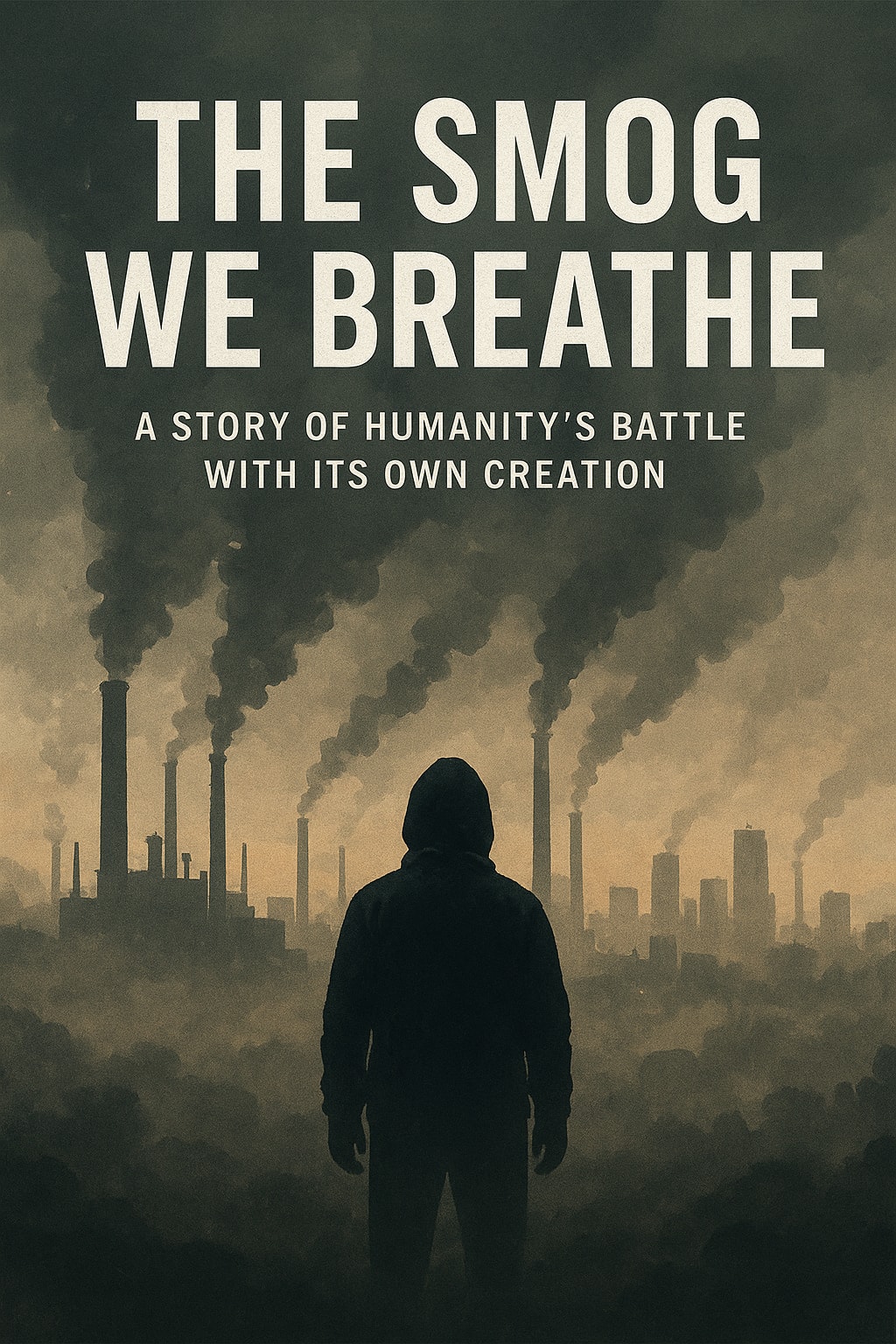
The Smog We Breathe
A Story of Humanity’s Battle with Its Own Creation
The sun no longer rose in full color over the city of Virelia—it merely bled through a gray haze, a pale disc struggling to be seen. The air carried a metallic taste, and every breath was a reminder of the choices humanity had made.
Mara adjusted her respirator and stepped out of her apartment, glancing at the digital pollution index flashing red above the doorway: AIR TOXIC – LIMIT EXPOSURE TO 2 HOURS. She tightened the strap on her mask and began her walk to the recycling plant.
It wasn’t that people didn’t care anymore—it was that they had grown used to caring in silence. Once, there had been protests, global movements, cries for change. But when the skies darkened for good and crops began to fail, survival replaced outrage.
The recycling plant loomed in the fog like a mechanical beast. Mara had worked there for eight years, sorting what remained of the old world’s plastics and metals—traces of a civilization that had traded green for gray. Her father used to say, “We built our own storm.” She hadn’t understood him then.
Inside the plant, conveyor belts clattered endlessly, carrying fragments of discarded lives—bottles, circuit boards, crumpled packaging. The machines hummed with relentless precision, breaking down waste and spitting out raw material for the new factories. It was a cycle that sustained the city but never healed it.
Her supervisor, a thin man named Idris, approached. “You’re on filter duty today. Sector 9.”
Mara nodded. Filter duty meant climbing the tower—one of the massive air purifiers that stood like skeletal monuments around the city. It was dangerous, but it gave her something precious: a view.
By midday, she was halfway up the tower. The smog thickened as she ascended, turning the world into shifting shadows. Below, the city sprawled endlessly—factories coughing black smoke, drones buzzing between towers, rivers the color of rust. She reached the top and began replacing the clogged filters, each one soaked in grime.
When she finally looked up, she saw something unexpected. A flicker of green.
She blinked. Just beyond the industrial perimeter, where the ground turned to waste fields, a small patch of color shimmered faintly beneath the smog. Green—impossible, but real. A living plant.
Mara froze, heart hammering. In a city where all vegetation had died decades ago, the sight felt like witnessing a miracle.
She climbed down and left the tower without reporting the anomaly. The guards at the city gate hardly looked at her as she passed—few people went outside willingly. The air beyond the walls was worse, but curiosity pulled her forward.
The journey took hours. The sky grew darker, and the ground was slick with oily mud. When she reached the spot, she knelt beside it. A single sprout, thin and trembling, pushed through the cracked soil. Its leaves were coated with dust, but alive.
Mara touched it gently, afraid it might crumble. A tear stung her eye—she couldn’t remember the last time she’d seen something so pure.
Behind her, a faint mechanical whir broke the silence. A drone.
She turned to see a patrol unit hovering nearby. Its red sensor light blinked rapidly. Trespassing beyond the walls was forbidden. The drone scanned her face and spoke in a calm, synthetic voice: “Unauthorized presence detected. Return to city limits immediately.”
Mara hesitated, shielding the sprout. “There’s life here,” she said. “Something’s growing.”
The drone paused, processing. Then: “Unregistered biological material detected. Report filed for containment.”
Containment. That meant the plant would be destroyed and the soil sterilized.
“No,” she whispered. “You can’t.”
When the drone extended its mechanical arm, Mara acted on instinct. She picked up a rock and smashed its sensor. Sparks burst, and the drone crashed into the dirt. She didn’t wait to see if it would recover. Gently, she dug the sprout from the soil, wrapped it in cloth, and hid it beneath her jacket.
By the time she returned to Virelia, night had fallen. She slipped through an old drainage tunnel to avoid the scanners and emerged near the residential district. Her lungs burned, her arms ached, but her heart raced with something she hadn’t felt in years—hope.
At home, she placed the sprout in a glass jar and set it beneath a broken skylight where a sliver of moonlight touched the soil.
Days passed. She watered it sparingly with filtered moisture, whispered to it as if it could hear. Against all odds, it grew. Tiny leaves unfurled, a bright green defiance against the gray.
Word spread quietly through the neighborhood. People came to see it—old men, children, workers like her. They spoke softly, reverently. Some brought scraps of clean water, others offered old UV lamps.
It became a symbol, a secret rebellion. For the first time in decades, the people of Virelia shared something that wasn’t despair.
But secrets didn’t stay hidden long.
One morning, Mara awoke to sirens. Outside, government drones hovered, their searchlights slicing through the smog. Loudspeakers blared: “Unauthorized biological growth detected. All residents remain indoors.”
Mara ran to the jar. The plant had blossomed overnight—a single white flower glowing faintly in the dim light. She smiled through tears. “You made it,” she whispered.
The door burst open. Soldiers in respirators stormed in.
Mara didn’t resist as they took the jar. “You can destroy it,” she said softly, “but you can’t stop it.”
Because she had already shared its seeds.
Across the city, hidden in pockets of soil and old containers, dozens of sprouts were already taking root—tiny breaths of life beneath the smog.
About the Creator
Keep reading
More stories from abdul qadir and writers in Chapters and other communities.
My Friend and I
My Friend and I Friendship is one of the most special things a person can have, and I’m lucky to have a friend who has always been by my side. His name is Ryan, and he’s been my best friend since the first day of second grade. Now we’re both fourteen, and even though we’ve changed and grown a lot, our friendship has only become stronger.
By abdul qadir5 months ago in Chapters
The Cave Part 6
If you have ever heard a tale about yourself that you cannot remember and doubtless think is made up, you will know how I felt when Tharkin related all that the eagle had seen of me before my memories were scattered. Of far distances and traveling companions that I did not recall, camping out under the stars and making our way to the mountains with deliberate purpose. The great bird had lost contact with my party once we entered the forests, and the seven other members were not seen again by him or his brethren since.
By Jamye Sharp22 days ago in Chapters
Sparrow on a Plank Chapter 19: Of Sparrows, Pirates, and...Vikings?
Back on Cyrill, Prince Ta was smiling to himself. He had long ago realized that Lord Ashigaru would be his opponent on this, and so had started a dossier on him. It was easy for him to keep a step ahead of the reptilian lord; Prince Ta didn't limit his thinking to what he thought his role was, and therefore was open to ideas that he would otherwise reject. He also treated his operatives with respect, and allowed that failure was an option. After all, if you send someone on a difficult assignment then it was likely that at sometime that someone would need to fail; it was just a matter of odds, and the odds didn't play favorites. He smiled, just a little thing on his lips, as he wondered how Lord Ashigaru would feel if Bubastos' high lord ever realized that his waffles were his weakness; without his daily waffles, his entire day was shot. They were part of his daily ritual, and something that needed to be changed.
By Jamais Jochim2 days ago in Chapters


Comments
There are no comments for this story
Be the first to respond and start the conversation.