
The Silence Below
The Silence Below: A Hidden City Beneath London

London was loud that night. The kind of loud that felt like it had crept into the cracks of the cobblestones, into the bones of the buildings, vibrating through the centuries. It wasn’t just traffic and tube brakes, or the squawks of drunken laughter spilling out of Soho pubs — it was a hum, a subterranean murmur, ancient and electric.
Maisie Ellwood stood at the mouth of Neal’s Yard, clutching a plastic bag from the Turkish corner shop, her eyes drawn to a shadow that had moved where shadows shouldn’t. She wasn’t new to the city. Born in Lewisham, aged in Camden, hardened in Shoreditch. She knew London, and London knew her. But this… this was different.
Earlier that evening, she’d gone to a pop-up gallery in Hackney — ironic collages of King Charles in Warhol colours, drones shaped like ravens, that sort of thing. It was her friend Zoe’s scene, not hers. She’d left early, tired of smiling and nodding at people who said things like, “Crypto is post-capitalist art, you know?” Now, under the pale orange glow of a dying streetlamp, she felt something tugging at her. Not her coat. Not the wind.
Something else.
She turned the corner. The quiet was instant. The kind that presses on your ears. Ahead, between an alley and a fire escape, was an iron grate half-covered in moss. Maisie had passed it a thousand times and never once noticed it. It wasn’t just the noise that stopped — her phone lost signal, too. It blinked blankly in her pocket. The city had gone mute.
She crouched by the grate. Beneath, through slats of rusted metal, she heard something — not footsteps, not traffic — but a steady, wet breathing. Not human. Not quite animal. Rhythmic. Ancient.
She should’ve walked away. Instead, she peeled the grate back.
A tunnel sloped downward. No graffiti, no rubbish, no rats. The walls were clean, tiled in pale green Victorian ceramic, still glistening after what must have been a hundred years. She stepped down. The air smelled of coal, rain, and peppermint — like the ghosts of a thousand London winters.
She walked.
Ten steps. Twenty. Then it opened up into a vast underground room lit by gas lamps. There were people — or things shaped like people — sitting on benches, reading newspapers from 1898. A woman in a corset glanced up and gave her a nod, as if Maisie had merely arrived late to a book club. No one spoke. Just the rustle of pages, the echo of a dropped teacup.
She whispered, “What is this place?”
A man with a cravat and a gold monocle looked up from his chair. His face was scarred like cracked marble.
“You’ve come to the Underhold,” he said, his voice like creaking wood. “The quiet that holds the city together.”
Maisie blinked. “Is this real?”
He nodded solemnly. “London above is chaos. Noise. Speed. Here… we remember. We listen. We keep balance. Without the Underhold, the city would devour itself.”
“Why me?”
“You heard the silence,” he said simply.
A hush fell again. The woman in the corset offered her a teacup. Maisie took it, though it was empty. She held it anyway.
There was something comforting in the stillness. In a world that measured your worth in likes and notifications, here, time simply sat down beside you and exhaled. No phones. No status. Just silence, and the living memory of a city too old to shout.
Maisie sat. Hours passed — or none at all. Eventually, the man in the monocle said, “You may leave now. But you will always carry the silence.”
She climbed back up the tunnel. Replaced the grate. Her phone buzzed as the signal returned — five missed calls, dozens of messages.
She didn’t answer.
That night, walking back along the Thames, she looked at London differently. Every crane became a sentinel. Every pigeon, a spy. Every bit of graffiti, a sigil. And beneath it all, that quiet thrum — like the purring of something enormous, sleeping under the streets, dreaming of fog and revolution.
About the Creator
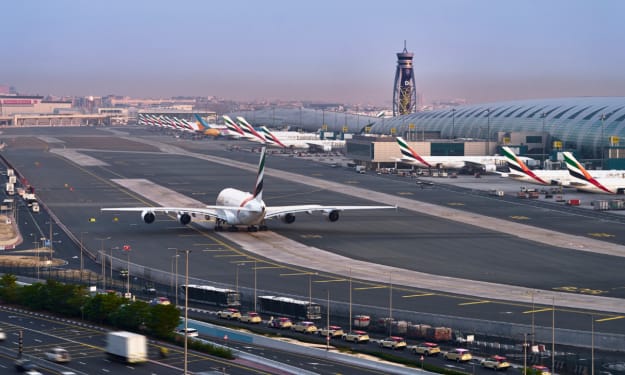
How has the Israel-US war with Iran affected air travel?
On February 28, Israel and the United States launched a coordinated military operation against Iran, killing Supreme Leader Ali Khamenei. Since then, the conflict has rapidly expanded and affected multiple countries.
By Real content2 days ago in Chapters



Comments
There are no comments for this story
Be the first to respond and start the conversation.