
The River That Took Them All: A Tragedy in Swat
A peaceful summer day turned into a nightmare as 19 family members were swept away by a sudden flash flood in Pakistan’s Swat Valley.

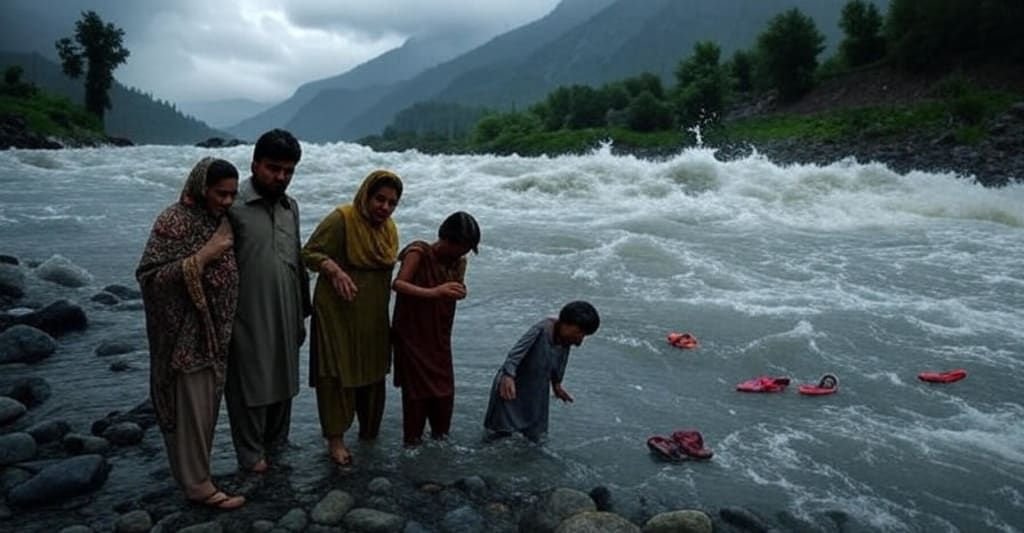
The morning began like any other in the lush, serene valley of Swat, Pakistan. Birds sang their songs in the pine trees, children laughed on the riverbank, and tourists wandered the scenic hills with cameras and curious eyes. But by sundown, what was once a landscape of peace had turned into the setting of an unspeakable tragedy.
On June 27, 2025, the beauty of the valley was shattered when a sudden flash flood tore through the Swat River — claiming the lives of at least 15 members of a single extended family, with others still missing. It was a moment that stunned a nation, paralyzed a community, and left scars that words can barely describe.
---
A Family Outing Turned Fatal
The family had come from different parts of Khyber Pakhtunkhwa for what was meant to be a joyful picnic. It was a break from the heat of the cities, a chance for cousins to reunite, and for elders to breathe the clean air of the mountains.
They chose a picturesque spot beside the Swat River — a place where the water seemed calm, children could dip their feet, and photos could be taken under the shadow of the hills.
But beneath that beauty was a storm brewing — both figuratively and literally.
---
The Moment It Happened
Around midday, the skies began to darken. It wasn’t unusual for monsoon clouds to roll in, and no weather alerts had reached the tourists. Within minutes, however, a deafening roar echoed through the valley — a rush of water unlike anything they’d seen before.
The flash flood arrived without mercy.
Witnesses say the river swelled within seconds. What was once a peaceful stream turned into a torrent of churning, brown water. Trees were uprooted. Rocks were hurled. And in the middle of it all, the family was caught.
Several children were nearest to the river when the water surged. As they screamed and struggled, their parents and older siblings rushed forward instinctively — not to escape, but to save them.
In doing so, they were swept away together.
---
A Scene of Helplessness
By the time emergency services arrived, it was already too late. The flood had carried away everything: people, belongings, memories.
Local rescue teams, joined by the Pakistan Army and volunteers, combed the river for hours. Slowly, one by one, bodies were recovered downstream — some as far as 10 kilometers away.
By evening, 12 bodies had been found. Some were locked in embrace. Others had scratches from rocks and tree branches. The youngest was only eight years old.
Among the deceased were mothers, fathers, teenagers, and toddlers. A family that had posed for a group photo hours earlier had now been reduced to names on a casualty list.
---
The Pain of Those Left Behind
The surviving members — those who watched from a distance or arrived late — were inconsolable.
One elderly man, the grandfather of three of the children who died, collapsed on the riverbank, repeating their names again and again. Another woman, barely able to stand, kept asking, “Why did God let this happen?”
Grief spread through the nearby town like wildfire. Shops closed. The mosque echoed with Quranic recitations for the dead. Neighbors wept with neighbors, strangers embraced each other, and the entire community mourned as one.
---
A National Wake-Up Call
The incident made national headlines within hours. News channels replayed the video — recorded by a bystander — of the family being swept away, the cries of children fading into the roar of the flood.
Many Pakistanis, especially those familiar with Swat’s treacherous terrain during monsoon season, asked the same questions:
Why weren’t there flood warnings?
Why is there no protective fencing along such a dangerous riverbank?
Why do these tragedies keep repeating every monsoon?
Government officials promised investigations and flood-mitigation measures. But for those who buried their loved ones, no promise could ease the ache of what was lost.
---
Nature’s Beauty — And Its Brutality
Swat has long been described as "the Switzerland of Pakistan" — its emerald rivers, snow-capped peaks, and terraced fields drawing millions of tourists. But this tragedy is a grim reminder that beauty can also be deadly.
Pakistan, already vulnerable to climate change, is witnessing more intense and unpredictable weather patterns each year. Sudden glacial melts, cloudbursts, and unmonitored tourism in flood-prone areas have made incidents like these more common — and more deadly.
---
The Ones We Lost
Here are some of their names, as released by the family:
Sanaullah, 45 — tried to save his two sons.
Rabiya, 16 — slipped while helping her cousin.
Haris, 10 — last seen clinging to a tree branch.
Zainab, 8 — smiling in the last photo taken that day.
And many others. Each one with a story. A future. A dream.
---
The River Still Flows
Today, the Swat River flows as it always has — indifferent, unconcerned. Tourists have returned. The rocks remain. The trees stand tall again. But for the families that lost their loved ones, time has stood still.
Every time a child laughs near the water, a mother flinches. Every time thunder rolls across the hills, hearts tighten. The river that once gave life to the valley has now become a symbol of what it can take away.
---
Final Words
We often forget how fragile life is until it’s too late. A riverbank picnic turned into a graveyard for 19 souls — all because nature struck without warning, and humanity wasn’t prepared.
Let their memory be a lesson. Not just in safety or climate awareness, but in valuing every moment, every hug, every goodbye.
Because sometimes, there is no next time.
About the Creator
TrueVocal
🗣️ TrueVocal
📝 Deep Thinker
📚 Truth Seeker
I have:
✨ A voice that echoes ideas
💭 Love for untold stories
📌 @TrueVocalOfficial
Locations:
🌍 Earth — Wherever the Truth Echoes
Valentine's Dates Over the Years
Colin grinned as Brooklyn slipped into the living room. “Is it all set?” he asked. The twenty-one year old grinned. She was in her last year of college and Colin knew that Lincoln was proud of her. Although she had been away at college, she’d eagerly helped Colin plan his surprise for Lincoln. “I’m so glad you’re finally doing this,” she said.
By Reb Kreyling16 days ago in Chapters
How Power Structures Protect Themselves
In 1949, a book was written titled Nineteen Eighty-Four, in which George Orwell fictionally explained how, in the future, systems and governments would become so powerful that they would prioritize their own power struggles over people’s well-being. And remember, we’re talking about the West, where democracy is considered very mature. According to Orwell, such states never truly end conflicts or wars; one way or another, they keep fear alive among people. If fear remains intact, people stay obedient.
By Ibrahim Shah a day ago in Chapters
When the Shelter Closes
Across the street from my house, a man slept under a tree, his dog by his side. My first, naive thought: he must be traveling through. But he kept coming back, often sleeping there during the day. Then it hit me—that person might not have a home.
By Bride of Sound3 days ago in Humans




Comments
There are no comments for this story
Be the first to respond and start the conversation.