
The Rise of Artificial Intelligence: How Machines Are Changing Our World
How Machines Are Changing Our World

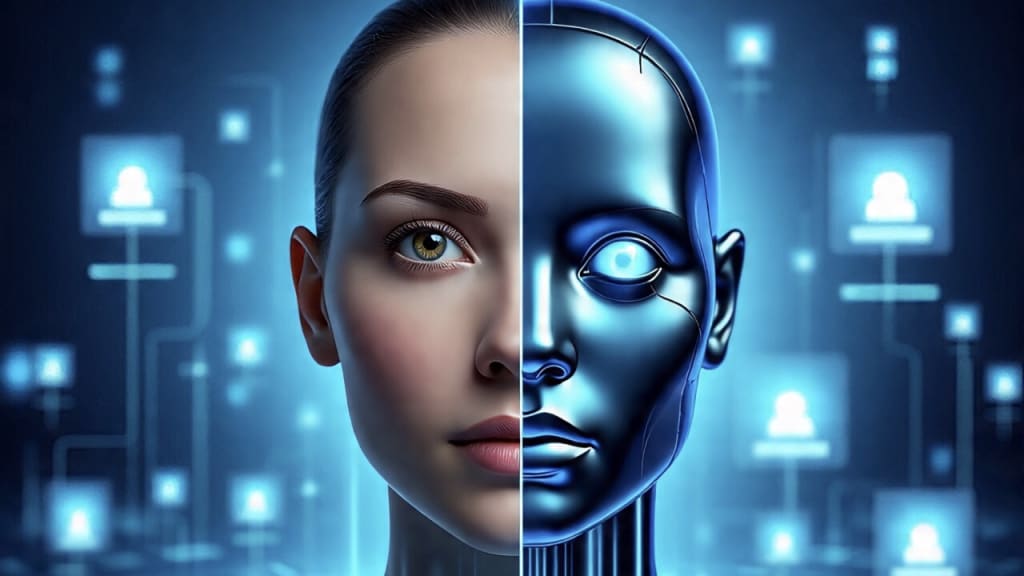
Imagine someone showing you a video in which you appear to be doing something—but you know with absolute certainty that you were never there. What if someone sends you a photo of a person claiming to be themselves, and it looks completely real, but that person doesn’t exist at all? Or you upload a picture of your late grandfather into an app, and it starts talking back in his voice and style. These may sound like scenes from a sci-fi movie, but they are very real—and powered by one thing: Artificial Intelligence (AI).
AI is rapidly transforming the way we live, work, and communicate. It allows machines to think, learn, and make decisions similar to human beings. But how does it work? What are its capabilities, and what does the future hold?
What Is Artificial Intelligence?
Artificial Intelligence refers to the simulation of human intelligence in machines that are programmed to think, reason, and learn. It’s a field of computer science that enables machines to perform tasks that would typically require human intelligence—like recognizing faces, understanding language, or even making creative decisions.
AI is generally classified into two types:
Narrow AI: This type of AI is designed for specific tasks. It powers features like facial recognition, spam filters in email, and voice assistants like Siri and Alexa. It’s highly effective but limited in scope.
General AI: Unlike narrow AI, General AI can theoretically perform any intellectual task that a human can. Although it's still in its early stages, recent advancements have brought us closer to this vision than ever before.
The Power of Deep Learning and Machine Learning
One of the core methods behind AI’s growing intelligence is Deep Learning—a subfield of machine learning that mimics how the human brain processes information. Using artificial neural networks, deep learning allows machines to learn patterns, understand language, and even predict outcomes.
For example, AI can understand regional dialects, speaking styles, and personal habits. If someone from Punjab speaks differently than someone from Lucknow, AI models can be trained to recognize and replicate those subtle differences. This makes the interaction feel far more natural and personalized.
AI models like ChatGPT, which stands for “Generative Pre-trained Transformer,” are trained on vast amounts of data—books, websites, conversations—to understand language and respond in human-like ways. It doesn't just memorize facts; it learns sentence structure, regional accents, and even cultural context. When you ask it a question, it doesn't just search for an answer—it predicts the most appropriate response based on everything it has learned.
Visual AI: Teaching Machines to See
AI isn’t limited to text. Visual AI allows machines to understand images and videos much like a human eye would. It analyzes visual data to recognize objects, faces, scenes, and even emotions.
It begins with image processing, where an AI system separates different parts of a picture—like faces, objects, or backgrounds. Then it uses object recognition to identify what’s in the image, and even matches faces against a database. It can detect what’s happening in a scene, how far objects are from each other, or what action is taking place.
One of the most powerful advancements is AI-generated media. Give it a command like, “Create an image of a man sitting on a tree branch eating something,” and AI can generate a realistic picture within minutes. If you ask for a video, it can produce that too—frame by frame, motion by motion.
This technology has applications in self-driving cars (which use AI to recognize roads, signs, and obstacles), medical imaging (to detect diseases), factory automation, and security (for facial recognition).
The Impact on Jobs and the Future of Work
With AI’s rapid evolution, a major concern is its impact on employment. Will machines replace human workers?
Studies from Oxford University suggest that nearly 47% of jobs could be automated within the next two to three decades—particularly in fields like manufacturing, transportation, and customer service.
But it's not all doom and gloom. According to the World Economic Forum, while AI could eliminate 85 million jobs by 2025, it could also create 97 million new ones in fields like tech, data science, and digital development.
The key is adaptation. While some routine jobs may disappear, entirely new industries and roles are emerging that demand creative thinking, emotional intelligence, and complex problem-solving—areas where humans still outperform machines.
Conclusion:
A Tool, Not a Threat Artificial Intelligence is not just the future—it’s already here. It’s changing how we communicate, diagnose disease, create art, and solve problems. But it’s not about replacing humans; it’s about enhancing what we can do.
To thrive in this new world, we must understand how AI works, learn to use it wisely, and build skills that complement, not compete with, machines. The future isn't about man versus machine—it's about man with machine.
Stay informed. Stay skilled. The AI revolution is here—and it’s only just beginning.
About the Creator
Taimoor Khan
Hi, I’m Taimoor Khan. Writing is my way of capturing the quiet moments of life that often go unnoticed.
Keep reading
More stories from Taimoor Khan and writers in Chapters and other communities.
The Bermuda Mystery: Unraveling the Enigma of the Devil’s Triangle
For decades, the Bermuda Triangle — often dramatically referred to as the “Devil’s Triangle” — has captured imaginations with tales of ships and planes vanishing without a trace. This mysterious region, forming a rough triangle between Miami, Florida, Bermuda, and San Juan, Puerto Rico, covers a large stretch of the western North Atlantic Ocean. While some see it as a natural danger zone, others believe it’s a hotspot of supernatural activity. So, what’s really going on in the Bermuda Triangle?
By Taimoor Khan8 months ago in Chapters



Comments
There are no comments for this story
Be the first to respond and start the conversation.