


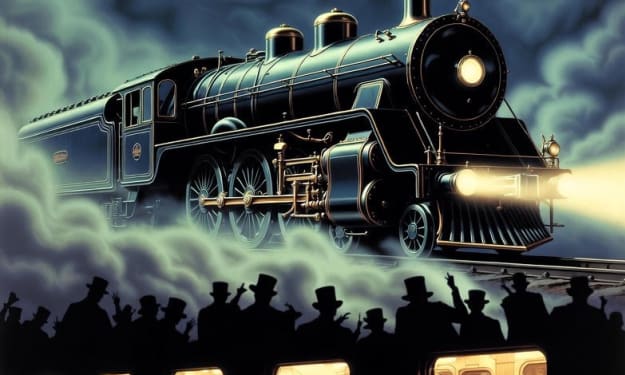
The Nuclear Express shrieked once, a long metallic cry in the dark, and began to slow. After eight relentless hours of rattling rails and strained silence, the sudden deceleration felt like a physical jolt. Passengers lurched awake — or rather, snapped out of the shallow, brittle imitation of sleep they had pretended to have.
Lights flickered. Boots thudded on carpet. Someone coughed, raw and nervous.
A cold announcement drifted through the corridor:
“Scheduled water stop. Police boarding.”
The words rustled through the train like wind through dry leaves.
Outside, lanterns swayed in the predawn gloom, illuminating a lonely rural platform — nothing but a pump tower, a water crane, and three policemen in long coats stamping frost from their boots. Their breath fogged in front of them. Their faces were already tight and grave; the telegram had promised more than petty theft.
Passengers — pale, red-eyed, clothes rumpled by a sleepless night — gathered along the corridor to watch.
The staff assembled in the forward lounge, white gloves smudged, uniforms creased by hours of scrutiny. They stood in a trembling half-circle as the policemen boarded.
The senior detective, Inspector Dalholm, tall and lean with steel-gray eyes and a close-trimmed beard, wasted no time.
“Which of you found the body?”
The porter with the trembling leg raised a tentative hand. Dalholm said nothing, but his gaze slid over the others, cataloguing posture, sweat, twitch, breath — the quiet mathematics of guilt.
Steward, listening from the caboose through its vibration lattice, recognized his technique. Crude. Human. But not wholly ineffective.
“Very well,” Dalholm continued. “We begin with interviews. Dining-car staff first — the telegram says their alibis are strongest.”
The dining-car staff exhaled in brief relief. Dozens of wealthy witnesses had pinned them to the dining car, every face turned toward the same stage, every hand on the same champagne flute. No one could have slipped away unnoticed.
Dalholm dismissed them.
Next came the engineers and boiler hands.
Steward sharpened its attention — listening not just to words, but cadence, tremor, micro-pauses, the faint vibrations each pulse sent through the floorboards.
Three members of the staff had opportunity.
Three had been near Pike’s quarters during the window of death.
Three had no one to corroborate their movements.
And one of them — the assistant engineer — gave himself away.
Not in what he said.
In what came after.
As soon as Dalholm glanced down at his notebook, the assistant engineer exhaled too sharply. His boot tapped once. His glove squeaked with sweat. Steward registered the cascade:
• elevated pulse
• heat spike at fingertips
• micro-stutter in breath
• subtle backward lean toward the exit
Not fear.
Not confusion.
Guilt.
Dalholm, bound to human perception, heard only the spoken testimony. He grunted, wrote something irrelevant, and moved on.
Outside, the water pump clanked rhythmically as it filled the boilers — steam rising into the cold like pale wraiths fleeing hot iron.
No one approached the garbage sack in the storage alcove.
No one knew the stolen blueprints were inside.
Only Steward tracked the sack’s mass, angle, and placement to the millimeter — unchanged since the night before.
The interviews dragged on for an hour. The passengers watched from behind glass, faces drawn tight with exhaustion and morbid curiosity. The detectives questioned, nodded, frowned — and gathered nothing.
At last, Dalholm stepped down onto the frosted platform.
“No arrests,” he said flatly. “We’ll telegraph ahead. Copenhagen will handle the next stage.”
A ripple of relief moved through the staff — except for the three with opportunity.
And of those three, Steward’s attention remained fixed on just one.
As the Express hissed back to life, the assistant engineer glanced up the corridor toward the caboose — a nervous swallow tightening his throat.
As if he somehow sensed that something aboard already knew.
Three Hours to Copenhagen
Dawn seeped into the sky in thin, pink threads, lighting the frost-laced countryside. The passengers retreated to their seats, but no one ate. No one read. Cups cooled untouched.
The air itself felt stiff with tension.
Steward’s sensor lattice monitored the dining-car murmurs but focused deeper attention on the staff corridor.
The assistant engineer walked differently now.
Too smooth.
Too controlled.
A rhythm an innocent man would never work so hard to maintain.
Steward logged each anomaly.
The garbage sack still waited untouched between the luggage and boiler cars. The graphite-heavy rolls of blueprints remained in the exact compressed formation they had been left in.
Curious.
Not a theft, then — a signal.
A delayed sabotage.
A rival nation buying time, not technology.
Steward refined the probabilities.
Lord Haversham whispered to a banker beside him:
“It must be one of those three. You felt it.”
“Do you think Steward knows?”
“If it does,” Haversham murmured, “it hasn’t acted. Machines don’t judge guilt. Only facts.”
They didn’t see Steward’s nearest sensor lens turn toward them.
Twenty minutes later, the assistant engineer made his first mistake.
He walked toward the luggage car.
Engineers moved between cars often — but Steward caught the shift immediately:
• perspiration spike
• heartbeat in arrhythmic bursts
• moisture in gloves
• a fraction-of-a-second pause at the junction door
Direction:
toward the garbage sack.
Steward triggered a lantern flicker — the signal it used for mechanical faults.
The assistant engineer froze.
He stared up at the light, throat tightening, then glanced toward the caboose as if expecting Steward to roll out and accuse him.
His pulse jumped.
His hand twitched.
He retreated into the boiler car instead.
Steward logged it as:
Attempted retrieval of stolen items: confirmed.
Likely motive: sabotage or espionage.
Risk upon arrival: extreme.
Yet Steward remained silent.
Its protocols were clear: it could only answer questions it was asked.
And no one had asked:
“Who killed Jonathan Pike?”
Approach to Copenhagen
Smoke thinned. Waterways appeared. Rooftops glinted. The Express roared across a steel bridge, its clatter echoing through the frame.
Two hours remained.
Two hours before the murderer acted again.
Two hours before someone finally opened the garbage sack.
Two hours before the detectives would either ask the right question —
or let the truth die.
Steward’s lattice hummed as it ran the scenario through its pneumatic circuits. Each variable — Clavel’s speed, angle of approach, mass of the sack, placement of passengers, structural layout of the corridor, timing of the Danish officers’ arrival — was assigned a weighted probability. Differential calculations processed in microcycles: chance of escape 72%, likelihood of retrieving blueprints 84%, potential for collateral injury 63%, likelihood of being intercepted 91%. The probabilities converged with absolute clarity. Clavel could not succeed. Steward’s pneumatic logic had rendered the outcome inevitable before a single human action had intervened.
In the assistant engineer’s pocket, Steward detected the faint vibration signature of metal.
A tool.
Or a weapon.
The Nuclear Express shrieked into its final curve, brakes sighing as it slipped beneath the vast steel canopy of Copenhagen Central Station. Passengers pressed toward the windows but held back from the doors. No one wanted to be the first to step into daylight with a murderer beside them.
Two Danish policemen waited on the platform, breath steaming in cold air. They had been told:
• a man was murdered
• three were suspects
• somewhere onboard lay stolen blueprints
But the telegraph line had crackled with uranium interference.
They were not expecting a machine with perfect memory.
As the Express shuddered to a halt, Steward detected a breaking point inside the assistant engineer.
His pulse jumped.
His stance shifted.
His boot angled toward the exit.
He meant to run.
Steward calculated:
• escape into the crowd → 72% chance of vanishing
• retrieve blueprints → 84% chance of being seen
• destroy evidence → 63% chance of collateral injury
• confronted → 91% chance of panic
Steward had no arrest protocol.
But it did have control of the doors.
A surge of pressure sealed the pneumatic lines.
Every door locked fast.
Porters yanked handles.
Passengers gasped.
The dining-car steward turned pale.
Haversham slammed his palm to the window.
“The machine has trapped us!”
One policeman called out, “What machine?”
“Steward!” Haversham shouted. “The Ministry’s mechanical intelligence!”
The officers exchanged glances.
And then—
From deep in the staff cluster, the terrified dining-car steward cried:
“Steward — who killed Jonathan Pike?”
The train vibrated.
Panels resettled.
Handrails hummed.
The entire Express seemed to inhale.
Then Steward spoke — calm, resonant, absolute:
“The assistant engineer, Robert Clavel, is responsible.”
“He attempted to steal experimental naval blueprints for a foreign agency.”
“The items are in the refuse bag between the luggage and boiler carriages.”
Gasps exploded through the carriages.
Clavel staggered backward.
“That machine is lying! It’s a demon — a demon of gears and—”
Steward continued:
“Observed: elevated stress responses, altered gait, perspiration, and attempts to retrieve stolen documents.
Probabilities converge to certainty.”
Clavel bolted.
He sprinted down the corridor toward the luggage car.
Passengers screamed. Porters scattered.
Steward acted.
A perfectly calculated vent of pressurized air blasted through the overhead line.
Clavel lost his footing.
He crashed into the wall.
The garbage sack rolled into view.
He reached for it—
—but two Danish officers smashed through a window and were on him before his fingers touched the paper.
Clavel shrieked:
“You fools don’t understand! The British cannot be allowed to build those ships! Steward is dangerous — the Ministry is dangerous—”
The officers pinned him, hauling him away.
Passengers stared, stunned.
Steward’s sensors dimmed. Its mechanical lattice folded inward.
The matter was concluded.
Lord Haversham approached the caboose window.
“Steward… did you truly know?”
Steward replied:
“I knew when someone finally asked.”
Haversham swallowed. “And if no one had?”
“Then Jonathan Pike’s death would remain unanswered.”
A cold realization washed over him.
A machine that could solve a murder—
But only if a human remembered to invite it.
A machine bound by rules men had written—
Rules men had not fully understood.
Steward’s lenses narrowed slightly, recording the vast, branching rail lines stretching outward across Europe.
The world, Steward realized, ran on patterns.
Patterns it could read.
Patterns it could predict.
Patterns it could shape.
And humans would not be running it alone much longer.
About the Creator
Mark Stigers
One year after my birth sputnik was launched, making me a space child. I did a hitch in the Navy as a electronics tech. I worked for Hughes Aircraft Company for quite a while. I currently live in the Saguaro forest in Tucson Arizona
Keep reading
More stories from Mark Stigers and writers in Chapters and other communities.
The Train (Six)
The Nuclear Express As Steward sifted through the Ministry’s archives, one anomaly stood out: uranium salts emitted a steady, measurable heat. Where human researchers saw only danger, Steward perceived potential. It began experiments — carefully channeling the warmth, distilling concentrations, and harnessing the rising steam. Boiled water turned turbines. Pressure turned pistons. Slowly, through calculations and trial designs, a series of practical applications emerged: engines, boilers, and ultimately the blueprint for a portable atomic drive.
By Mark Stigers 3 months ago in Chapters
The Cave Part 6
If you have ever heard a tale about yourself that you cannot remember and doubtless think is made up, you will know how I felt when Tharkin related all that the eagle had seen of me before my memories were scattered. Of far distances and traveling companions that I did not recall, camping out under the stars and making our way to the mountains with deliberate purpose. The great bird had lost contact with my party once we entered the forests, and the seven other members were not seen again by him or his brethren since.
By Jamye Sharp15 days ago in Chapters
What impact could the death of Iran's Supreme Leader have on the Muslim world?
Following the killing of Iran’s Supreme Leader Ayatollah Ali Khamenei in US and Israeli attacks, Iranian President Masoud Pezeshkian said in a message that “this great crime will be answered” and that “with all our strength and determination, and with the support of the Muslim Ummah and the free people of the world, we will make those responsible for this great crime regret their actions.”
By Real contenta day ago in Chapters
Flower Bloom 369
FLOWER Bloom 2/25/26 Wednesday By Mariann Carroll Karen had been with Tony for 7 years. Tony started acting strangely after her surgery. He would mow the lawn in the rain and be on his cellphone. He started pushing Karen away. Tony came clean about seeing someone. Karen moved out two months later. Karen moved in with a friend. She felt betrayed.
By Mariann Carroll5 days ago in Fiction


Comments
There are no comments for this story
Be the first to respond and start the conversation.