
The Line and the Cow: A Tale of Boundaries and Belonging
When a boundary became a bridge, and a cow taught the village the true meaning of unity
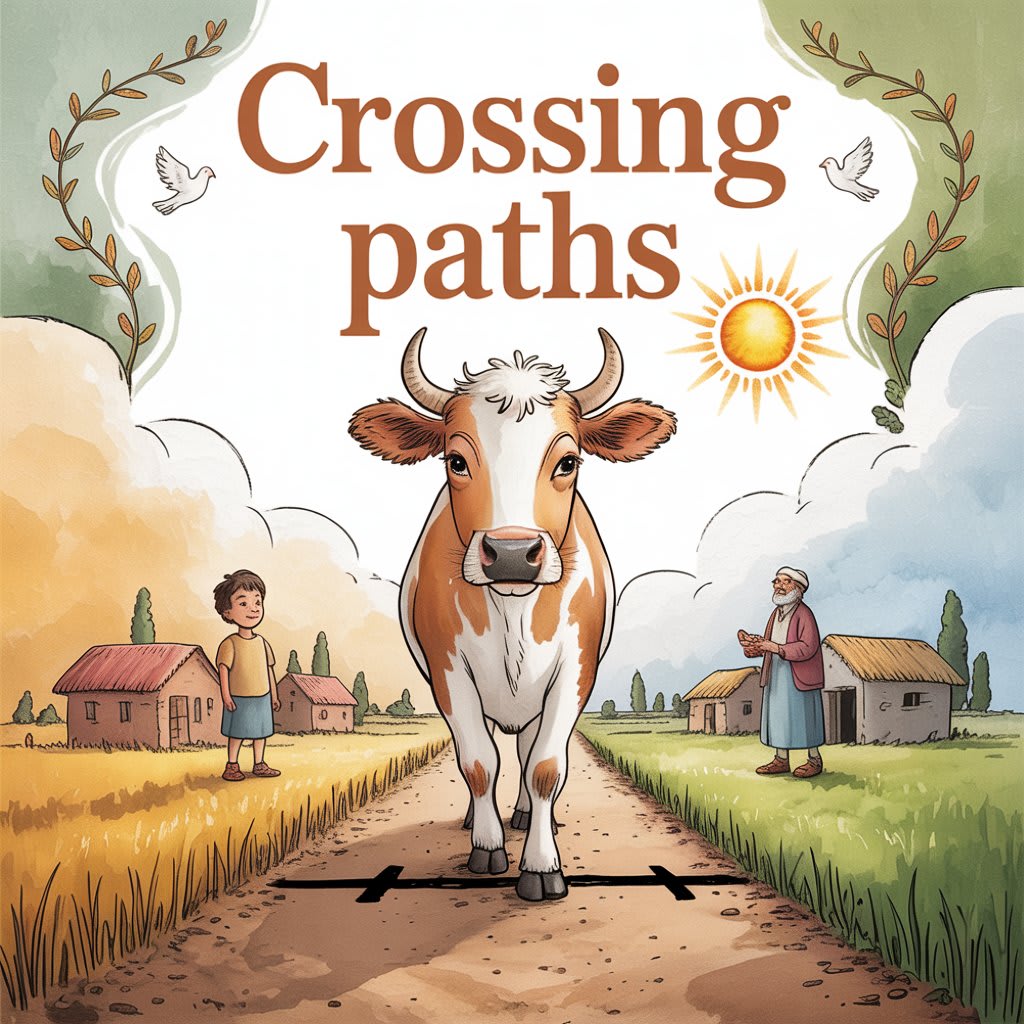
In a valley nestled between two low mountains, there lay two villages—Varan to the east and Mekla to the west. The villagers shared the same river, breathed the same mountain air, and prayed under the same sky. But between them ran a line.
It was a line no one dared cross.
No one remembered exactly how or why the line was drawn, only that it had always been there—etched in the soil, sometimes marked with stones or stakes, patrolled by silence more than people. Varan people called the Mekla folk stubborn and secretive. Mekla whispered that Varan was greedy and untrustworthy.
Trade had stopped long ago. Children from either side were warned never to play too close to the line. Even the animals, it seemed, learned to keep to their side.
But then came Gori—a creamy white cow with amber eyes and a bell that jingled when she trotted.
Gori belonged to an old widow named Lalima in Varan. Lalima loved Gori more than anything in the world. She whispered to her as if she were a child, fed her sweet jaggery on winter mornings, and told her stories of when the valley had been whole.
One autumn morning, while Lalima was hanging clothes to dry, Gori wandered off. The grass near the line was lush, and she, unaware of ancient grudges or invisible fences, trotted right across it.
Into Mekla.
When Lalima noticed Gori missing, panic seized her chest. She ran, calling out, tears pricking her eyes. At the same time, across the line, Biren, a kind-hearted farmer from Mekla, was leading Gori gently by her rope. He’d found her munching on his cabbages and, recognizing her as a well-kept village cow, planned to return her.
He stopped just short of the line.
Lalima arrived, her breath ragged. The two stood staring—Biren with the cow, Lalima with outstretched arms. The line lay between them.
“She's mine,” Lalima said softly.
Biren nodded. “She crossed over.”
“Yes. I’ll take her back.”
They stood in silence.
“I’ll bring her,” Biren offered, placing the rope gently in Lalima’s hands. “She's a good girl.”
And that should have been it—a cow returned, a problem solved.
But the story rippled.
The next day, Mekla’s village council asked Biren why he’d spoken to a Varan woman. In Varan, whispers reached Lalima's door—“Traitor’s cow,” some muttered. But both Biren and Lalima, older than most and wiser than many, ignored the murmurs.
What no one knew was that Gori would not forget.
A week later, she wandered off again. And again, she went west.
This time, Lalima and Biren sat on either side of the line while Gori grazed peacefully in between. They talked—about the weather, their crops, their aches. The next week, she came back with a pot of pickle for Biren’s wife. He sent back a basket of lemons.
Children from Mekla watched first, wide-eyed. Soon they began edging closer. Varan children did the same. Gori became a fixture—her presence calming, her bell a signal of peace.
A month later, the village councils met—not to argue, but to talk. They gathered near the line, with Gori lying between them like a sleepy guardian. They discussed how the stream had shifted, how festivals might be better if shared, how tools could be exchanged, how stories could be told across fires again.
They erased the line.
Not with erasers or decrees, but with shared meals and borrowed baskets, with songs and games, with marriages and mended fences. The line became a path. And on that path, Gori walked freely.
Years later, when Gori passed away, both villages wept. They buried her where the line once was, under a willow tree planted by the children of Varan and Mekla.
On her grave, a stone reads:
“She knew no borders—only grass, kindness, and the way home.”
And to this day, the people say that Gori didn’t just cross a line.
She erased it.
About the Creator
Keep reading
More stories from ibrahimkhan and writers in Chapters and other communities.
The Crown Within: How a King Trained His Daughter to Rule
In the kingdom of Elowen, where mist curled around ancient towers and oak leaves whispered secrets of old, King Theron ruled with a mind sharpened by war and a heart softened by loss. His beloved queen had died giving birth to their only child, a daughter named Alina. From her earliest breath, Alina was the light in the king’s grief-darkened world.
By ibrahimkhan8 months ago in Chapters
Search for a Sister, Chapter Two
4-H-N heard not a word about her secret mission around Headquarters over the following days, so had to conclude either Mini-Flash Phytolith hadn’t been listening in after all, or she’d misjudged him. She hoped it was the latter, as she wanted the pair of them to get on, even if he wasn’t going out of his way to make it easy for her.
By Doc Sherwood19 days ago in Chapters
Ludacris and Nelly draw backlash over bookings at MAGA-coded music festival
Ludacris and Nelly headlining a mostly right-wing event is good for them. It’s also great for the genre of hip hop. The two rap veterans have showcased their talents on other stages. Why can’t they perform for mostly MAGA folks and grab that bag?
By Skyler Saunders4 days ago in Beat




Comments (1)
This story really shows how silly these long-held grudges can be. It's crazy that a line divides these villages over who knows what. I wonder if this event made them start to question the line and their differences. Would love to know if things changed after this. I can picture Lalima's panic and Biren's kindness. It's a simple situation that highlights how needless these divides often are. Makes me think about similar divides in our own communities. Do we hold onto things that don't really matter?