
The Last Librarian
In a world without books, one woman guards the final stories

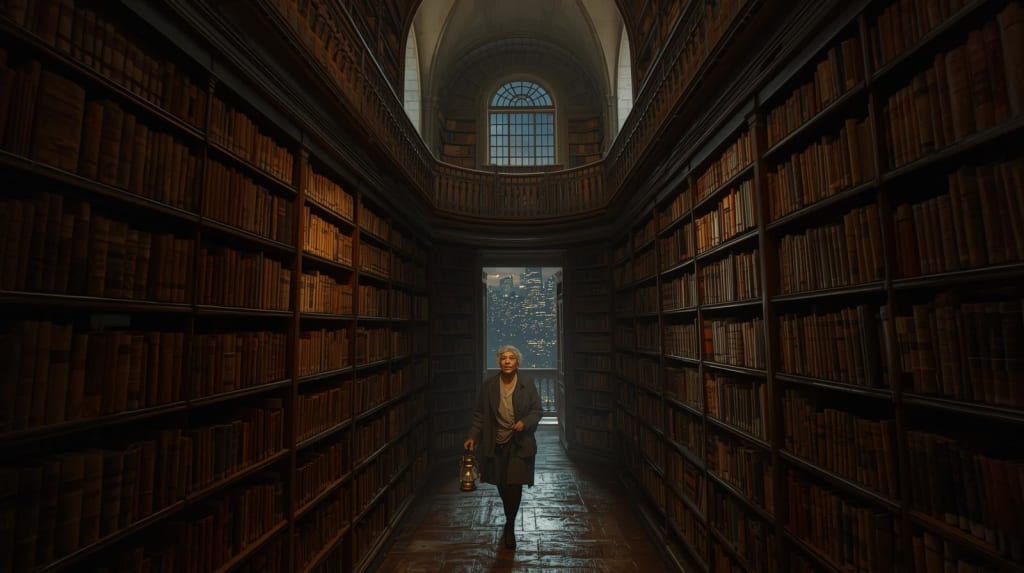
The Great Digital Shift happened gradually, then all at once. First, newspapers vanished from doorsteps. Then bookstores became hologram parlors. Finally, the last printing press fell silent, its metal bones sold for scrap. Knowledge became instant, disposable—streamed directly into neural implants. No one needed to remember anything when everything could be recalled with a thought.
Except Elara remembered.
She was the last librarian, keeper of the Alexandria II, the final repository of physical books left on Earth. The building stood as a silent monument in the center of Neo-London, surrounded by shimmering towers that reached for a sky full of transport drones.
"Books breathe," Elara would tell the empty reading rooms. "Data files just exist."
Today was different. A young man stood at the library's bronze doors, his government-issued neural implant glowing faintly at his temple. He looked confused, as if he'd stumbled upon a relic from a dream.
"Is this... a museum?" he asked, his eyes wide as he took in the towering shelves.
"This is a library," Elara corrected gently. "I'm Elara. And you must be lost."
"I'm Kael," he said. "I was looking for the Data Hub. My navigation implant malfunctioned." He gestured to the temple where the tiny light flickered erratically.
Elara smiled. "Perhaps it led you here for a reason. Come, I'll show you something you've never seen before."
She led him to the fiction section, her fingers trailing along leather spines. "These are stories," she explained. "Not data streams. They live differently in your mind."
Kael watched as she pulled a volume from the shelf. "But why keep these? The Global Network has every story ever written. Access is instantaneous."
"Are you accessing stories," Elara asked, "or are stories accessing you?"
She opened the book—Bradbury's Fahrenheit 451—and placed it in his hands. Kael flinched at the texture of paper, the weight of the volume, the smell of ink and time.
"Read the first page," she urged.
His eyes moved across the words, slowly at first, then with growing wonder. "It's... different," he whispered. "The words stay. They don't scroll away."
"That's because you're not consuming content," Elara said. "You're building a world in your mind, brick by brick. Each word is a choice you make to continue."
As days turned into weeks, Kael kept returning to the library. His neural implant stopped working entirely after his third visit, but he found he didn't mind. For the first time, he was remembering things without digital assistance—plot lines, character names, even entire passages.
"The implants don't just give us information," Elara explained one evening as they reshelved classics. "They shape how we think. Quick, efficient, disposable. Books teach us patience. Depth. Connection."
Their quiet routine was shattered when government officials arrived. "The Preservation Mandate has been revoked," their leader announced. "This building is to be cleared for the new Data Transmission Tower. The books will be recycled."
Kael watched in horror as they began boxing volumes, handling them like obsolete equipment. But then something remarkable happened. As the officials touched the books, their neural implants began flickering, some shutting down completely. They grew confused, disoriented.
"The paper is infused with a mild electromagnetic pulse," Elara explained quietly to Kael. "My grandfather's design. It doesn't harm people, just their implants. It gives them a moment to think for themselves."
In the confusion, Kael had an idea. "We don't need to save the building," he told Elara. "We need to save the books. All of them."
They worked through the night, distributing volumes throughout the city—left in parks, on benches, in cafes. Each book with a simple note: "Read me. Remember how."
The library fell the next day, but something else was born. All over Neo-London, people picked up the strange paper objects. They struggled with the unfamiliar act of reading, then discovered the magic Elara had preserved.
Kael became the second librarian, though he had no building. He taught others how to read, how to sit with a story, how to let it change them slowly.
The government eventually stopped trying to collect the books. They discovered something troubling—people who read physical books started asking better questions, thinking more critically, demanding more from their leaders.
Elara passed away as quietly as a turned page, but the library lived on—in parks, in homes, in the minds of people learning to think for themselves again. The last librarian was gone, but she had planted seeds that would grow into a forest of stories, proving that while data could be controlled, imagination could not.
About the Creator
The 9x Fawdi
Dark Science Of Society — welcome to The 9x Fawdi’s world.
Keep reading
More stories from The 9x Fawdi and writers in Chapters and other communities.
The Night Gardener
In the forgotten part of the city, where streetlights flickered like dying fireflies, there was a garden that only grew at night. Old Man Hemlock tended it with hands that knew more of magic than of soil. He was the Night Gardener, though few remembered the title or the man.
By The 9x Fawdi4 months ago in Chapters



Comments
There are no comments for this story
Be the first to respond and start the conversation.