
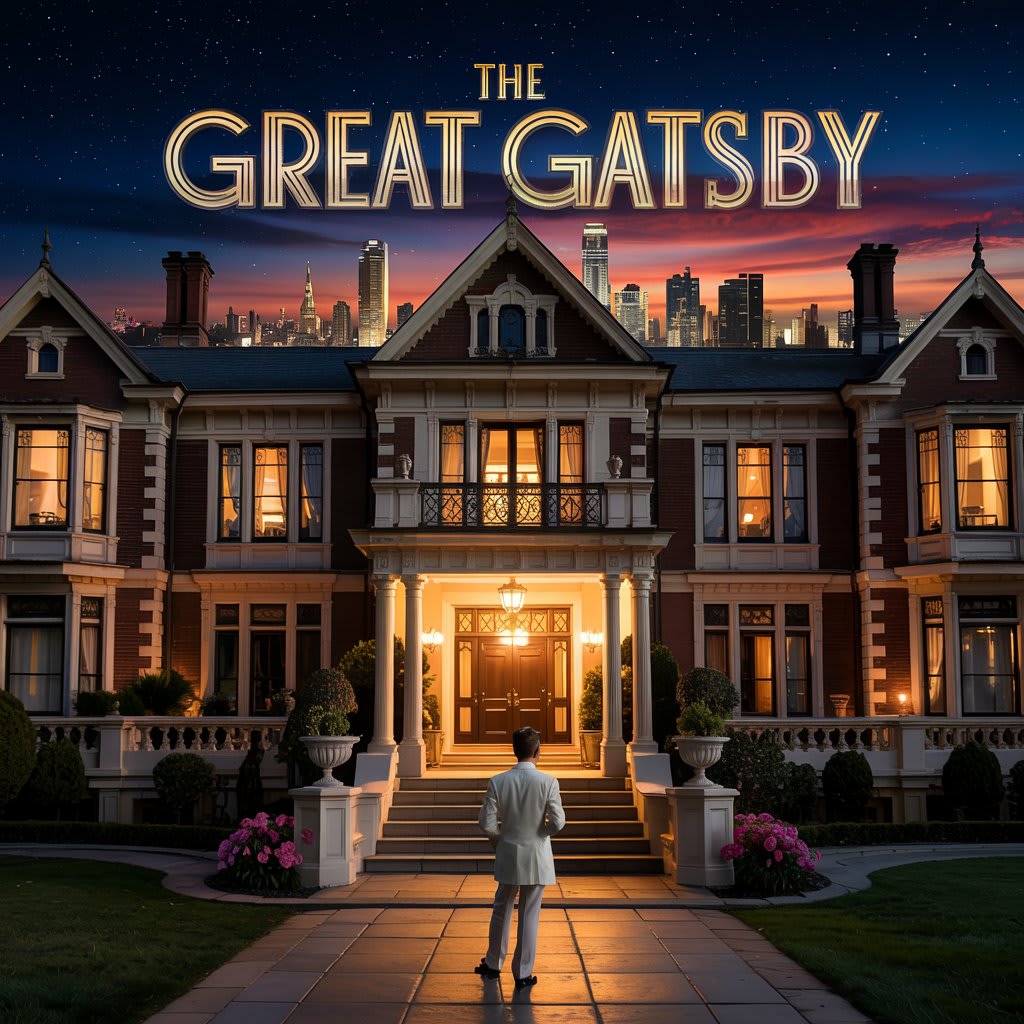
Start*The Great Gatsby* has a rich history, both in its creation and its reception. Here’s a comprehensive look at the full history of the novel:
### **The Creation of *The Great Gatsby***
**F. Scott Fitzgerald’s Inspiration:**
F. Scott Fitzgerald, the author of *The Great Gatsby*, wrote the novel in 1924 and 1925. Fitzgerald had experienced significant personal struggles, including financial instability, as well as tumultuous relationships, particularly with his wife, Zelda Sayre. Their lives mirrored some of the opulence and excess that the novel critiques, and the social atmosphere of the Jazz Age was a major influence on the story.
The novel was inspired by the society Fitzgerald observed during his time living on Long Island and the glamorous parties he witnessed in the East Egg and West Egg communities. Fitzgerald also drew from his own personal experiences, including his time spent in New York City and his relationships with wealthy socialites. The idea of the American Dream, particularly its promise of achieving success through hard work and ambition, became a central theme in the book.
**Writing Process:**
Fitzgerald began drafting *The Great Gatsby* in 1924. He struggled with writer's block and a sense of dissatisfaction with his early drafts. However, by the winter of 1924-1925, he had developed a clearer vision of the novel, which was completed by February 1925. The novel was initially titled *Trimalchio* (after a character in the ancient Roman text *Satyricon*), but Fitzgerald eventually changed it to *The Great Gatsby*, which was more in line with the story's themes of grandeur and illusion.
### **Publication and Initial Reception**
**Publishing the Novel:**
*The Great Gatsby* was published by Charles Scribner's Sons on April 10, 1925. Fitzgerald’s previous works, including *This Side of Paradise* and *The Beautiful and Damned*, had gained him some literary fame, but he was still striving for recognition as a serious writer.
At the time of publication, Fitzgerald was not a household name, and *The Great Gatsby* did not initially achieve commercial success. The novel received mixed reviews, some praising its elegance, while others criticized its focus on the rich and its lack of a strong plot. Sales were modest, and the book went largely unnoticed in comparison to Fitzgerald’s earlier works.
### **Decline in Popularity and Posthumous Fame**
After *The Great Gatsby* was published, it did not achieve immediate success. Fitzgerald’s reputation as a writer was fading during his lifetime, and the novel did not sell well. In fact, by the time of Fitzgerald’s death in 1940, fewer than 25,000 copies of the book had been sold.
### **Reappraisal and Critical Success**
However, over time, the novel began to gain recognition as one of the great American literary works. Several factors contributed to its reappraisal:
1. **World War II Impact**: In the 1940s and 1950s, there was a greater emphasis on American literature, and *The Great Gatsby* began to be viewed as a key text in this canon. The disillusionment and moral decay represented in the novel resonated with readers, particularly after the upheavals of World War II.
2. **New Editions**: The novel was reissued by publishers with new introductions and critical essays, which helped spark interest in it once more.
3. **Literary Criticism**: Literary scholars began to examine the novel more closely, and its themes—such as the corrupting influence of wealth, the fragility of the American Dream, and the disillusionment of post-World War I society—were recognized as profound and timeless.
4. **The Rise of the American Novel**: By the 1950s, *The Great Gatsby* became central to the study of American literature in schools and universities. It became a staple of the American literary canon and was increasingly seen as a critique of the American Dream and the pursuit of material success.
### **Legacy and Cultural Impact**
**Academic Recognition:**
Today, *The Great Gatsby* is widely regarded as one of the greatest novels in American literature and is frequently included in high school and college curricula. It is celebrated for its exploration of themes such as idealism, materialism, social stratification, and the American Dream. The novel’s elegant prose and its depiction of the Jazz Age have made it a subject of extensive analysis.
**Adaptations:**
The novel has been adapted into several films, stage productions, and even opera performances. Some notable film adaptations include:
1. **1926 Silent Film**: The first film adaptation, a silent version, was released in 1926 but is now considered lost.
2. **1974 Film**: Directed by Jack Clayton and starring Robert Redford as Gatsby and Mia Farrow as Daisy, this version became the most famous adaptation for many years. Though not universally acclaimed, it is often remembered for its lavish visuals.
3. **2013 Film**: Directed by Baz Luhrmann, this version stars Leonardo DiCaprio as Gatsby and Carey Mulligan as Daisy. It received mixed critical reviews but was praised for its modern take on the novel, as well as its visual style and music.
**Cultural Impact:**
*The Great Gatsby* has had a significant cultural impact, influencing everything from fashion to the way people perceive the Jazz Age. The novel’s themes of excess, materialism, and the hollowness of wealth continue to resonate with contemporary audiences. The character of Jay Gatsby has become an iconic figure representing unattainable ambition and the tragic pursuit of an idealized version of love.
### **Themes and Analysis**
1. **The American Dream**: The novel critiques the idea of the American Dream, which promises success and fulfillment through hard work and determination. Gatsby’s rise from poverty to wealth is ultimately shown to be hollow, as his wealth cannot bring him the happiness or love he desires.
2. **Class and Social Stratification**: The novel highlights the stark differences between the old-moneyed aristocracy (represented by Daisy and Tom Buchanan) and the new-moneyed individuals like Gatsby. It underscores the ways in which class shapes people's destinies, relationships, and even their identities.
3. **Love and Desire**: Gatsby’s obsessive love for Daisy is central to the plot, and it represents a desire for something beyond mere affection: he yearns for an idealized version of the past. His longing for Daisy is symbolic of a larger societal yearning for the unattainable.
4. **Moral Decay**: The novel reflects the moral decay of the era, where wealth and status often overshadow genuine human connections. It critiques the shallow, hedonistic lifestyle of the 1920s, where people indulge in materialism, often at the expense of true values.
### **Conclusion**
*The Great Gatsby* has evolved from a relatively obscure novel to one of the most important works in American literature. Its exploration of the American Dream, social class, love, and the consequences of excess still resonate today, making it a timeless piece of literature. The novel’s continued relevance, along with its status as a fixture in academic curricula and popular culture, ensures that its legacy endures. writing...
About the Creator
Search for a Sister, Chapter Two
4-H-N heard not a word about her secret mission around Headquarters over the following days, so had to conclude either Mini-Flash Phytolith hadn’t been listening in after all, or she’d misjudged him. She hoped it was the latter, as she wanted the pair of them to get on, even if he wasn’t going out of his way to make it easy for her.
By Doc Sherwood19 days ago in Chapters
The Devil's Cut
“Comrade, finally you’re awake.” The voice was smooth, sensual. A flickering incandescent bar was all that lit the white, sterile room. All Vladimir remembered was everything going black. He tried to move his arms and found them strapped to the gurney.
By Matthew J. Fromm5 days ago in Fiction


Comments
There are no comments for this story
Be the first to respond and start the conversation.