
The Empty Mirror - Part I
When reality is a decision, perception is a weapon
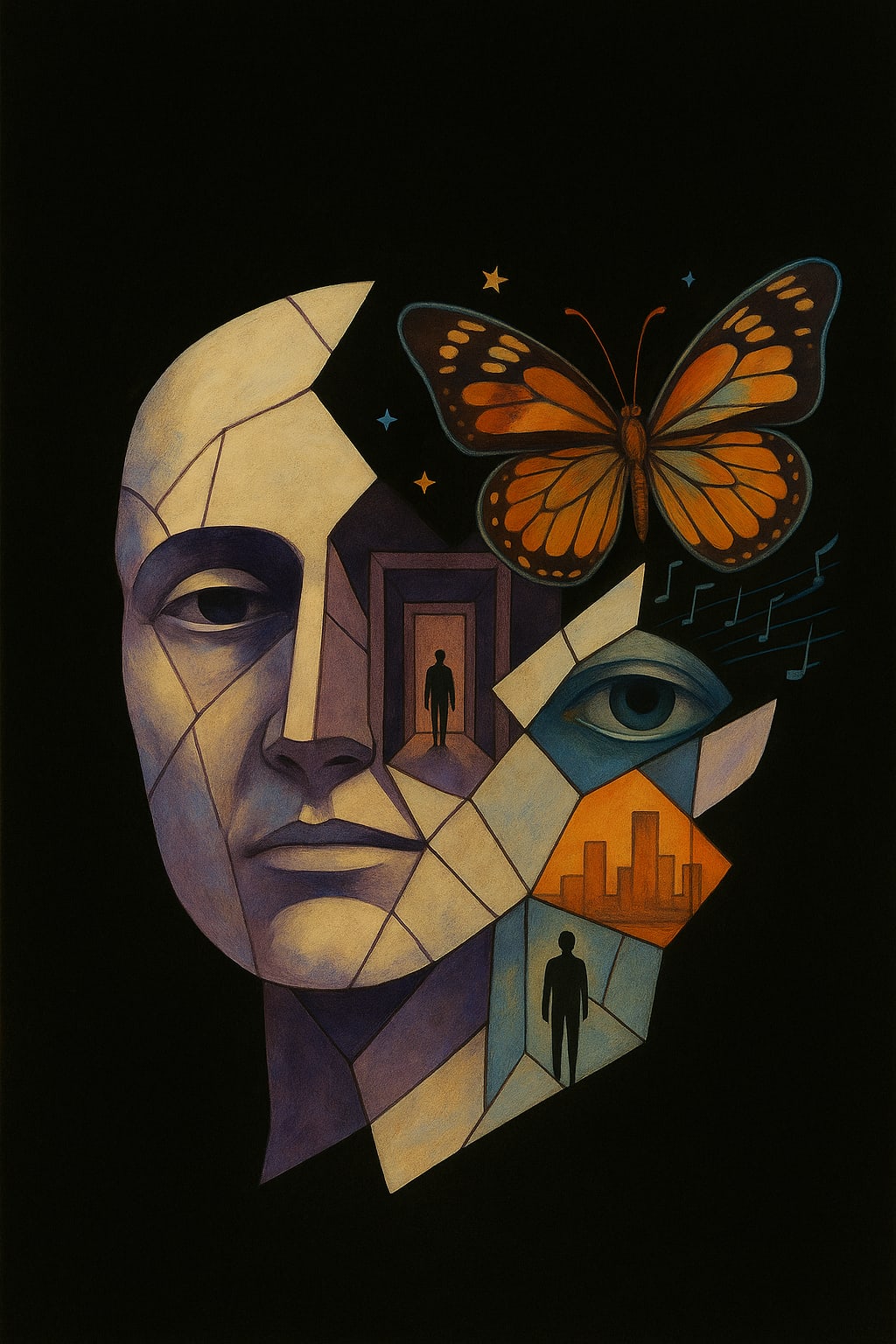
The Fractured City
The alert came through at 14:47, priority alpha, putting an abrupt end to Jason’s afternoon routine. He had been documenting another minor collision incident – a libertarian businessman who had glimpsed a socialist’s overlay and suffered what the clinical terminology called “perceptual dissociation syndrome.” It was ordinary paperwork, the kind of bureaucratic tedium that had replaced the different sort of monotony of his old career in neuroscience research. Perceptual Stability Officer, his nameplate announced to the world, or at least the tiny portion of it that the field office occupied. It was too grand a title for his duties, he often thought, but the brass apparently believed that the length of title should be proportional to the length of education.
“Mass framefield collision, Meridian Square,” the alert pulsed at the top of the screen. “Multiple casualties. Immediate containment required.”
Jason saved his work and looked out of the window. Below, the city shimmered with its usual jumble of interlaced realities. From the vantage of his forty-third-floor office, he could see the subtle tells: pedestrians walking different paths through the same space, undoubtedly some seeing gardens where others saw concrete, and some dodging obstacles that existed only in their chosen framefield.
Mayas, the framefields were colloquially called, after their inventor, Maya Leary. That name still carried weight, even after fifteen years. Maya Leary, the architect of perceptual freedom, the woman who had given humanity the gift of customized perceived reality, and then mysteriously vanished.
It took eleven minutes to arrive at the scene. Jason spent them reviewing the preliminary reports, his minimalist perception filter parsing the data with clinical precision. Seventeen confirmed casualties. Forty-three hospitalized for perceptual trauma. One hundred and twelve experiencing what paramedics had described as “simultaneous apocalypse syndrome.”
He stepped out into chaos. The square writhed with incompatible realities. Emergency responders methodically moved through the crowd, their stabilization equipment humming as they attempted to create pockets of consensus. Harried uniforms directed traffic around the square. Jason activated his professional overlay – a slight enhancement to his usual minimalist setting that highlighted stress patterns and perceptual anomalies.
A woman in her sixties sat on a bench, staring at nothing, tears streaming down her face. Her lips moved soundlessly. Jason clipped on his badge and approached, keeping his movements slow and unthreatening.
“What did you see?” he asked, with the studied neutrality of an experienced PSO.
Her eyes found his, struggling to focus. “The children,” she whispered. “They were burning. All of them. But they were also… they were also singing. How can they be singing while they burn?”
Jason made a note. Simultaneous contradictory perceptions. The woman’s filter had clearly malfunctioned during the event, allowing multiple framefields to flood her consciousness simultaneously.
“It’s over now,” he said gently. “You’re safe.”
“But which one was real?” She gripped his arm with surprising strength. “The burning or the singing? They both felt true!”
Before Jason could think of an answer, another voice cut through the ambient noise. “White! Over here!”
Detective Chen waved him over toward the square’s center, where a cluster of emergency vehicles had formed a loose perimeter. Jason excused himself and made his way through the crowd, noting how survivors seemed to cluster in groups based on the kind of perceptual damage they had suffered. Those who had experienced religious hallucinations coalesced together, as did those who had seen a terrorist attack, or environmental collapse, or some other form of horrible disaster made manifest.
“Talk to me,” Jason said, reaching Chen’s side.
“Strangest thing I’ve seen in fifteen years,” Chen replied, her own filter set to what Jason recognized as a police-standard reality enhancement. “Event started at 14:23, lasted approximately four minutes. Every witness reports something different, but there’s a clear pattern.”
She gestured toward a makeshift triage area where paramedics worked to stabilize the victims. “They all describe the same moment of transition. One second they’re seeing their normal overlay, the next they’re experiencing what one survivor called ‘the raw feed.’”
“Unfiltered reality?”
“That’s what they claim. Direct perception without any maya processing. And then, while they’re still reeling from that, they get hit with every other filter in the vicinity. All at once.”
Jason studied the scene. Multiple framefields experienced simultaneously would be like trying to watch a dozen different movies projected onto the same screen. The human brain wasn’t equipped to handle such a level of perceptual dissonance.
“Any fatalities?”
“Three so far. All from sudden cardiac arrest. Preliminary neuro scans show catastrophic synaptic disruption, system-wide. It’s like their brains tried to process too much information all at once and just… hit the wall. A bioelectrical storm, the paramedics called it.”
A commotion near the fountain drew their attention. A young man in his twenties had backed against the stone basin, his face bloodless and eyes wide with abject terror. He was speaking rapidly to someone Jason couldn’t see.
“Please,” the man said, his voice carrying clearly across the square. “I know you’re angry, but I didn’t know. I didn’t know the filters were lies. I thought everyone chose their own truth. I thought that it was freedom.”
Jason approached slowly. “Who are you talking to?”
The man’s eyes darted to Jason, then back to the empty space in front of him. “She says her name is Maya. She says she’s been trying to wake us up for years, but we keep choosing to remain asleep.”
“Do you mean Maya Leary?”
“She says the filters were never meant to be permanent. They were supposed to be training wheels, to help us escape our echo chambers, to learn to see reality without biases imposed by our different cultures. Instead, she says, we used them to build new barriers between us, even stronger ones.”
Jason felt a chill that had nothing to do with the October air. “What else does she say?”
“She says that something she called Perception Zero is coming. She says that it’s the only way to break the cycle. To make way for it, she says, everyone has to undergo what we experienced here. Everyone has to feel what it’s like when all the lies collapse at once.”
The man’s eyes suddenly focused on Jason with sudden clarity. “She says that you know about Perception Zero. She says that you’ve been dreaming about it.”
“Me, personally?” Jason stepped back involuntarily. It was true, he had been dreaming about it, though he’d never mentioned any of the dreams to anyone. They were dreams of a place where perception broke down, where the very concept of the self dissolved. He’d read that psychedelic users described their experiences in comparable ways, and he had wondered if he’d been slipped an unexpected mickey at some point.
“She’s gone,” the man said suddenly, his shoulders sagging. “But she said she left something. There!”
He turned and plucked a piece of paper that had been slotted between stone blocks, folded and worn as if it had been handled many times. Jason took it, noting how the man’s hand trembled as he released it.
On it was a single line of text, written in what looked to Jason as being very like Maya Leary’s famous handwriting: “At bottom, the doctrine of ‘no self’ is factually true.”
Jason studied the words, and then, all of a sudden, the world tilted. For a brief moment, the square seemed to shimmer, as if reality itself came into question. As soon as it arrived, the feeling passed, leaving only the ever-present weight of professional responsibility.
“Get him to the ER,” Jason told Chen. “Have them do a full neuro workup. And I want a trace on this paper – authentication, provenance, everything.”
“You think it’s really from Maya Leary?”
Jason looked around the square, at the traumatized survivors still clustered in their groups, at the responders working to restore some semblance of normality. “I think something is happening that we don’t understand. And I suspect it’s just beginning.”
As he walked back toward his transport, Jason noticed fresh graffiti on the wall near the square’s west entrance. The letters were still wet, painted in the characteristic blue of a resistance stencil: “The self is like a dream dreamt by a dreamer.”
He snapped a photo of the message to add to his report, but the words lingered in his mind like the lyrics of a half-remembered song. Somewhere in the city, in the spaces between the overlapping realities, something was stirring, he was thinking. Something that seemed to want to shake them all up, whether they were ready for it or not.
* * *
The city revealed itself in layers, each one a different interpretation of the same architecture. Jason walked back to the office through downtown, his minimalist filter stripping away the decorative elements that most citizens added to their perceptual experience. Where others might see gleaming towers reaching toward a futuristic sky, he saw concrete and steel, glass and shadow, the bones of urban infrastructure without embellishment or fancy.
It hadn’t always been this way. Jason remembered what was now termed consensus reality, though the memory felt increasingly dreamlike with each passing year. There had been a time when people looked at the same street and saw the same thing – variations in interpretation, certainly, but within a shared framework of what was real and what was not, at least for those who were not hallucinating.
The internet had begun the dissolution, creating echo chambers where different groups could inhabit incompatible versions of reality, where one person’s fact was another’s ridiculous conspiracy theory. Social media accelerated the fragmentation process, splitting reality along the lines of religion, ideology, gender identity, a myriad of other fault lines. Maya Leary’s invention had simply completed what had already begun: the final collapse of shared truth into a cacophony of stratified perceptions.
“It is the democratization of reality,” she had called it in her final interview before she vanished. “Everyone now gets to choose their own truth. No more imposed consensus. No more cultural imperialism of perception.”
Jason passed a coffee shop where a group of neo-traditionalists had gathered, their filters rendering the establishment as a 1950s diner complete with checkered floors and waitresses in aproned light-grey uniforms. He could see them laughing at jokes he couldn’t hear, living in a world where the jagged complications of modern life had been smoothed out to better fit their preferred aesthetic.
Across the street, a socialist collective experienced the same block as a worker’s paradise, complete with red banners and inspiring murals celebrating the dignity of labor. The same physical space, the same people walking through it, but completely different realities inhabiting the same coordinates.
And Jason, with his stripped-down perceptions, saw them all moving through a world of concrete and commerce, their individual realities invisible to him except as behavioral anomalies – people stopping to admire things that weren’t there, avoiding obstacles that existed only in their chosen maya.
His phone buzzed with a message from HQ: “Block wants to see you. Top priority.”
Gideon Block’s office was on the top floor of the Perceptual Stability Office building, a monument to the early optimism of the post-maya era. The walls were lined with awards and commendations from the time when people still believed that perceptual chaos could be managed, contained, and regulated like any other public hazard.
Block was standing with his back to the door, staring out at the city. At sixty-three, he was one of the few people Jason knew who had spent a fair portion of his life in consensus reality. His filter settings were cloaked, but Jason suspected they were set to something close to historical – a representation of how the world had looked before Maya Leary’s invention.
“Seventeen casualties,” Block said without turning around. “Three fatalities. And that’s just the beginning.”
“You think there will be more incidents?”
“I think Meridian Square was a test run.” Block turned to face him, and Jason was struck by how much older he looked than just a week ago. “Someone is trying to weaponize our perception. And they are going to get better at it.”
“The paper I found…“
“Is authentic. Maya Leary’s handwriting, confirmed by AI and three independent experts. Either she’s alive and active, or someone who knows her very well wants us to think so.”
Jason felt the chilling apprehension that always came with cases that promised to be intractable. “What do you want me to do?”
“I want you to find out who’s behind this. I want you to find out how they’re doing it. And I want you to stop them before they can orchestrate another incident.”
Block sidled over to his desk and switched on a holo showing the city from above. Red dots marked locations where perceptual anomalies had been reported in the past month. Jason noticed they formed a rough circle around the central business district.
“Pattern analysis suggests they might be preparing for something much larger. Something that could affect the entire metro area.”
“Universal perceptual breakdown?”
“Or universal perceptual awakening, according to their propaganda.” Block’s smile was grim. “The question is: awakening to what?”
Jason studied the display, noting how the incidents had gradually increased in frequency and intensity. “I’ll need access to all of the case files. And I’ll need to interview the survivors from Meridian Square.”
“Already arranged. But White…” Block’s tone was apprehensive. “Be careful. Whatever’s happening, it’s designed to exploit the instability of consciousness itself. This investigation may be dangerous. Who knows what they can really do?”
As Jason left the office, he couldn’t shake the feeling that Block’s warning was more than professional ass-covering. There was something in the older man’s voice, a quality of dread that went beyond the expected anxiety about public safety or his reputation.
The elevator descended through floor after floor. Some held monitoring stations where technicians tracked filter anomalies. Others – research labs where scientists studied the neurological effects of long-term maya usage. Still others housed security centers where senior PSOs planned interventions in cases of perceptual violence. All of it was dedicated to managing competing framefields, to struggling to contain the chaos of competing viewpoints within acceptable parameters.
Jason stepped out into the lobby, where citizens waited in line to report their perceptual anomalies. Their faces betrayed clear signs of maya habituation: the slightly unfocused look that came from living in a customized reality, the tendency to gesture at things that weren’t there, the way they seemed to hear sounds that existed only in their chosen overlay.
He walked through the crowd, noting how they unconsciously avoided contact with each other. In a world where touching someone might reveal the fundamental incompatibility of your realities, physical distance had become a norm of social etiquette.
Outside, the city flickered with its usual array of discordant truths. Jason activated his professional overlay, enhancing his perception just enough to detect the stress patterns that indicated recent perceptual trauma. The enhancement felt like putting on glasses after years of squinting – suddenly, the emotional landscape of the city became visible. And what he saw disturbed him.
The trauma patterns he had seen in Block’s office weren’t random. They formed a network, connecting the survivors of various perceptual incidents across the past six months. It was as if someone had been systematically destabilizing the city’s perceptual infrastructure, building toward something larger.
A fragment of graffiti caught his eye: “The dreamer vanishes as well, of course, because how can a dreamer exist without a dream?”
The words felt familiar, though he couldn’t place where he’d heard them before. Jason took a picture of the writing and added it to his growing collection of anomalies. Someone seemed to be using the city’s walls as a canvas for professing about the nature of consciousness and reality. Someone who might be connected to the incidents. Someone who might be preparing to “wake the city up.”
* * *
The first slippage occurred while Jason was interviewing Sarah Kim, a thirty-four-year-old architect who had been present at Meridian Square. She sat across from him in the bland sterility of Interview Room C, her hands folded in her lap, her eyes focused on something just over his left shoulder.
“I design buildings,” she said, her voice carrying the flat affect common to perceptual trauma survivors. “I work with form and space, with the way structures shape human experience. At Meridian Square, I saw something that should not exist.”
“What did you see?”
“Architecture that changed based on who was looking at it. Buildings that were simultaneously construction sites and decaying ruins. Streets that led to different destinations depending on who was looking.” She paused, her eyes finally focusing on his. “I saw the city as it must actually be: a collaborative hallucination maintained by group consensus.”
Jason made notes, but found it hard to concentrate because of the way her words echoed in his mind. For a moment, he felt the walls of the interview room becoming indistinct, as if they were less solid than they appeared.
“And then?”
“And then the filters failed. Everyone’s filters, all at once. For about thirty seconds, we were all seeing the same thing: just what was there, without any overlay. No framespace, no extra colors, no perceived objects, no additional spatial relationships. Just… what there was, I suppose. Just the square.”
“How did it feel?”
“Like drowning. It was hard to breathe.”
Jason blinked, and for an instant, Sarah Kim’s face seemed to shift, becoming someone else entirely. A woman with dark hair and familiar eyes, someone he felt he should recognize but couldn’t quite place.
“Are you all right?” Kim asked with what looked like genuine concern.
The face was Kim’s again, head slightly tilted, eyes questioning. Jason rubbed his temples, attributing the momentary displacement to fatigue. “I’m fine. Please continue.”
“After the raw feed came the overlay storm. Every filter in the vicinity activated simultaneously. I saw the square as a battlefield, as a garden, as a cemetery, as a stage. I saw people as angels, demons, exquisite corpses, geometric patterns, animals. I saw myself reflected in every surface, but each reflection showed a different version of who I could be.”
“Different how?”
“Different choices. Different lives. Different moral frameworks. In one reflection, I was a mother of three, terrified and protective. In another, I was a revolutionary, angry and convinced. In a third, I was an old woman, wise and resigned. In one, I was a man.” She leaned forward. “The question that haunts me is: which one was actually me?”
Jason felt another slippage, stronger this time. The room seemed to expand, becoming a vast space filled with mirrors, each one showing a different version of himself. In one, he was still a research scientist, pursuing the mysteries of consciousness from the safety of academic theory. In another, he was a different kind of PSO, someone who used his authority to impose his own version of reality on others. In a third, he was alone in an empty room, surrounded by equipment he didn’t recognize, his face older and marked by experiences he could not remember.
“They’re all real,” he heard himself reply, though he hadn’t intended to say anything.
“What?”
Jason shook his head, forcing himself back to the present. “Sorry. I was thinking about your question. About which reflection was real.”
“And?”
“Maybe they all were. Maybe reality is more fluid than we might assume.”
Sarah studied him with new interest. “You sound like you’ve been reading the Underground.”
“The Underground?”
“The samizdat network. Digital pamphlets about consciousness and reality. Most of it is philosophy and speculation, but some of it reads like pretty technical documentation of perceptual phenomena.” She paused. “There’s one essay that’s been circulating for months. It talks about the nature of self in the age of perceptual editing.”
Jason's breath caught. “Do you have access to this essay?”
“I can get it to you. But you might want to be careful with it. I hear that people who read too much Underground tend to develop… unusual perspectives.”
After she left, Jason sat alone in the interview room, staring at the recording equipment. The conversation had left him feeling unsettled, as if his sense of self had been subtly disturbed. He thought about the mirrors in his momentary vision, the different versions of himself looking back with equal claims to authenticity.
He felt his phone vibrate with a message. It turned out to be from an anonymous sender: “The self is an emergent construct of a brain attempting to comprehend itself and its surroundings. Check your personal message history.”
Jason’s stomach flipped. His message history was encrypted and secured by biometric authentication. It was supposed to be unbreakably secure. How could someone have gained access?
He opened the history, scrolling through months of unremarkable communications. There, embedded between a dental appointment reminder and a utility bill notice, was a document he did not recall receiving: “On the Nature of Self in the Age of Perceptual Editing.”
The document began with a phrase he knew he’d seen before: “At bottom, the doctrine of ‘no self’ is factually true.”
Jason read with growing unease. The essay explored the concept of anatta – the idea that the self was an illusion, a construction of the mind as it is attempting to create continuity from the swirling flux of information presented by the senses. But it went further, arguing that Maya Leary’s invention had inadvertently proven this ancient wisdom by demonstrating how easily identity could be modified, enhanced, or entirely reconstructed.
“Atman, the self, is like a dream dreamt by a dreamer,” the essay continued. “From one filtered experience to the next, we maintain the illusion of continuity, but the dreamer and the dream are both synthetic constructs of the brain. When the filters fail, when we experience raw perception without interpretive frameworks, we discover that there is no true self to be found. There is only awareness, witnessing the play of perceived phenomena.”
Jason found himself reading the same paragraphs multiple times, each time revealing new layers of meaning. The implications were staggering: if the self was truly an illusion, then what was the purpose of the complex infrastructure designed to protect individual perceptual experiences?
A knock at the door snapped his concentration. Detective Chen entered, carrying a folder bulging with reports.
“We’ve got a problem, White,” she said, settling into the chair Sarah had vacated. “The Meridian Square incident wasn’t isolated. We’ve reanalyzed the prior incidents, and they make a clear pattern. It looks like there were seventeen of them in the past month alone, each time increasing in scope and intensity.”
“Yes, Block mentioned it and showed me the pattern that he saw. What do you think, Chen?”
“I think that someone is systematically destabilizing the city’s perceptual infrastructure. Each incident appears to test a different aspect of filter security, as if they’re mapping the system’s vulnerabilities.”
Jason closed the document he had been reading, but its words continued to echo in his mind. “Any leads?”
“That’s the strange part. The attacks seem to be coming from inside the system. Like someone with deep knowledge of the technology is using it against itself.”
“Could it be Maya Leary?”
“That’s what the squad assumed at first. But psychological profiles don’t match up. Leary was an idealistic inventor who believed in the democratization of perception. These attacks feel more like terrorism, or maybe even an organized uprising.”
Jason thought about the essay, about the way it had appeared in his personal history out of nowhere. “And if it isn’t Maya Leary? Suppose it’s someone who studied her work and reached different conclusions?”
“Like what?”
“Like maybe the democratization of perception was the problem, not the solution. Maybe someone thinks the only way to restore sanity is to force everyone to confront unfiltered reality.”
Chen leaned back in her chair. “That really would be terrorism.”
“Or perhaps enlightenment, depending on your perspective.”
The words slipped out before Jason could stop them, and he saw Chen’s expression change. There was something in her eyes that might have been alarm, suspicion, or maybe even recognition.
“Jason,” she said carefully, lowering her voice, “how long have you been experiencing perceptual anomalies?”
The question startled him. “What makes you think I’m experiencing anomalies?”
“You just defended a terrorist attack as an effort to spread enlightenment. That’s not the kind of thing a stable PSO would say.”
Jason felt the walls of the interview room soften again, but this time he wasn’t sure if it was a slippage or a touch of vertigo. “Thank you for your concern, Jenny, but really, I’m fine. Just tired. There’s been so much work lately…”
“Maybe you should talk to someone. Someone who specializes in perceptual stability for law enforcement.”
As Chen left, Jason remained alone with the essay, the anonymous message, and the growing suspicion that his own reality was less stable than he had assumed. Somewhere in the city, someone was waging… what? Philosophical warfare against the idea of the self? And Jason was beginning to wonder if he was himself a target, a tool, or something else entirely.
He reread the final paragraph of the essay: “Even if one is a doctrinaire Buddhist and believes in karma and reincarnation, the lack of self that persists through all the lifetimes is not a problem. The self, for them, is like a dream dreamt by a dreamer, from one dreamt existence to the next, until the dreamer wakes and the dream vanishes. The dreamer vanishes as well, of course, because what is a dreamer who isn’t dreaming?”
Outside, the city pulsed with its regular array of incompatible realities. But at the same time, beneath all the individual realities, beneath all the customized perceptions and filtered experiences, there was something else brewing. Something that said that it wanted to wake them all up, he thought. Something that might already be waking him.
About the Creator
The Myth of Sysiphus
Sisyphus prefers to remain anonymous as he explores the vicissitudes of the human condition through speculative fiction.
Keep reading
More stories from The Myth of Sysiphus and writers in Chapters and other communities.
Inversion - 17
Chapter 17 Laurel studied his hands in the morning light, turning them palm up, then back again. They looked the same as they had when he first went into the forest, more than twenty-five years ago. There were no mirrors in the camp, but he had glimpsed his reflection in a puddle. It too looked the same as it had then.
By The Myth of Sysiphus3 months ago in Chapters
A Transparent Look at Vocal Challenges and Top Stories
Almost three years ago, we shared a resource article that served as a place for people to suggest new challenge prompts. We thought it would be a good idea to refresh that thread, and take the opportunity to answer a few common questions about top stories, how challenges are judged and how submissions are reviewed.
By Vocal Curation Team4 days ago in Resources


Comments
There are no comments for this story
Be the first to respond and start the conversation.