
“The Day the Moon Forgot Its Name”
Genre: Poetic Fiction Suddenly the moon loses its glow and everyone on Earth can hear it whispering, trying to remember who it is. A deaf astronomer is the only one who understands its language — and must help it find its forgotten name.
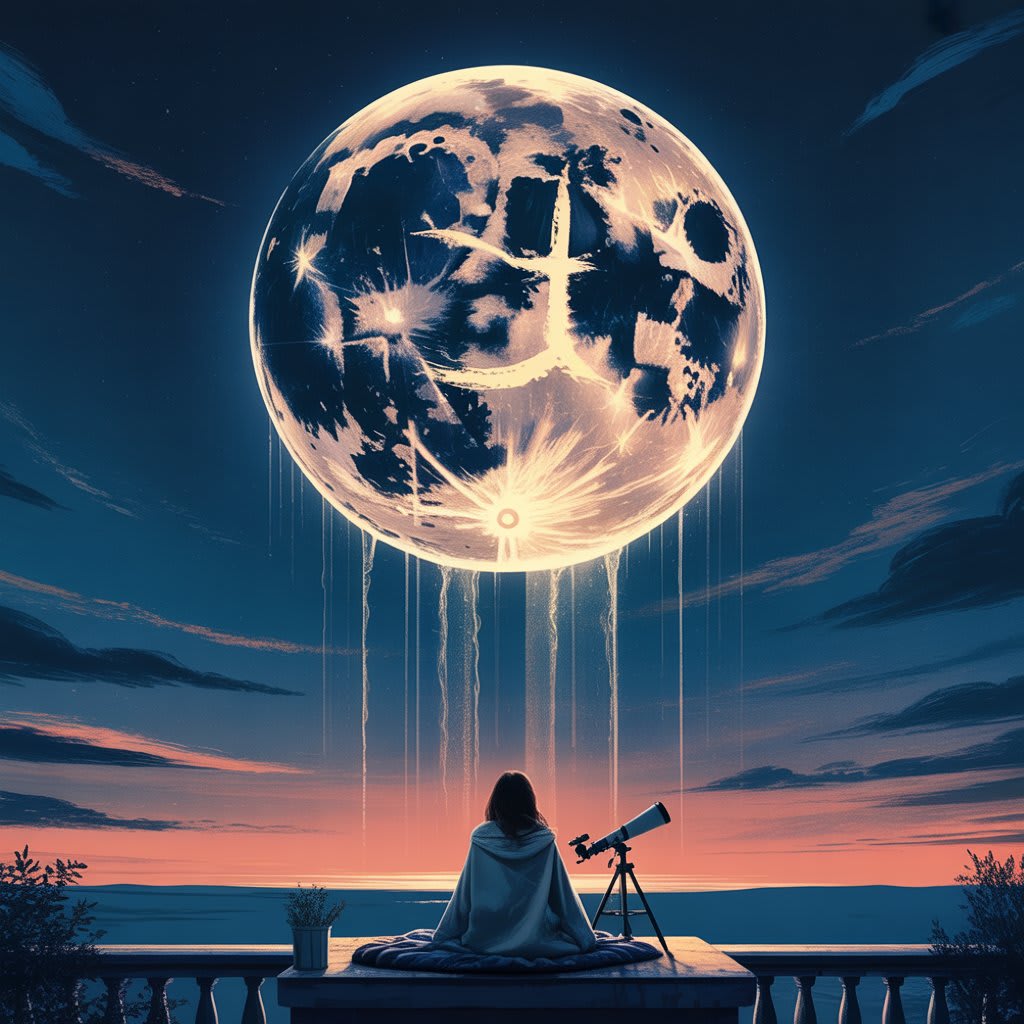
The Day the Moon Forgot Its Name
On the night the moon forgot its name, the sky flickered — not like a failing lightbulb, but like a memory being erased in real time. People stepped out of their houses, phones pointed upward, murmuring into the cold air as if asking it for answers.
The moon, usually round and certain, had dimmed to a pale bruise, a fading ghost of itself. And then the whispering began.
It wasn’t a haunting sound. It wasn’t even loud. It was like a breath being pushed through thin paper, a trembling voice that seemed unsure of the shape of its own throat.
No one could understand it.
No one except Leila Rowan.
She had been awake already — she rarely slept during lunar weeks, the periods when the moon came closest to Earth and her research flared with new data. The irony, of course, was that she couldn’t hear the world she studied. She’d been deaf since she was eight, long before she’d ever learned that silence has textures.
People thought she heard with her eyes. They were wrong. She heard with her mind.
That night, she felt the moon’s whisper before she saw it — a vibration deep in her bones, tapping against the edges of her consciousness like someone asking for entry.
She stepped out onto her balcony, her telescope already pointed upward.
Through the lens, the moon wasn’t simply dimming.
It was trembling.
A ripple crossed its surface like a forgotten breath. The faint whispering brushed her awareness again, more insistent this time. And then the words formed — not as sound, but as impressions, translating themselves in symbols and sensations only she could decipher.
I… lost… the word…
The word that is me…
Name… gone…
Leila tightened her grip on the telescope. Her heartbeat, steady as clockwork, stumbled.
The moon had forgotten its name.
By morning, the world had boiled into panic. Scientists argued on news broadcasts. Psychics claimed this was the end of humanity. Children cried because their nightlight in the sky had dimmed to a dull, frightened shadow.
But Leila heard — no, felt — every shaky whisper from above. The moon repeated the same question over and over, like someone calling out to a crowd hoping the right person would turn around.
Who am I…?
What was I called…?
And beneath that:
Why is it missing?
Leila knew she couldn’t tell anyone, not yet. They would never believe her.
A deaf astronomer was already an anomaly in their eyes; a deaf astronomer who claimed the moon was talking to her would be dismissed as delusional.
But the moon was panicking. She could feel its fear like static humming under her skin.
So she wrote a message on a whiteboard, propped it on her roof, angled toward the sky. The letters were thick and bold:
YOU ARE STILL THE MOON. EVEN WITHOUT YOUR NAME.
The whisper that came back rippled through her bones.
Not words…
Need… name…
Need… truth…
Was a name really truth?
Or was it a cage?
Leila had spent years wondering the same thing. She had been named after a constellation — Lyra originally, but her parents changed it to Leila, thinking it sounded softer, easier to say, easier to live with. Her name had always felt both too small and too large, like borrowed clothing that never quite fit.
Perhaps the moon felt the same.
By the third day, its glow had faded completely. Night arrived with an unnatural heaviness — a starless, moonless void. People lit candles in their windows as though mourning a friend.
Leila sat on her roof wrapped in a blanket, staring at the empty sky.
She felt the moon’s trembling like a creature shivering in the dark.
Help… please…
She closed her eyes, letting the vibrations settle inside her. A memory surfaced — an old textbook she’d read as a child.
Selene.
Luna.
Maah.
Chandra.
Artemis’s lamp.
Night’s eye.
Silver watcher.
Queen of tides.
Names layered across centuries, cultures, and tongues.
She picked up her notebook and began writing every name she could recall, flipping page after page under the starlight.
Then she lifted the pages one by one toward the sky.
The response came slow, hesitant.
Not… it…
Not… right…
And then:
Show me… first memory…
Leila froze.
The moon didn’t want humanity’s name for it — it wanted its own.
So she returned to her telescope. She tracked craters, shadows, ridges. She mapped the ancient scars on its surface like lines on an elder’s face. She followed the arc of where molten oceans once cooled, where impacts carved letters older than language.
Hours passed. Then, suddenly, she saw it.
A pattern.
Not random.
Not geological.
A symbol.
A shape repeated across lunar basins — a curve intersected by a single mark.
Not a word, but a concept.
Not a name, but an origin.
A meaning.
She drew it on her notebook.
And the whisper hit her like wind through an open door.
YES…
THAT IS ME…
THAT WAS ALWAYS ME…
The symbol had no translation in any human language.
But to Leila, it felt like this:
“The One Who Watches the Dark and Keeps It Gentle.”
The moon didn’t need a human name.
It needed remembrance.
Slowly, softly, the sky brightened.
A thin silver glow traced the moon’s edge, like breath returning to a sleeping body.
People gasped across the world.
Children pointed upward.
Scientists shouted into microphones.
But Leila simply smiled.
The moon pulsed once — a thank-you.
Not in words.
In light.
Its true name was not something to be spoken.
It was something to be understood.
And that night, for the first time in her life, Leila felt that silence had never separated her from the world.
It had connected her to it.
The moon glowed a little brighter — for her, for itself, and for the dark it promised to keep gentle.
About the Creator
Valentine's Dates Over the Years
Colin grinned as Brooklyn slipped into the living room. “Is it all set?” he asked. The twenty-one year old grinned. She was in her last year of college and Colin knew that Lincoln was proud of her. Although she had been away at college, she’d eagerly helped Colin plan his surprise for Lincoln. “I’m so glad you’re finally doing this,” she said.
By Reb Kreyling18 days ago in Chapters
How World War III Could Begin in Our Time
The First Sparks: How World War III Could Begin in Our Time World War III may not start with a single declaration or one massive attack. Instead, it could begin quietly, through a series of connected crises, misunderstandings, and power struggles already happening today. The world is more connected than ever, but that connection also makes global conflict easier to spread.
By Wings of Time about 12 hours ago in Chapters
When the Shelter Closes
Across the street from my house, a man slept under a tree, his dog by his side. My first, naive thought: he must be traveling through. But he kept coming back, often sleeping there during the day. Then it hit me—that person might not have a home.
By Bride of Sound4 days ago in Humans



Comments
There are no comments for this story
Be the first to respond and start the conversation.