

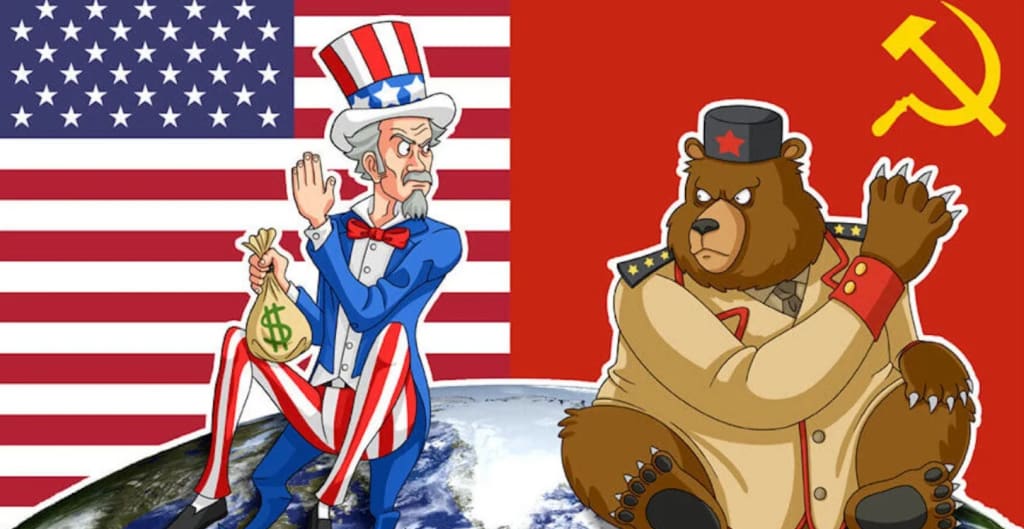
The Cold War wasn’t your typical war—it was a tense, decades-long standoff between two global superpowers: the United States and the Soviet Union. Unlike traditional wars fought on battlefields, this one played out through espionage, propaganda, nuclear threats, and ideological clashes. For nearly half a century, the world lived under the shadow of a conflict that could have turned into World War III at any moment.
How Did It All Start?
After World War II ended in 1945, the world should have been celebrating peace, right? Not quite. The U.S. and its allies promoted capitalism and democracy, while the Soviet Union spread communism. These two ideologies were fundamentally opposed, and neither side trusted the other.
Instead of direct battles, they competed for global influence, forming military alliances—NATO (led by the U.S.) and the Warsaw Pact (led by the USSR). Countries around the world became hotspots for Cold War tensions, from Korea and Vietnam to Cuba and Afghanistan.
Key Moments of the Cold War
The Arms Race & The Threat of Nuclear War
Both superpowers were obsessed with nuclear weapons. After the U.S. dropped atomic bombs on Japan in 1945, the Soviets developed their own in 1949. What followed was a dangerous arms race where both nations stockpiled thousands of nuclear warheads, capable of wiping out civilization. This led to the terrifying concept of MAD (Mutually Assured Destruction)—basically, if one side attacked, the other would retaliate, and both would be obliterated.
The Space Race: A Battle Beyond Earth
If nuclear bombs weren’t enough, the U.S. and USSR also competed in space exploration. The Soviets took an early lead, launching Sputnik (the first satellite) in 1957 and sending Yuri Gagarin (the first human) into space in 1961. The U.S. responded by landing Neil Armstrong on the Moon in 1969, a major Cold War victory.
The Cuban Missile Crisis (1962): The World on the Brink
In October 1962, the Cold War almost turned hot. The Soviets placed nuclear missiles in Cuba, just 90 miles from the U.S. In response, the U.S. imposed a blockade, and for thirteen nerve-wracking days, the world held its breath. Finally, both sides agreed to step back—the Soviets removed their missiles from Cuba, and the U.S. secretly agreed to remove its own missiles from Turkey.
Proxy Wars: Fighting Without Directly Fighting
Rather than fighting each other directly, the U.S. and USSR backed opposing sides in wars around the world:
1. Korean War (1950–1953): North Korea (backed by the USSR and China) vs. South Korea (backed by the U.S.). It ended in a stalemate, with Korea still divided today.
2. Vietnam War (1955–1975): A brutal conflict where the U.S. tried (and failed) to stop communist North Vietnam from taking over South Vietnam.
3. Soviet-Afghan War (1979–1989): The USSR invaded Afghanistan, but the U.S. supplied Afghan rebels (Mujahideen) with weapons, leading to a costly Soviet defeat.
The Cold War’s End: How Did It Finally Finish?
By the 1980s, the Soviet Union was struggling. A failing economy, expensive wars, and internal unrest put enormous pressure on the communist system. Then came Mikhail Gorbachev, the Soviet leader who introduced reforms like Glasnost (openness) and Perestroika (economic restructuring). But instead of strengthening the USSR, these changes sped up its collapse.
In 1989, the Berlin Wall fell, symbolizing the end of communist rule in Eastern Europe. By 1991, the Soviet Union itself dissolved, officially marking the end of the Cold War.
Why Does It Still Matter Today?
Even though the Cold War is over, its impact shaped modern politics, technology, and global alliances. Many of today’s conflicts, space programs, and even pop culture references (like all those spy movies) stem from this era. The world may no longer be divided by a Cold War, but tensions between global powers still exist—just in different forms.
About the Creator
Keep reading
More stories from Gus Woltmann and writers in Chapters and other communities.
The Future of Coding and AI
In the ever-evolving world of technology, the future of coding is undergoing a profound transformation driven by the rapid rise of artificial intelligence (AI). What was once the exclusive domain of human programmers is now becoming a dynamic partnership between humans and intelligent machines. As AI continues to advance, it’s not replacing coders, it’s redefining what it means to code.
By Gus Woltmann7 days ago in Chapters
Has World War III Started?
Has World War III Started? The question “Has World War III started?” is no longer limited to academic debate or fictional movies. It is now openly discussed in newsrooms, policy circles, and online platforms around the world. While the simple answer remains no, the conditions shaping today’s global environment are deeply alarming. The world is experiencing an unprecedented convergence of regional wars, technological disruption, and power competition that closely resembles the early stages of past global conflicts.
By Wings of Time 4 days ago in Chapters


Comments