
The Artificial Intelligence Intellectual Property Portfolio of Sweden: Trends, Key Players and Nordic Comparisons (2020-2025)
A Comprehensive Analysis of Sweden's AI Intellectual Property Assets

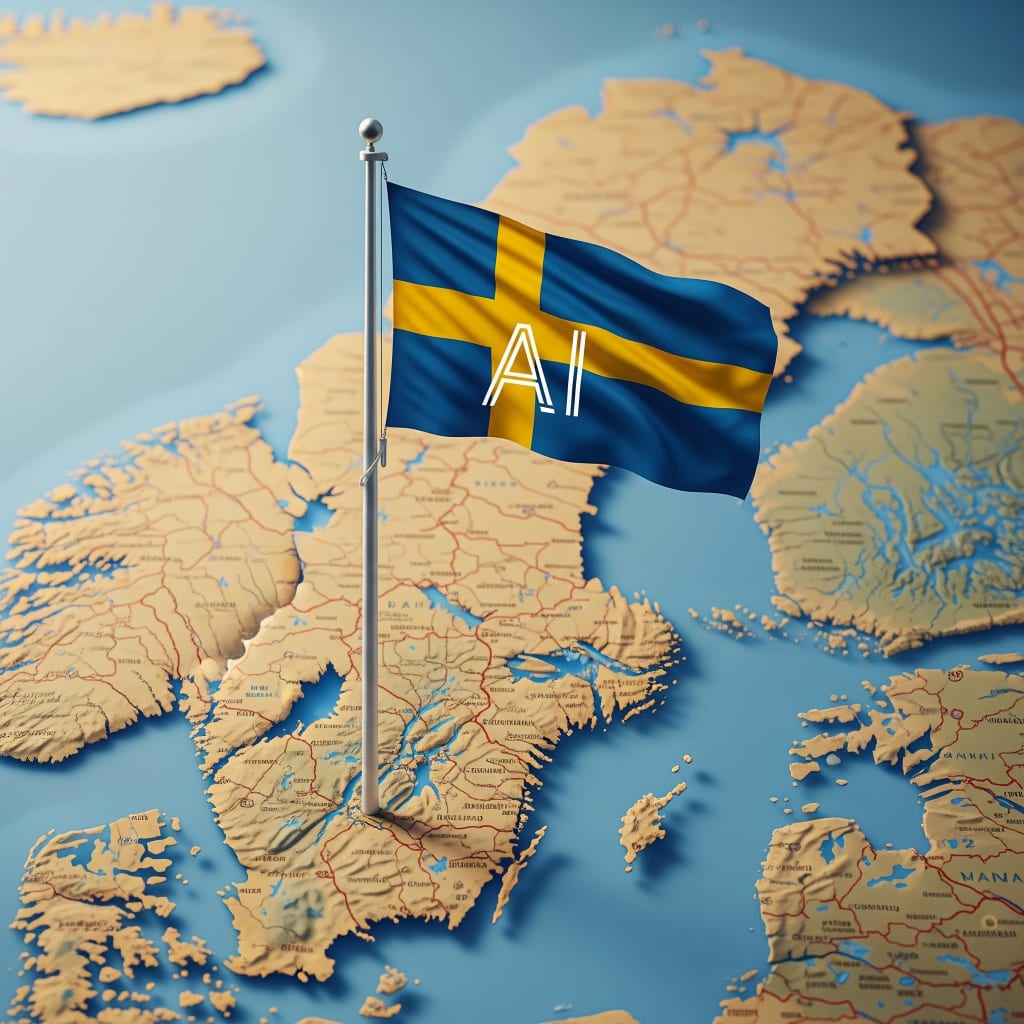
I. Executive Summary
This report provides a comprehensive analysis of Sweden's Artificial Intelligence (AI) intellectual property (IP) landscape from 2020 to 2025. Sweden has demonstrated a growing commitment to AI innovation, underscored by significant national investment and strategic initiatives aimed at bolstering its competitive edge. Over the past five years, Sweden has accumulated approximately 1,265 AI patents, with notable growth in AI-related filings at the European Patent Office (EPO), particularly in computer technology, which encompasses machine learning and pattern recognition.
Key areas of AI patenting activity in Sweden include telecommunications AI, autonomous driving technology, and applications in life sciences and manufacturing. Established corporations such as Ericsson and Volvo are prominent AI patent holders, leveraging AI to enhance their core offerings. Concurrently, a dynamic ecosystem of Small and Medium-sized Enterprises (SMEs), startups, and research institutions, including Lund University and the national AI Sweden center, contributes significantly to the innovation pipeline.
Comparatively, while Sweden maintains a solid AI IP portfolio, Finland has shown a more rapid recent growth in AI patent filings at the EPO. Norway is also strategically focusing its AI development in key sectors. All Nordic countries benefit from high levels of digital maturity and skilled workforces, though they face challenges related to scale.
The report profiles John Elvesjo, co-founder of Tobii AB, as an illustrative example of a prolific inventor in an AI-intensive field (eye-tracking), highlighting Tobii's substantial global patent portfolio and its AI-driven product development.
Emerging trends indicate a global and Swedish shift towards specialization in AI subfields, an increasing focus on Generative AI, the use of AI for IP management itself, and a growing emphasis on ethical and sustainable AI. For Sweden, the effective implementation of AI across its economy, particularly by SMEs, and continued investment in talent and R&D will be crucial for translating IP strength into broader economic impact and maintaining its position in the competitive global AI arena.
II. Introduction: Sweden's Strategic Imperative in Artificial Intelligence
Artificial Intelligence (AI) has emerged as a pivotal technology of the 21st century, promising to reshape industries, drive economic growth, and address complex societal challenges. For a technologically advanced nation like Sweden, harnessing the potential of AI is not merely an option but a strategic imperative to maintain global competitiveness and foster innovation. This section explores the context of Sweden's AI ambitions, the critical role of intellectual property in the AI domain, and the national legislative framework supporting patent protection.
Context of Sweden's AI Ambitions:
Sweden has formally acknowledged the transformative power of AI and is undertaking significant measures to enhance its national capabilities. A recent landmark is the announcement of a €1.5 billion investment dedicated to AI, a move that, while substantial, has been characterized as a response to calls for a more urgent approach to the nation's AI development.1 This national commitment is situated within a broader European strategy, wherein the European Union has earmarked approximately €150 billion for AI and digital technologies, signaling a continent-wide effort to regain and assert competitive ground in this critical field.1
The Swedish government's AI Commission has put forth a strategic roadmap. This plan aims to cultivate a skilled AI workforce, facilitate the adoption of AI by businesses through improved infrastructure and research, and foster public-private partnerships. A notable element of this strategy includes the democratization of AI access, envisioned through a state-managed hub offering tools akin to ChatGPT, Gemini, and Claude.1 The underlying belief is that creating an AI-savvy society is fundamental for long-term national competitiveness. Supporting this, studies indicate that the successful scaling of innovative digital businesses leveraging AI is vital for Sweden to bridge existing innovation and competitiveness gaps. Such scaling has the potential to generate up to 37,000 high-value jobs and contribute approximately SEK 41 billion annually to the Swedish economy.2
The nature of Sweden's recent substantial AI investment being described as "reactive" is noteworthy. This characterization stems from its timing as a response to a critical report that urged a "crisis mode" approach due to perceived lags in AI advancements.1 While Sweden possesses foundational strengths such as high digital maturity and a skilled populace 3, this suggests a potential delay in strategically capitalizing on AI at a national level compared to some global frontrunners. Consequently, while IP generation has been ongoing, a more accelerated and diversified surge in AI-related IP might be anticipated in the coming years as this new national strategy gains traction.
The Role of Intellectual Property in AI:
Intellectual Property, particularly patents, serves as a cornerstone for protecting AI innovations. It provides the necessary incentives for research and development (R&D) and is a critical enabler for the commercialization of AI technologies.5 The increasing sophistication and pervasiveness of AI, especially with the advent of Generative AI (GenAI), introduce novel challenges and considerations for IP rights, including copyright law.5 International bodies like the World Intellectual Property Organization (WIPO) have highlighted the necessity for timely, transparent, and accessible standards for the granting of patents in the AI field, reflecting the technology's rapid evolution and unique characteristics.5 The strategic value of AI patents is amplified by the global competition for AI leadership, making robust IP management crucial for Sweden's economic resilience and digital sovereignty.
Swedish Legislative Framework for Patents:
Sweden has recently modernized its patent legislation with the new Swedish Patent Act (2024:945). This Act aligns Swedish law more closely with the European Patent Convention (EPC) and the Agreement on a Unified Patent Court (UPCA), aiming to create a more accessible, efficient, and contemporary patent system.7 Key modifications introduced by the new Act include the requirement for payment of the application fee before the formal processing of a patent application commences and an updated definition of 'prior art'.7
The Swedish Intellectual Property Office (Patent- och registreringsverket, PRV) is the national body responsible for patents and provides several databases for searching Swedish and European patents, facilitating access to patent information for innovators and the public.8 In the calendar year 2024, the PRV received 2,149 national patent applications, of which a significant majority, 1,846, originated from Swedish companies.7 This legislative modernization and the services provided by PRV are vital for AI innovators, potentially influencing filing rates and the specific types of AI inventions that are protected.
The EU's initiative towards a "28th legal regime" for innovative companies 1, alongside Sweden's updated Patent Act, reflects a broader European endeavor to balance the fostering of innovation with the establishment of clear legal and ethical frameworks for rapidly advancing technologies like AI. This evolving regulatory environment is likely to shape the criteria for AI patentability and the enforcement of IP rights, thereby influencing the direction of AI R&D and the nature of patent filings in Sweden.
III. Analyzing Sweden's AI Intellectual Property Portfolio (2020-2025)
An examination of Sweden's AI intellectual property portfolio over the last five years reveals a nation actively engaging in AI innovation, with specific strengths and growth patterns. This section delves into the volume and dynamics of AI patenting, categorizes the types of AI innovations being protected, and identifies key industry applications.
AI Patent Volume and Growth Dynamics in Sweden:
Data compiled for the period 2019-2025 indicates that Sweden holds approximately 1,265 AI patents.9 This figure positions Sweden among the top 15 countries globally for AI patent filings, although it remains considerably behind global leaders such as China and the United States. General patent application trends offer some context; for instance, overall patent applications by Swedish residents saw a 2.3% increase, with 21,294 total applications filed in 2023, representing a 2% rise from the previous year.10 While these figures are not exclusively for AI, they suggest a generally active innovation environment.
More specifically, statistics from the European Patent Office (EPO) are illuminating. In 2024, "computer technology," a category that explicitly includes AI, machine learning, and pattern recognition, emerged as the leading field for patent applications filed at the EPO.11 Within this trend, Sweden demonstrated notable activity, with a reported 10.6% growth in AI-related patent filings at the EPO during 2023.12
A summary of AI patent activity for Sweden (2020-2025) includes:
Approximate total AI patents (2019-2025): 1,265 9
Growth in AI-related filings at EPO (2023): +10.6% 12
Computer technology (incl. AI) as leading EPO patent field in 2024 11
These figures provide a quantitative baseline for Sweden's AI IP output and its recent growth trajectory, indicating a committed engagement in AI innovation that aligns with broader European trends towards digitalization and AI development.
Categorization of Patented AI Innovations:
Swedish AI patents span a range of core AI technologies and are being applied across diverse industry sectors, reflecting both foundational research and practical implementation.
Key AI Subfields:
Patenting activity is evident in fundamental AI domains. Innovations in machine learning algorithms and neural networks form a significant part of this. For example, a European patent granted to Deepmind Technologies Limited (EP3593288, based on application EP18727294.3), titled "TRÄNING AV NEURALA NÄTVERK FÖR ÅTGÄRDSVAL MED HJÄLP AV FRAMÅTBLICKANDE SÖKNING" (Training of neural networks for action selection using lookahead search), was published by the PRV, signifying advanced work in neural network training methodologies validated in Sweden.13
Globally, Generative AI (GenAI) has experienced explosive growth, with the number of patent families in this subfield increasing by over 800% in the last decade.15 While specific figures for Swedish GenAI patents are not isolated in the available data, the global prominence of GenAI strongly suggests it is an emerging and active area of innovation within Sweden as well. Key GenAI technologies attracting patent protection worldwide include Generative Adversarial Networks (GANs), Large Language Models (LLMs), Variational Autoencoders (VAEs), diffusion models, and autoregressive models. The primary data types involved in these GenAI patents are image, video, text, speech, sound, and music.15
Industry Sector Applications:
Swedish AI innovations are being patented across several key industry sectors:
Telecommunications: Major Swedish multinational Ericsson is a prominent filer, with a focus on telecom AI, developing AI solutions to enhance network performance and operations.9
Automotive: Volvo stands out for its contributions to AI in autonomous driving and advanced vehicle systems.9 Patents from Volvo Car Corporation include, for example, an "Intelligent battery system" utilizing AI methods (U.S. Patent No. 12,275,328) and methods for maneuvering at least partially autonomous vehicles.16
Life Sciences & Healthcare: A growing number of companies are applying AI in the medical field. Firms like Sectra and Elekta are developing AI-based solutions, particularly targeting precision medicine and oncology.17 AI is being patented for applications such as medical image analysis, diagnostic tools (e.g., Gnosco's work on melanoma detection and Immunovia’s IMMray platform for disease biomarker discovery), and AI-driven drug discovery processes.17
Manufacturing & Industrials: AI is being leveraged for applications such as predictive maintenance of machinery, optimization of industrial processes, and automated quality control, reflecting the broader Industry 4.0 trend.18
Other Sectors: The general technical fields dominating overall Swedish patent applications include digital communication (25.5%), transport (9.4%), and computer technology (6.6%).10 These fields have strong and natural intersections with AI. Globally, GenAI patents also find applications in diverse areas such as software development, document management, business solutions, transportation logistics, and security systems 15, suggesting similar applications are likely being pursued or patented by Swedish entities.
The concentration of AI IP in Sweden appears significantly driven by large, established companies such as Ericsson and Volvo. These corporations are integrating AI into their traditional areas of strength—telecommunications and automotive manufacturing, respectively.9 This pattern suggests that a substantial portion of Sweden's current AI patent leadership represents an evolution of existing industrial capabilities, augmented by AI, rather than the dominance of entirely new, AI-native industries in the IP landscape. This approach indicates that Sweden is effectively embedding AI into its key economic engines. However, it also prompts consideration of whether sufficient disruptive, AI-first innovation is being patented by newer entities, which is often crucial for long-term economic diversification and maintaining a competitive edge in rapidly evolving technological frontiers.Furthermore, the nature of AI patents in Sweden, as suggested by examples like Deepmind's neural network training application 13 and Volvo's AI in battery systems 16, along with EPO guidelines stating that AI applied to solve a technical problem is patentable 18, indicates a focus on practical applications. Swedish AI patents are more likely to protect the application of AI to solve specific technical problems in various fields, rather than purely abstract algorithms. This aligns with global patent office trends that are generally cautious about patenting abstract mathematical methods devoid of a concrete technical application. For Sweden, this implies that its AI IP portfolio is likely rich in tangible, industry-relevant solutions, which is advantageous for commercialization and achieving real-world impact. The innovations being patented are thus predominantly functional applications of machine learning, neural networks, computer vision, and natural language processing, rather than foundational mathematical AI principles in isolation.
IV. Leading Entities in Sweden's AI Innovation Ecosystem
Sweden's AI innovation ecosystem is characterized by a mix of large established corporations, a growing number of dynamic SMEs and startups, and active academic and research institutions. These entities collectively contribute to the generation of AI-related intellectual property.
Major Corporate AI Patent Holders:
Several large Swedish companies are at the forefront of AI patenting:
Ericsson: A global telecommunications leader, Ericsson holds an extensive patent portfolio with over 60,000 granted patents worldwide and is a significant contributor to global mobile standards like 3GPP.19 The company is explicitly recognized for its substantial contribution to Sweden's AI patent landscape, particularly in telecom AI.9 Their AI development includes AI Intent-Based Operations designed to optimize 5G network performance.19 In 2024, Ericsson filed 1,470 patent applications at the EPO across all technologies 21, and in 2023, it saw a 9.6% increase in its AI-related filings at the EPO.12
Volvo Group / Volvo Car Corporation: A prominent name in the automotive industry, Volvo is a key player in developing and patenting AI for autonomous driving and advanced vehicle technologies.9 Recent patents from Volvo Car Corporation cover AI applications such as intelligent battery management systems 16 and sophisticated methods for maneuvering autonomous vehicles.16 The Volvo Group is also among the leading entities requesting Unitary Patent protection for its European patents, indicating a strategic approach to IP management.11 Volvo itself utilizes AI in its patent analysis processes to forecast future technological developments.22
Tobii AB (publ): This company possesses one of the world's most extensive patent portfolios in the fields of eye tracking, attention computing, and related technologies, claiming over 1,000 patents and patent applications globally, including more than 200 granted U.S. patents.23 Their IP covers a wide range of innovations, from image sensors and system designs for eye tracking to illumination techniques, algorithms, gaze interaction methods, and specific applications in sectors like automotive, biometrics, and virtual/augmented reality.23 Tobii reports having 887 patents globally, with 488 granted and over 77% currently active. The United States is their primary jurisdiction for patent filings, followed by China and Europe. Within Sweden, Tobii holds 29 patents.24 While not all of these patents are exclusively AI, eye-tracking technology is deeply intertwined with AI, particularly computer vision and machine learning for interpreting gaze data and user behavior.
Other Potentially Active Corporations: While specific AI patent counts are less detailed in the available information, companies like Sectra and Elekta are significant players in the precision medicine space and are known to be developing AI-based medical solutions.17 Prevas AB, a technology development consultancy, holds intangible assets including patents and has been involved in developing advanced prosthetics incorporating electronics and firmware 25; their direct AI patent volume is not specified but their field of operation is conducive to AI application.
The Role of SMEs and Startups:
Sweden's AI innovation landscape is significantly energized by a vibrant startup scene, which contributes to the nation's AI patenting activity.9 As of April 2020, there were 183 AI startups identified in Sweden.4 More recent data from 2025 highlights several promising AI startups, including:
Sana: Provider of AI tools for personalized professional training, having secured $170 million in funding.
BehavioSec: Developer of fraud detection systems based on behavioral biometrics.
Skyqraft: Utilizes AI for the automated detection of issues in powerline infrastructure.
Aifloo AB: Focuses on AI solutions for the healthcare sector.
Ekkono Solutions: Specializes in embedded AI software for connected devices.
Unibap: Develops AI solutions for the space industry.27 The contribution of smaller entities is also reflected in EPO filing statistics, where 22% of patent applications originating from Europe in 2024 were filed by individual inventors or SMEs.11 This underscores the critical role these smaller, often more agile, organizations play in driving innovation and generating new IP.
Academic and Research Contributions:
Swedish universities and public research organizations are integral to the AI ecosystem. Lund University, for example, was noted in an EPO study for fostering 92 startups, indicating a strong culture of innovation and technology transfer.7 Across Europe, 7% of patent applications filed at the EPO in 2024 originated from universities and public research organizations 11, a figure likely mirrored in Sweden.
AI Sweden, the national center for applied artificial intelligence, plays a crucial role by bringing together leading AI experts, data scientists, and research engineers from various sectors to foster collaboration and accelerate AI adoption.28 AI Sweden is also involved in significant international research initiatives, such as the OpenEuroLLM project, which aims to advance European capabilities in large language models.29
The interplay between large corporations, startups, and academia forms a dynamic innovation pipeline. Large companies often benefit from the agility and novel ideas of startups, sometimes leading to acquisitions or partnerships, while universities provide fundamental research and a steady stream of skilled talent. National initiatives like AI Sweden are designed to strengthen these connections.28 The health and productivity of Sweden's AI IP landscape are therefore dependent not only on its established industrial giants but on the vitality of this entire ecosystem.
Furthermore, Swedish AI innovators demonstrate a clear global outlook. Companies like Tobii actively file patents internationally, with significant portfolios in major markets such as the USA and China.24 Ericsson also maintains a global patent strategy, evidenced by its worldwide operations and patent licensing activities.19 This international approach is consistent with WIPO data for Sweden, which shows a high volume of patent applications filed abroad by Swedish residents (14,297 in 2023).10 This global orientation signifies that Swedish AI innovations are targeting international markets, necessitating robust and sophisticated international IP strategies to protect their assets across diverse jurisdictions.9
V. Sweden in the Nordic AI Arena: A Comparative IP Analysis
To better understand Sweden's position in AI innovation, it is instructive to compare its intellectual property activities with those of its Nordic neighbors, Norway and Finland. These countries share similar socio-economic structures, high levels of digitalization, and strategic interests in AI.
Benchmarking AI IP Activity (Sweden, Norway, Finland):
A comparative look at patenting metrics offers insights into the relative AI IP dynamism of the three nations:
Sweden: As previously noted, Sweden holds approximately 1,265 AI patents based on data spanning 2019-2025.9 In 2023, Sweden saw a 10.6% growth in AI-related patent filings at the European Patent Office (EPO).12 The total number of patent applications filed by Swedish residents in 2023 was 6,997.10
Finland: Finland has demonstrated remarkable recent growth in AI-related IP. In 2023, AI-related filings from Finland at the EPO surged by 32.2%, a significantly higher rate than Sweden's.12 In 2024, Finnish applicants filed 1,770 national patent applications out of a total of 1,829 received by the Finnish Patent and Registration Office (PRH).30 Finland boasts a strong academic tradition in AI research, which likely underpins this growth.31 The PRH itself is leveraging AI tools like IPRally to enhance its patent search processes.32
Norway: In 2023, the Norwegian Industrial Property Office received a total of 1,398 patent applications, with 55.9% of these originating from Norwegian applicants. This figure represents an 8.7% decrease in total applications compared to 2019.33 Specific AI patent counts for Norway are not as clearly delineated in the provided information as they are for Sweden or for Finland's EPO growth. The Norwegian Industrial Property Office is also adopting AI, utilizing tools for machine translation and exploring the use of generative AI for patent searches.34
This comparison suggests that while Sweden has a larger absolute number of AI patents mentioned in some sources, Finland is currently exhibiting a more rapid growth trajectory in AI-related patent filings at the EPO. This dynamism in Finland may be attributed to factors such as its strong research base and potentially a focused national strategy on converting research into commercial IP. Finland's higher per capita investment in "Talent, skills and lifelong learning" related to AI 3 could also be a contributing factor to this accelerated IP generation. If this trend persists, Finland could narrow the IP gap with Sweden and potentially emerge as a leader in specific AI niches within the Nordic region. Sweden's comparatively larger investment in "Data, technology and Infrastructure" 3 might yield different types of IP outcomes or a surge in patenting with a certain time lag.
Advancement and Sophistication of AI Inventions:
Assessing the "advancement" of AI inventions is a qualitative endeavor that goes beyond mere patent counts, involving the nature of the innovations, their potential impact, and the underlying R&D capabilities.
Sweden: Demonstrates strength in applied AI, particularly within its established industries like telecommunications (Ericsson) and automotive (Volvo), alongside a growing startup ecosystem.9 Historically, some bibliometric data suggested that Swedish AI research had limited international competitiveness in terms of AI development, indicating a stronger focus on AI adoption and implementation.4 However, recent significant national investments in AI are aimed at bolstering its development capabilities.
Finland: The rapid growth in AI patent filings at the EPO suggests an increasing sophistication in its AI inventions.12 Nokia is a major Finnish contributor to this trend.12 Finland possesses a robust research foundation and is strategically focused on fostering scalable digital companies that can effectively integrate AI into their products and services.31 The country is also an early adopter of AI within its own patent office operations.32
Norway: Is strategically directing its AI development efforts towards sectors where it holds competitive advantages, such as health, maritime industries, energy, public administration, and mobility.4 The Norwegian strategy emphasizes stimulating investment in strong research communities.
The Nordic countries collectively benefit from several key enablers, including highly educated populations, advanced digital maturity, agile workplace cultures, and a generally positive societal attitude towards AI and innovation, reflected in high AI readiness rankings.3 A common challenge, however, is the relatively small scale of their domestic markets and tech clusters when compared to global giants.3Sweden's historical emphasis on AI adoption and implementation 4 might mean its current IP portfolio is richer in applied AI solutions within existing industries. In contrast, Finland, with its strong AI research history 31, might be generating more IP rooted in foundational or novel AI research. The recent substantial AI investment in Sweden could catalyze a shift towards a greater "inventor" status in the AI IP domain. This distinction in the type and stage of AI innovation is important when comparing their levels of advancement.
National Strategies, Investment, and Talent:
National strategies and investment levels are critical drivers of R&D, talent development, and ultimately, IP generation.
Sweden: Has committed €1.5 billion to its national AI strategy, guided by the AI Commission's roadmap, which emphasizes workforce development, AI adoption by businesses, and public-private partnerships.1 According to one study, Sweden allocated a relatively higher share of its AI-related ICT investment (45%) to "Data, technology and Infrastructure" compared to Finland and Denmark, while investing 30.1% in "Talent, skills and lifelong learning".3 The Nordics collectively host approximately 2% of the worldwide AI talent pool, with Sweden having the largest share within the region.3
Finland: Benefits from a strong research tradition and platforms like the ELLIS (European Laboratory for Learning and Intelligent Systems) institute. The Finnish strategy focuses on bridging the gap between research and commercial opportunities and cultivating centralized innovation ecosystems.31 Finland invested a larger proportion (77.42%) in "Talent, skills and lifelong learning".3
Norway: Its national strategy underscores the need for stronger basic and applied AI research and enhanced international collaboration in the field.4 Comparative AI investments per capita, based on Eurostat data, were reported as: Denmark (€42.7), Finland (€36.4), and Sweden (€27.6).3 These figures, while potentially from a slightly earlier period than the latest national announcements, provide a useful benchmark.
Despite shared Nordic strengths and a common outlook on ethical AI 3, there is an observation that a "lack of joint Nordic vision" may lead to "a loss of collaboration possibilities".3 While each nation pursues its individual strategy, the potential for greater synergy in AI R&D and IP generation across the Nordic region appears to be an underexploited opportunity. For Sweden, this presents a dual landscape: a competitive environment with its neighbors, but also an avenue for strategic alliances to pool resources, address shared challenges like market scale, and enhance collective competitiveness on the global AI stage. Future IP strategies could potentially involve collaborative patenting initiatives or cross-licensing agreements within the Nordic bloc.
VI. Spotlight on a Leading AI Inventor in Sweden
Identifying the single individual in Sweden who has invented the "most AI type patents" presents a challenge due to the granularity of available patent data and the broad definition of an "AI patent." However, by examining individuals associated with companies holding significant patent portfolios in AI-intensive fields with a Swedish presence, a candidate can be profiled to illustrate the inventive capacity within the nation.
Selection Criteria and Identification:
The request is to profile the person in Sweden with the highest number of "AI type patents." Publicly accessible databases and the provided research do not offer a direct, ranked list of individual AI inventors in Sweden based on AI-specific patents registered nationally.
Max Tegmark, a Swedish-American physicist and machine learning researcher, is a highly influential figure in AI, particularly concerning AI safety and ethics, and is associated with MIT and the Future of Life Institute.35 He has over 300 publications, with a research focus that has shifted towards machine learning.35 However, details of his specific patent portfolio, especially AI patents registered in Sweden, are not available in the provided materials. His primary base of operation is in the United States.
Considering inventors with a strong connection to Swedish companies and substantial patent output in AI-relevant technologies, the founders of Tobii AB emerge as notable figures. Tobii AB holds an extensive global patent portfolio in eye-tracking technology, a field that heavily relies on AI disciplines such as computer vision and machine learning.23 Among the founders, John Elvesjo is attributed with 144 patents globally.24 Given Tobii's Swedish origins and its 29 patents registered in Sweden 24, and interpreting "AI type patents" to include innovations in enabling technologies that are fundamentally AI-driven, John Elvesjo serves as a pertinent example of a prolific Swedish inventor in an AI-proximate domain.
It is important to acknowledge the inherent difficulty in definitively identifying the single "most" prolific AI-specific inventor in Sweden solely from the available information. Patent databases categorize by technical fields, and pinpointing "AI" as the primary inventive concept versus an enabling component within each patent requires deep, claim-level analysis beyond the scope of this report's sources. The following profile of John Elvesjo is presented based on the best available proxy: high patent volume in an AI-reliant technology area with a clear Swedish IP footprint.
Inventor Profile: John Elvesjo
Background: John Elvesjo is one of the co-founders of Tobii AB, a company established in Sweden in 2001.24
AI-Related Expertise: Elvesjo's expertise in AI is demonstrated through his contributions to Tobii's core technology. Eye-tracking, Tobii's specialty, inherently involves sophisticated AI techniques. These include computer vision algorithms for processing image sensor data, machine learning models for interpreting gaze patterns and user attention, and AI-driven methods for analyzing human behavior based on eye movements.23
Patent Portfolio Highlights: John Elvesjo is credited with 144 patents globally within Tobii's portfolio.24 While a detailed breakdown of the AI-specific claims within his Swedish patents is not available, Tobii's overall patent strategy covers technologies such as advanced algorithms and methods for robust and cost-efficient eye tracking, novel illumination techniques for sensor accuracy, gaze-based multimodal interaction methods for user interfaces, and specific AI-driven applications of eye-tracking across various industries.23 His inventive work has been crucial to establishing Tobii's strong IP position.
Associated AI Ventures: Tobii AB
Company Overview: Tobii AB (publ) is a publicly traded company headquartered in Sweden, listed on the Stockholm Stock Exchange (ticker: TOBII.ST).36 It is a global leader in eye-tracking technology and attention computing solutions.23
AI Product Development: Tobii's products and intellectual property are deeply rooted in AI. Their offerings span specialized image sensors, system designs for both screen-based and wearable eye-tracking, advanced illumination methods, core algorithms for gaze detection and analysis, data transfer mechanisms, and eye control interaction techniques.23 These technologies find application in diverse markets, including assistive technology for individuals with disabilities, behavioral research and consumer insights, healthcare (diagnostics and medical training), automotive (driver monitoring systems), and immersive technologies like virtual reality (VR) and augmented reality (AR).23 AI is fundamental to the functionality and intelligence of these products.
Commercial Impact and Market Valuation (Tobii AB):
Market Value: As a publicly listed company, Tobii AB's market capitalization is subject to public market dynamics and can be sourced from financial market data providers. The provided information lists a stock price and an "Inventory" figure of USD 6.84 million 36, though "Inventory" in this context is unlikely to represent market capitalization and its precise meaning here is unclear. The company's overall public valuation reflects its significant market position in the global eye-tracking industry, which is increasingly recognized as an AI-intensive field.
Financials/Impact: It is challenging to isolate the market value derived exclusively from Tobii's "AI product development" as AI is an integral enabling technology across its entire product suite. The company's financial performance and market valuation are representative of its success in commercializing its advanced eye-tracking solutions, which are inherently AI-powered.
The case of Tobii and its founders, like John Elvesjo, illustrates how Swedish innovation in specialized, AI-reliant technology areas can lead to significant global IP portfolios and market presence. However, it also underscores the nuance required when discussing "AI companies" and their market valuation. For a company like Tobii, its value is derived from its comprehensive business in eye-tracking hardware, software, and integrated solutions, where AI is a critical enabling technology rather than a standalone "AI product" in the way one might consider a pure AI software firm. This distinction is important for accurately assessing the commercial landscape of AI in Sweden.
VII. Emerging AI IP Trends and Future Outlook for Sweden
The global and Swedish intellectual property landscapes for Artificial Intelligence are dynamic, shaped by rapid technological advancements, evolving legal frameworks, and shifting strategic priorities. Understanding these trends is crucial for Sweden to navigate its future in AI innovation effectively.
Key Emerging AI IP Trends in Sweden:
Several key trends are influencing AI-related IP, both globally and within Sweden:
Specialization in AI Subfields: Consistent with global patterns, countries and companies are increasingly focusing their R&D and patenting efforts on specific AI domains rather than AI in general.9 For Sweden, this likely means deeper specialization in AI applications within its existing industrial strengths, such as telecommunications, automotive manufacturing, life sciences, and industrial automation.
AI-Driven Innovation and IP Ownership: The rise of AI, particularly Generative AI (GenAI), is creating new forms of innovation and content. A significant emerging trend involves developing clear strategies for managing IP ownership of AI-generated or AI-assisted inventions and creative works, alongside ensuring robust IP protection for these novel outputs.6
Emphasis on Patent Quality and Strategic International Filing: There is a discernible shift, mirroring approaches seen in the U.S., from prioritizing the sheer volume of patent filings towards focusing on high-impact, high-quality patents that offer strong, defensible protection.9 Concurrently, securing international patent protection in key markets is recognized as increasingly vital for technologies with global application potential.9
Ascendance of Generative AI (GenAI): The recent boom in GenAI technologies, including Large Language Models (LLMs), diffusion models, and other generative techniques, is fueling a surge in research interest and patenting activity worldwide.15 This trend will undoubtedly impact Sweden, with GenAI applications anticipated across a wide array of sectors such as software development, content creation, life sciences (e.g., drug discovery), and manufacturing (e.g., design optimization).15
AI for IP Management (Meta-Trend): Businesses and IP offices are increasingly leveraging AI-powered platforms to streamline and enhance IP management processes. This includes automating patent searches, tracking competitor IP activities, monitoring for potential infringement, and conducting patent landscape analyses.6 Patent offices, including Sweden's PRV, the EPO, and those in Norway and Finland, are already using or actively exploring AI tools to improve their operational efficiency and search capabilities.8 This dual role of AI—as both the subject of IP and a tool for managing IP—is a significant meta-trend. Swedish companies and IP bodies will need to adopt these AI tools for their own IP strategy and management to maintain competitiveness.
Ethical AI, Trust, and Explainability: As AI systems become more pervasive and autonomous, building trust in their operations and outcomes is paramount for widespread adoption.29 This societal and market demand is likely to drive IP generation around technologies that enhance AI transparency, such as explainable AI (XAI), methods for bias detection and mitigation, and robust AI governance frameworks.
AI and Sustainability (Green AI): An increasing focus is being placed on developing energy-efficient AI models and algorithms ("Green AI") and on utilizing AI to address broader sustainability challenges.12 For example, Ericsson is involved in initiatives related to e-waste circularity and promoting greener supply chains in the telecom industry, areas where AI can play a significant role.19
Future Opportunities and Challenges for Sweden:
Sweden is poised to capitalize on several opportunities while also needing to address specific challenges:
Opportunities:
Leveraging its robust digital infrastructure, high levels of digitalization, and a well-educated, tech-savvy workforce.3
Capitalizing on the recently announced €1.5 billion national AI investment to significantly boost R&D, innovation, and commercialization of AI technologies.1
Fostering the growth of innovative digital businesses that utilize AI, which has the potential to create substantial high-value employment and economic growth.2
Positioning itself as a leader in AI adoption, thereby inspiring and enabling other businesses across various sectors to integrate AI and enhance productivity.2
Challenges:
Effectively bridging the "AI gap" that was identified in the report which catalyzed the recent substantial national investment, requiring concerted efforts in both development and deployment.1
Ensuring that the national workforce is adequately prepared for an AI-driven economy, including upskilling and reskilling initiatives to address potential job transformations and skill shortages.2
Navigating and potentially simplifying the regulatory landscape for AI, particularly for startups and SMEs, to foster innovation without undue friction.1
Addressing technical challenges inherent in current AI models, such as "hallucinations" in GenAI, and continuing to build public and organizational trust in AI systems.29
Overcoming potential difficulties in recruiting highly specialized AI talent, a challenge common to many nations competing in the AI field.4
Projected Trajectory of AI Evolution in Sweden:
The evolution of AI in Sweden is likely to follow several key trajectories:
Continued and deepening integration of AI into core Swedish industries, including manufacturing, automotive, telecommunications, and healthcare, leading to more sophisticated and value-added applications.
Significant growth in the number and maturity of AI-native startups, potentially accelerated by new national funding mechanisms, improved support structures, and a more favorable regulatory environment.
An increased research and development focus on creating more advanced AI agents with enhanced reasoning, tooling, and scalability capabilities, as predicted by AI experts.29
Greater emphasis on and strengthening of public-private partnerships and collaborative innovation ecosystems, with organizations like AI Sweden playing a central coordinating and facilitating role.1
A critical aspect for Sweden's future success in AI will be the "implementation imperative." Beyond strategic investments and the generation of IP, the true test will be the widespread, effective, and impactful implementation and adoption of AI across the entire economy, particularly by SMEs.1 Sweden's historical strength in technology adoption could be a significant advantage in this regard.4 The IP landscape should, over time, reflect this successful implementation through an increasing number of application-focused patents that solve real-world problems.Finally, the development of AI, especially foundational models like those pursued by the OpenEuroLLM project (in which AI Sweden participates 29), and the establishment of ethical guidelines and standards 5, are increasingly becoming matters of global or regional collaborative effort. Sweden's AI IP strategy, therefore, cannot be formulated in isolation. It will inevitably be influenced by, and will need to align with, international standards, collaborative research initiatives, and evolving regulatory frameworks such as the EU AI Act. This international context will impact patentability criteria, the strategic value of different types of AI IP, and Sweden's overall competitiveness in the global AI arena.
VIII. Conclusion
Sweden's journey in Artificial Intelligence innovation, as reflected through its intellectual property portfolio from 2020 to 2025, is one of committed engagement and strategic evolution. The nation has established a solid foundation in AI, with approximately 1,265 AI patents and notable growth in AI-related filings at the European Patent Office. This activity is particularly strong in computer technology, encompassing machine learning and pattern recognition, and is being driven by applications in key Swedish industries such as telecommunications, automotive, life sciences, and manufacturing.
Leading corporations like Ericsson and Volvo are at the vanguard of AI IP generation, integrating AI to enhance their core competencies and global competitiveness. Simultaneously, a vibrant ecosystem comprising innovative SMEs, a growing number of AI startups, and dedicated research institutions like Lund University and the national AI Sweden center, is crucial for nurturing novel ideas and contributing to the national IP output. This symbiotic relationship between established players and emerging entities is vital for the sustained dynamism of Sweden's AI landscape.
In the Nordic context, Sweden maintains a significant AI IP presence. While Finland has recently demonstrated a more rapid growth rate in AI patent filings at the EPO, Sweden's overall patent volume and strategic national investments position it as a key regional player. The comparative strengths of the Nordic countries in digital maturity and skilled workforces provide a conducive environment for AI development, though challenges related to market scale and the need for enhanced Nordic collaboration persist.
The profile of John Elvesjo, co-founder of Tobii AB, illustrates the potential for Swedish inventors to build substantial global IP portfolios in AI-intensive fields like eye-tracking. Tobii's success underscores the commercial viability of AI-driven technologies originating from Sweden.
Looking ahead, emerging global IP trends—including specialization in AI subfields, the rise of Generative AI, the increasing use of AI for IP management, and the growing importance of ethical and sustainable AI—will continue to shape Sweden's AI trajectory. The nation's €1.5 billion investment in AI signals a strong commitment to addressing identified gaps and accelerating innovation.
For Sweden to fully realize its AI potential, several strategic implications emerge for businesses, investors, and policymakers:
Sustained Investment in R&D: Continued public and private investment in AI research and development is paramount to fuel the innovation pipeline and generate high-quality IP.
Talent Development and Retention: Prioritizing AI education, upskilling, and reskilling programs is essential to cultivate and retain the specialized talent required to drive AI advancements.
Fostering SME Adoption and Innovation: Supporting SMEs in adopting AI technologies and navigating the IP system will be crucial for broad economic impact and diversification of the AI ecosystem.
Strategic IP Management: Swedish entities must develop and implement robust national and international IP strategies that protect their innovations, facilitate commercialization, and align with evolving global standards and patentability criteria.
Emphasis on Implementation: Translating AI research and IP into tangible products, services, and productivity gains across all sectors of the economy—the "implementation imperative"—will be the ultimate measure of Sweden's AI success.
International Collaboration and Regulatory Alignment: Actively participating in international AI research collaborations and aligning with evolving regional (e.g., EU) and global regulatory frameworks will be necessary for Sweden to maintain its competitiveness and influence in the global AI arena.
By addressing these strategic considerations, Sweden can continue to evolve its AI capabilities, leverage its intellectual property for economic growth, and solidify its position as a significant contributor to global AI innovation.
IX. References
AI Finland. (2025a). Nordic State of AI 2021. [Online] Available at: https://aifinland.fi/wp-content/uploads/2025/04/Nordic-State-of-AI-2021-compressed-compressed.pdf (Accessed: 15 July 2025).
AI Finland. (2025b). The State of AI in Finland 2025. [Online] Available at: https://aifinland.fi/wp-content/uploads/2025/02/en_finnishailandscape_aifinlandbusinessfinland_2025.pdf (Accessed: 15 July 2025).
AI Sweden. (2025a). AI Trend Seminar 2025: Navigating the era of collective intelligence. [Online] Available at: https://www.ai.se/en/news/ai-trend-seminar-2025-navigating-era-collective-intelligence (Accessed: 15 July 2025).
AI Sweden. (2025b). Contact Us. [Online] Available at: https://www.ai.se/en/contact (Accessed: 15 July 2025).
Arapackelaw.com. (2025). AI Patents by Country Revealed: The Top 15 Nations Dominating the Future of Tech. [Online] Available at: https://arapackelaw.com/patents/ai-patents-by-country/ (Accessed: 15 July 2025).
Biostock. (2020). Overview of Swedish life science companies using AI. [Online] Available at: https://biostock.se/2020/05/overview-of-swedish-life-science-companies-using-ai/ (Accessed: 15 July 2025).
Ericsson. (2025a). Ericsson and Lenovo settle patent litigation. [Online] Available at: https://www.ericsson.com/en/press-releases/2025/4/ericsson-and-lenovo-settle-patent-litigation (Accessed: 15 July 2025).
European Patent Office (EPO). (2024a). Patent Index 2024. [Online] Available at: https://www.epo.org/en/about-us/statistics/patent-index-2024 (Accessed: 15 July 2025).
European Patent Office (EPO). (2024b). Insight into artificial intelligence. [Online] Available at: https://www.epo.org/en/about-us/statistics/patent-index-2023/insight-artificial-intelligence (Accessed: 15 July 2025). (Note: URL indicates 2023 but content refers to 2023 data, likely published in 2024).
European Patent Office (EPO). (2025a). Technology insight reports. [Online] Available at: https://www.epo.org/en/searching-for-patents/business/technology-insight-reports (Accessed: 15 July 2025).
European Patent Office (EPO). (2025b). Patent Index 2024: European innovation remains robust amid global uncertainty. [Online] Available at: https://www.epo.org/en/news-events/press-centre/press-release/2025/1352247 (Accessed: 15 July 2025). (Note: URL indicates 2025, content refers to 2024 data, likely published in early 2025).
European Patent Office (EPO). (n.d.). Artificial intelligence. [Online] Available at: https://www.epo.org/en/news-events/in-focus/ict/artificial-intelligence (Accessed: 15 July 2025).
Evertiq. (2025). Europe's patent landscape: Stable, but no breakthrough. [Online] Available at: https://evertiq.com/news/2025-04-25-europes-patent-landscape-stable-but-no-breakthrough (Accessed: 15 July 2025).
Forbes. (2025). Sweden, The EU And The Race To Innovate. [Online] Available at: https://www.forbes.com/councils/forbestechcouncil/2025/05/02/sweden-the-eu-and-the-race-to-innovate/ (Accessed: 15 July 2025).
Future of Life Institute. (2025). We Can't Stop AI – Here's What To Do Instead (Keep The Future Human). [Online] Available at: https://futureoflife.org/video/we-cant-stop-ai-heres-what-to-do-instead-keep-the-future-human/ (Accessed: 15 July 2025).
Google Patents. (n.d.a). US9489630B2. [Online] Available at: https://patents.google.com/patent/US9489630B2/en (Accessed: 15 July 2025).
Google Patents. (n.d.b). US20170060574A1. [Online] Available at: https://patents.google.com/patent/US20170060574A1/en (Accessed: 15 July 2025).
Google Patents. (n.d.c). US9165040B1. [Online] Available at: https://patents.google.com/patent/US9165040B1/en (Accessed: 15 July 2025).
Google Patents. (n.d.d). US10317518B2. [Online] Available at: https://patents.google.com/patent/US10317518B2/en (Accessed: 15 July 2025).
Google Patents. (n.d.e). US20200398138A1. [Online] Available at: https://patents.google.com/patent/US20200398138A1/en (Accessed: 15 July 2025).
GreyB. (2025a). Tobii Patents – Key Insights and Stats. [Online] Available at: https://insights.greyb.com/tobii-patents/ (Accessed: 15 July 2025).
GreyB. (2025b). Artificial Intelligence Patent Landscape (2019-2025). [Online] Available at: https://insights.greyb.com/artificial-intelligence-patent-landscape/ (Accessed: 15 July 2025).
Gurufocus. (2025). Prevas AB Goodwill. [Online] Available at: https://www.gurufocus.com/term/good-will/FRA:J89 (Accessed: 15 July 2025).
IamIP. (2025). IP Trends in 2025: What to Expect and How to Prepare. [Online] Available at: https://iamip.com/ip-trends-in-2025-what-to-expect-and-how-to-prepare/ (Accessed: 15 July 2025).
Implement Consulting Group. (2024). The AI innovation opportunity in Sweden. [Online] Available at: https://implementconsultinggroup.com/article/swedens-innovative-digital-businesses (Accessed: 15 July 2025).
ip fray. (2025). Erich Spangenberg's SIM IP inks Europe-focused patent monetization deal, leverages 1,000 AI-focused patents. [Online] Available at: https://ipfray.com/erich-spangenbergs-sim-ip-inks-europe-focused-patent-monetization-deal-leverages-1000-ai-focused-patents/ (Accessed: 15 July 2025).
IPRally. (2023). Press release: The Finnish Patent and Registration Office and IPRally deepen co-operation in using AI to facilitate patent examinations. [Online] Available at: https://www.iprally.com/news/the-finnish-patent-and-registration-office-and-iprally-deepen-co-operation-in-using-ai-to-facilitate-patent-examinations (Accessed: 15 July 2025).
Justia Patents. (2025). Volvo Car Corporation Patents. [Online] Available at: https://patents.justia.com/assignee/volvo-car-corporation (Accessed: 15 July 2025).
LexisNexis IP. (2024). Build an Instant Patent Landscape With Gen AI. [Online] Available at: https://www.lexisnexisip.com/resources/instant-patent-landscape/ (Accessed: 15 July 2025).
Norwegian Industrial Property Office (Patentstyret). (2024a). Which AI tools does the Norwegian Industrial Property Office use in the proceedings? [Online] Available at: https://www.patentstyret.no/en/patent/application-process/which-ai-tools-does-the-norwegian-industrial-property-office-use-in-the-proceedings (Accessed: 15 July 2025).
Norwegian Industrial Property Office (Patentstyret). (2024b). Who's (whose) right? [Online] Available at: https://www.patentstyret.no/kurs/whose-right (Accessed: 15 July 2025).
Norwegian Industrial Property Office (Patentstyret). (n.d.). Patent landscape analysis. [Online] Available at: https://www.patentstyret.no/en/patent/search-services/patent-landscape-analysis (Accessed: 15 July 2025).
Norwegian School of Economics (NHH). (2021). AI in the Nordic Countries. [Online] Available at: https://www.nhh.no/contentassets/2ab1d13fcc13453291a8f0fca1793712/ai-in-the-nordic-countries.pdf (Accessed: 15 July 2025).
PR Newswire. (2025). SIM IP Acquires Video Patent Portfolio from Finland, Expanding Global IP Holdings. [Online] Available at: https://www.prnewswire.com/news-releases/sim-ip-acquires-video-patent-portfolio-from-finland-expanding-global-ip-holdings-302453450.html (Accessed: 15 July 2025).
Prevas. (2016). Hy5 for innovation of a prosthetic hand! [Online] Available at: https://www.prevas.com/Inspiration/References/2016-05-02-Hy5-for-innovation-of-a-prosthetic-hand (Accessed: 15 July 2025).
PRV (Swedish Patent and Registration Office). (2025a). Search results (neurala nätverk). [Online] Available at: https://tc.prv.se/spd/search?lang=en&sort=publicationno&reverse=TRUE&tidar_from=2024&tidnr_from=41&tidar_tom=2024&tidnr_tom=41&hits=true&tab=2&start=120&range=10 (Accessed: 15 July 2025). (Note: Actual search parameters may vary for specific data points).
PRV (Swedish Patent and Registration Office). (2025b). Search results (neurala nätverk title sort). [Online] Available at: https://tc.prv.se/spd/search?sort=title&lang=en&reverse=TRUE&tidar_from=2024&tidnr_from=41&tidar_tom=2024&tidnr_tom=41&hits=true&tab=2&start=10&range=10 (Accessed: 15 July 2025). (Note: Actual search parameters may vary for specific data points).
PRH (Finnish Patent and Registration Office). (2025). Annual statistics. [Online] Available at: https://www.prh.fi/en/patentit/Tilastoja/vuositilastot.html (Accessed: 15 July 2025).
Scribd. (n.d.). Search Databases - PRV. [Online] Available at: https://www.scribd.com/document/335046756/Search-Databases-PRV (Accessed: 15 July 2025).
Seedtable. (2025). 16 Best Ai Startups in Sweden to Watch in 2025. [Online] Available at: https://www.seedtable.com/best-ai-startups-in-sweden (Accessed: 15 July 2025).
Statistics Norway (SSB). (2024). Patents, design and trademarks. [Online] Available at: https://www.ssb.no/en/teknologi-og-innovasjon/informasjons-og-kommunikasjonsteknologi-ikt/statistikk/patenter-design-og-varemerker (Accessed: 15 July 2025).
StockViz. (2025). Top Artificial Intelligence (AI) companies in Sweden by Inventory. [Online] Available at: https://stockviz.com/en/ranking-of-sweden-stocks-in-artificial-intelligence-ai-by-inventory (Accessed: 15 July 2025).
TelecomTalk. (2025). Ericsson Pushes AI-Powered 5G, Settles Patent Disputes with Lenovo. [Online] Available at: https://telecomtalk.info/ericsson-lenovo-patent-odido-5g-celcomdigi-ai/992779/ (Accessed: 15 July 2025).
Tobii AB. (n.d.). IP Licensing. [Online] Available at: https://www.tobii.com/products/integration/ip-licensing (Accessed: 15 July 2025).
Visual Capitalist. (2025). Charted: Countries Accumulating the Most AI Patents. [Online] Available at: https://www.visualcapitalist.com/charted-countries-accumulating-the-most-ai-patents/ (Accessed: 15 July 2025).
Volvo Group. (n.d.). Strategic foresight and AI: Shaping the future of transport. [Online] Available at: https://www.volvogroup.com/en/careers/working-at-volvo-group/diversity-inclusion-stories/techer/techer-stories/Strategic-foresight.html (Accessed: 15 July 2025).
WebSummit. (2024a). Patrick Collison & Max Tegmark | Web Summit 2024. YouTube video. [Online] Available at: https://www.youtube.com/watch?v=Qr2E5-98WLE (Accessed: 15 July 2025).
WebSummit. (2024b). AI billionaires are coming, says H2O.ai CEO. [Online] Available at: https://about.websummit.com/summary-service/ai-billionaires-h2o-ai/ (Accessed: 15 July 2025).
Wikipedia. (2025a). Max Tegmark. [Online] Available at: https://en.wikipedia.org/wiki/Max_Tegmark (Accessed: 15 July 2025).
Wikipedia. (2025b). List of Swedish inventors. [Online] Available at: https://en.wikipedia.org/wiki/List_of_Swedish_inventors (Accessed: 15 July 2025).
Wikipedia. (2025c). Future of Life Institute. [Online] Available at: https://en.wikipedia.org/wiki/Future_of_Life_Institute (Accessed: 15 July 2025).
WIPO (World Intellectual Property Organization). (2024a). Intellectual property statistics - Sweden. [Online] Available at: https://www.wipo.int/edocs/statistics-country-profile/en/se.pdf (Accessed: 15 July 2025).
WIPO (World Intellectual Property Organization). (2024b). Key Findings: Patent Landscape Report on Generative Artificial Intelligence. [Online] Available at: https://www.wipo.int/en/web/patent-analytics/generative-ai (Accessed: 15 July 2025).
WIPO (World Intellectual Property Organization). (n.d.a). Artificial Intelligence and Intellectual Property. [Online] Available at: https://www.wipo.int/en/web/frontier-technologies/ai_and_ip (Accessed: 15 July 2025).
WIPO (World Intellectual Property Organization). (n.d.b). Index of AI initiatives in IP offices. [Online] Available at: https://www.wipo.int/about-ip/en/artificial_intelligence/search.jsp?technology_id=&territory_id= (Accessed: 15 July 2025).
World IP Review. (2024). A welcome change: Sweden's new patent act. [Online] Available at: https://www.worldipreview.com/patent/a-welcome-change-swedens-new-patent-act (Accessed: 15 July 2025).
Valuetainment. (2024). VTNews.ai - The Unbiased News Aggregator. YouTube video. [Online] Available at: https://www.youtube.com/watch?v=qEqKy3cYriE (Accessed: 15 July 2025).
Works cited
- Sweden, The EU And The Race To Innovate - Forbes, accessed June 10, 2025, https://www.forbes.com/councils/forbestechcouncil/2025/05/02/sweden-the-eu-and-the-race-to-innovate/
- The AI innovation opportunity in Sweden - Implement Consulting Group, accessed June 10, 2025, https://implementconsultinggroup.com/article/swedens-innovative-digital-businesses
- The Nordic State of AI - AI Finland, accessed June 10, 2025, https://aifinland.fi/wp-content/uploads/2025/04/Nordic-State-of-AI-2021-compressed-compressed.pdf
- AI in 4 Nordic countries | NHH, accessed June 10, 2025, https://www.nhh.no/contentassets/2ab1d13fcc13453291a8f0fca1793712/ai-in-the-nordic-countries.pdf
- Artificial Intelligence and Intellectual Property - WIPO, accessed June 10, 2025, https://www.wipo.int/en/web/frontier-technologies/ai_and_ip
- IP Trends in 2025: What to Expect and How to Prepare - IamIP, accessed June 10, 2025, https://iamip.com/ip-trends-in-2025-what-to-expect-and-how-to-prepare/
- A welcome change: Sweden's new patent act | Jurisdiction reports | World IP Review, accessed June 10, 2025, https://www.worldipreview.com/patent/a-welcome-change-swedens-new-patent-act
- Search Databases - PRV | PDF | Patent Application | Trademark - Scribd, accessed June 10, 2025, https://www.scribd.com/document/335046756/Search-Databases-PRV
- AI Patents by Country Revealed: The Top 15 Nations Dominating the 2025 Landscape, accessed June 10, 2025, https://arapackelaw.com/patents/ai-patents-by-country/
- Intellectual property statistics - Sweden - WIPO, accessed June 10, 2025, https://www.wipo.int/edocs/statistics-country-profile/en/se.pdf
- Patent Index 2024: European innovation remains robust amid global economic uncertainties | epo.org, accessed June 10, 2025, https://www.epo.org/en/news-events/press-centre/press-release/2025/1352247
- Insight into artificial intelligence | epo.org - European Patent Office, accessed June 10, 2025, https://www.epo.org/en/about-us/statistics/patent-index-2023/insight-artificial-intelligence
- 13 - Swedish Patent Database, Results list - PRV, accessed June 10, 2025, https://tc.prv.se/spd/search?lang=en&sort=publicationno&reverse=TRUE&tidar_from=2024&tidnr_from=41&tidar_tom=2024&tidnr_tom=41&hits=true&tab=2&start=120&range=10
- Swedish Patent Database, Results list - PRV, accessed June 10, 2025, https://tc.prv.se/spd/search?sort=title&lang=en&reverse=TRUE&tidar_from=2024&tidnr_from=41&tidar_tom=2024&tidnr_tom=41&hits=true&tab=2&start=10&range=10
- Top Generative AI Trends from the Patent Landscape Report - WIPO, accessed June 10, 2025, https://www.wipo.int/en/web/patent-analytics/generative-ai
- Patents Assigned to Volvo Car Corporation, accessed June 10, 2025, https://patents.justia.com/assignee/volvo-car-corporation
- Overview of Swedish life science companies using AI - Biostock, accessed June 10, 2025, https://biostock.se/2020/05/overview-of-swedish-life-science-companies-using-ai/
- Artificial intelligence | epo.org - European Patent Office, accessed June 10, 2025, https://www.epo.org/en/news-events/in-focus/ict/artificial-intelligence
- Ericsson–Lenovo Patent Deal, Odido 5G Experience, CelcomDigi AI Network Push, and More - TelecomTalk, accessed June 10, 2025, https://telecomtalk.info/ericsson-lenovo-patent-odido-5g-celcomdigi-ai/992779/
- Ericsson and Lenovo settle patent litigation, accessed June 10, 2025, https://www.ericsson.com/en/press-releases/2025/4/ericsson-and-lenovo-settle-patent-litigation
- Europe's patent landscape: stable, but no breakthrough - Evertiq, accessed June 10, 2025, https://evertiq.com/news/2025-04-25-europes-patent-landscape-stable-but-no-breakthrough
- The future of AI according to strategic foresight - Volvo Group, accessed June 10, 2025, https://www.volvogroup.com/en/careers/working-at-volvo-group/diversity-inclusion-stories/techer/techer-stories/Strategic-foresight.html
- World's largest eye tracking patent portfolio - Tobii, accessed June 10, 2025, https://www.tobii.com/products/integration/ip-licensing
- Tobii Patents - Key Insights and Stats, accessed June 10, 2025, https://insights.greyb.com/tobii-patents/
- Prevas AB (FRA:J89) Goodwill - GuruFocus, accessed June 10, 2025, https://www.gurufocus.com/term/good-will/FRA:J89
- Hy5 for innovation of a prosthetic hand! - Prevas, accessed June 10, 2025, https://www.prevas.com/Inspiration/References/2016-05-02-Hy5-for-innovation-of-a-prosthetic-hand
- 16 Best Ai Startups in Sweden to Watch in 2025 - Seedtable, accessed June 10, 2025, https://www.seedtable.com/best-ai-startups-in-sweden
- Our team - AI Sweden, accessed June 10, 2025, https://www.ai.se/en/contact
- AI Trend Seminar 2025: Navigating the era of collective intelligence - AI Sweden, accessed June 10, 2025, https://www.ai.se/en/news/ai-trend-seminar-2025-navigating-era-collective-intelligence
- Patents - Annual statistics - PRH, accessed June 10, 2025, https://www.prh.fi/en/patentit/Tilastoja/vuositilastot.html
- AI landscape - AI Finland, accessed June 10, 2025, https://aifinland.fi/wp-content/uploads/2025/02/en_finnishailandscape_aifinlandbusinessfinland_2025.pdf
- Press release: The Finnish Patent and Registration Office and IPRally deepen co-operation in using AI to facilitate patent examinations, accessed June 10, 2025, https://www.iprally.com/news/the-finnish-patent-and-registration-office-and-iprally-deepen-co-operation-in-using-ai-to-facilitate-patent-examinations
- Patents, design and trademarks – SSB, accessed June 10, 2025, https://www.ssb.no/en/teknologi-og-innovasjon/informasjons-og-kommunikasjonsteknologi-ikt/statistikk/patenter-design-og-varemerker
- Which AI tools does the Norwegian Industrial Property Office use in the proceedings?, accessed June 10, 2025, https://www.patentstyret.no/en/patent/application-process/which-ai-tools-does-the-norwegian-industrial-property-office-use-in-the-proceedings
- Max Tegmark - Wikipedia, accessed June 10, 2025, https://en.wikipedia.org/wiki/Max_Tegmark
- Top Artificial Intelligence (AI) companies in Sweden by Inventory | StockViz.com, accessed June 10, 2025, https://stockviz.com/en/ranking-of-sweden-stocks-in-artificial-intelligence-ai-by-inventory
- Build an Instant Patent Landscape With Gen AI - LexisNexis IP, accessed June 10, 2025, https://www.lexisnexisip.com/resources/instant-patent-landscape/
- Index of AI initiatives in IP offices - WIPO, accessed June 10, 2025, https://www.wipo.int/about-ip/en/artificial_intelligence/search.jsp?technology_id=&territory_id=
About the Creator
Alexander Hyogor
Psychic clairvoyant fortune teller on future self aware artificial intelligence effect on your work career business and personal relationships to marriage.
Keep reading
More stories from Alexander Hyogor and writers in Chapters and other communities.
Future Artificial Intelligence Jobs, Careers, Work Opportunities in Umea, Sweden
Section 1: Introduction: Charting Your Future in Umeå's AI-Driven Economy Artificial Intelligence (AI) is rapidly transitioning from a futuristic concept to a tangible force reshaping industries worldwide, and Umeå is no exception. While the notion of "self-aware AI" remains a distant prospect, the impacts of "advanced AI"—encompassing technologies like machine learning, natural language processing, and computer vision—are set to create significant shifts in the job market within the next seven years. This report is designed to serve as a guide for the young people of Umeå, from secondary school students to university graduates, offering clarity and practical advice for navigating this evolving professional landscape. The aim is to demystify AI's influence on careers and provide a roadmap for identifying and pursuing emerging opportunities within the local context.
By Alexander Hyogor7 months ago in Futurism
Tattoos & Rail Guns Chapter 12: The Little Shoeshine Boy
The gargoyle dropped off the camera and flew out of the rook. Deezle the Defiler hooked the camera up to his laptop and proceeded to watch the footage. He became visibly more upset with every frame. At the end, he had to prevent himself from smashing the camera to bits or at least tossing it through a wall. He couldn't believe what he had seen; he hadn't expected the shade to survive; it was a minor demon at best and therefore imminently expendable, but it had practically died on arrival. The soldiers could have killed it.
By Jamais Jochim6 days ago in Chapters




Comments